

Photo adjustments
EXIF orientation normalized; resized without changing aspect ratio; converted to WebP. No subject edits.
Explore the region
About Aiken Spring Viewing Area
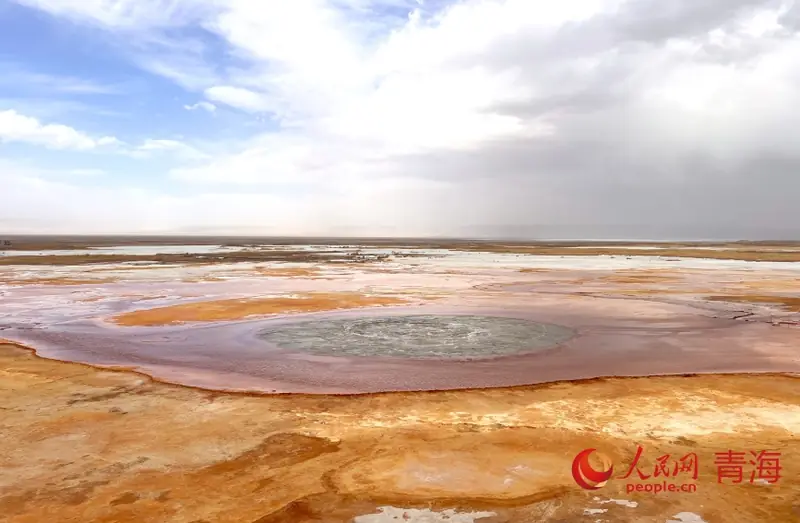
The People's Daily Online report describes the spring mouth as more than 10 m across and boiling all year, and says that because the water is rich in sulphur and other minerals, long deposition has formed ring-shaped bands of red-brown and golden yellow, so that from the air it looks like a pupil set in the earth. Because of the high sulphur content, it says, birds and animals keep away from the mouth and nothing grows along its outflow. The China National Radio feature adds that the spring does not freeze in winter, that its reddish outflow forms a shape it calls 'dragon eye, phoenix feather', that tests show a high mineral content and the water is not drinkable, and that geologists suggest an underground low-temperature river may meet a geological fault and turn upwards to produce irregular surges. Within tens of metres of the spring, it says, are two small blue springs, the better known called 'the angel's tear'.
The two accounts differ on the Mongolian meaning of the spring's name: the People's Daily Online report gives 'Aiken' as 'fearful', while the China National Radio feature gives it as 'source' and says 'Halong Wusu' is Mongolian for hot-water spring. The China National Radio feature describes the outflow crossing the Aral grassland and finally emptying into Gaskule lake, depositing a hard crust of sinter on the way, with algae and beetles in the water forming a distinctive ecosystem, and it records that in November 1884 the Russian Przewalski surveyed the Gasi area for more than a month and recorded the spring in his notes, and that in November 2015 the local naturalist Wang Xiaojiong recognised that description as the hot-water spring the local Mongols knew, after which the spring drew the attention of publicity and tourism departments. Neither page gives the spring an area, a designation or a boundary, and the catalogue's label 开放观景区 is an editorial description rather than a designation either page states.
What to look for
- The spring mouth itself, which the People's Daily Online report describes as more than 10 m across and boiling all year
- The ring-shaped bands of red-brown and golden yellow that the same report attributes to long deposition of minerals from the sulphur-rich water
- The two small blue springs within tens of metres of the main spring, one of which the China National Radio feature calls "the angel's tear"
- The outflow crossing the Aral grassland towards Gaskule lake, where the China National Radio feature describes a hard crust of sinter and a distinctive ecosystem
Location & getting there
Getting to Aiken Spring Viewing Area
Use an authorised visitor route. Cave sections, geological sites and access roads can close independently, so confirm the area that your ticket covers.
- Search for 艾肯泉开放观景区 with 海西蒙古族藏族自治州 and 茫崖市.
Find Aiken Spring Viewing Area
艾肯泉开放观景区 · 茫崖市
No reliable map pin yet: search by the Chinese name.
Sources & visit information
The linked sources support the identity and background described in this introduction. Opening hours, admission, activity availability and exact arrival arrangements have not been comprehensively checked. Confirm current visitor information with the venue; the original catalogue locality and editorial review flag are retained.