

Photo adjustments
Full frame retained; EXIF orientation normalized, proportionally resized to at most 800 pixels and converted to WebP. No generated pixels or subject changes. Cards may crop the display.
Explore the region
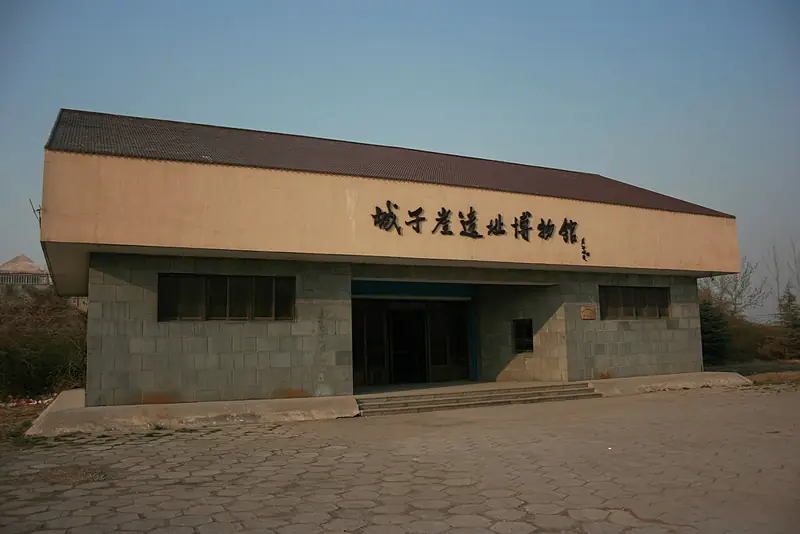
About Chengziya Site Museum
The archaeologist Wu Jinding came to Longshan on 24 March 1928 while investigating the Han-period city of Dongpingling nearby, and noticed pottery in the sides of a gully; the terrace that local people called Eyacheng turned out to be an ancient walled site. The Shandong Antiquities Research Society, set up jointly by the Institute of History and Philology of Academia Sinica and the Shandong provincial education department, excavated it in 1930 and 1931. Pottery from the lower layer was overwhelmingly black ware of the late Neolithic, and because the site lay beside Longshan town the culture was named after the town. Chengziya was the first prehistoric site that Chinese archaeologists found and excavated on their own account, and the State Council placed it in the first group of national key cultural heritage protection units in 1961.
Three walled towns are superimposed on the site, one of Longshan culture, one of the later Yueshi culture and one of the Zhou period, and what survives is chiefly ramparts, gateways and moats across roughly 190,000 square metres. The museum building dates from 1994; its main block covers 4,000 square metres with 3,000 square metres of galleries, and the display is built around the results of the excavations of 1930 and 1931 and those of 1990 and 1991. Since 2013 the museum has stood inside the Chengziya national archaeological site park, planned over about 1.32 million square metres and divided into zones for site display, museum display, riverside remains, pottery, archaeological experience and farming; the park was listed as a national archaeological site park in December 2017. A 'prehistoric workshop' on the grounds runs hands-on activities including pottery making, stone-tool grinding, fire drilling and rammed-earth wall building.
What to look for
- The galleries on the results of the 1930-1931 and 1990-1991 excavations at Chengziya
- The earthen ramparts, gateways and moats of the superimposed Longshan, Yueshi and Zhou-period towns
- The 'one gate, three passages' north gateway of the Yueshi-period town
- The western rampart, where Wu Jinding identified the site in 1928
- The 'prehistoric workshop', where pottery making and rammed-earth wall building are demonstrated
Location & getting there
Getting to Chengziya Site Museum
Confirm the venue or campus, reservation channel and exhibition calendar. A museum name may cover more than one building.
- Search for 城子崖遗址博物馆 with 济南市 and 章丘区.
Find Chengziya Site Museum
城子崖遗址博物馆 · 章丘区
No reliable map pin yet: search by the Chinese name.
Sources & visit information
The linked sources support the identity and background described in this introduction. Opening hours, admission, activity availability and exact arrival arrangements have not been comprehensively checked. Confirm current visitor information with the venue; the original catalogue locality and editorial review flag are retained.