

Photo adjustments
EXIF orientation normalized; resized without changing aspect ratio; converted to WebP. No subject edits.
Explore the region
About Linqing Grand Canal Customs House
Linqing Grand Canal Customs House (临清运河钞关) is the former Ming and Qing tax station for canal shipping on the west bank of the Grand Canal in Linqing (临清), Liaocheng (聊城), Shandong.
The station opened in 1429, the fourth year of the Ming Xuande reign, to tax the cargo boats moving along the canal. People's Daily Online explains the name: in the early Ming, silver could not be used directly in trade and taxes were paid in paper notes, so a customs barrier was called a chaoguan, a 'paper-note customs'. The canal had seven of them, from Hangzhou in the south to Chongwenmen (崇文门) in the north, and with the Jiujiang station on the Yangtze they formed the 'eight great customs houses'. Ma Lukui (马鲁奎), a former head of the Linqing Museum, told Qilu Net that its formal title was the Ministry of Revenue's tax sub-office (户部榷税分司); chaoguan was the popular name.
In the Wanli era Linqing collected more than 83,000 taels of silver a year in boat dues and trade taxes, the most of the eight great customs houses; in 1578 the whole province of Shandong raised only 8,860 taels. Chinese Wikipedia records a tax revolt at the customs house in 1599 that bears the name of Wang Chaozuo (王朝佐). The station shut in 1930, the last of the customs houses to close.
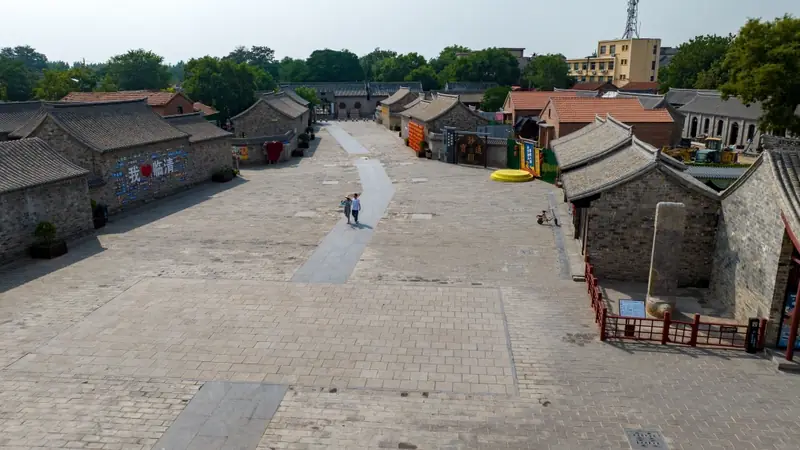
The complex lies about 100 metres south along Houguan Street (后关街) in Linqing. Ma Lukui describes the original compound as more than 40,000 square metres in a plan shaped like the character 'bu' (不), split into a front customs that stopped boats, checked goods and levied tax and a rear customs where the officials worked and lived; what survives is about a fifth of it. Chinese Wikipedia counts more than 80 rooms of old buildings, among them the ceremonial gate, the south and north through-halls, the main hall, the patrol barracks and the boat-dues office. Most are grey-tiled halls with flush gables, offices in the front court and storerooms behind. Old pagoda trees grow inside the ceremonial gate, and Ming and Qing stone inscriptions survive in the grounds. The site became a national key cultural relic protection unit in 2001 and part of the Grand Canal World Heritage listing in 2014.
What to look for
- The ceremonial gate (仪门), with century-old pagoda trees just inside
- The south and north through-halls (穿厅), the best-preserved buildings
- Displays in the north through-hall, including a reconstruction drawing of the station and tables of Ming canal tax receipts
- The boat-dues office (船料房) and patrol barracks (巡拦房)
- Ming and Qing stone inscriptions in the grounds
- Restored residences of the customs officials
Location & getting there
Getting to Linqing Grand Canal Customs House
- Search for 临清运河钞关 with 聊城市 and 临清市.
Find Linqing Grand Canal Customs House
临清运河钞关 · 临清市
No reliable map pin yet: search by the Chinese name.
Sources & visit information
Written from the linked sources and checked sentence by sentence against quoted extracts by a separate reviewer on 2026-09-23. Opening hours, admission and access arrangements are not covered; confirm current visitor information with the site.
Some facts checked against Wikipedia contributors, "临清运河钞关" · CC BY-SA 4.0.