

Entry & permits for Tibet (Xizang)
Foreign tourists need Tibet entry approval, commonly called a Tibet Travel Permit, and an organised visit arranged through a specialist travel agency in China. Confirm your approved route before booking transport. Requirements differ for Taiwan residents and for travellers using mainland or Hong Kong/Macao Chinese resident documents; check the document guide before you book.
Check the travel-document requirements →Policy scope verified: 2026-09-06. UK FCDO: China regional travel advice ↗ State Council Taiwan Affairs Office: Tibet entry approval ↗ Xizang Department of Culture and Tourism: Medog border permit notice ↗
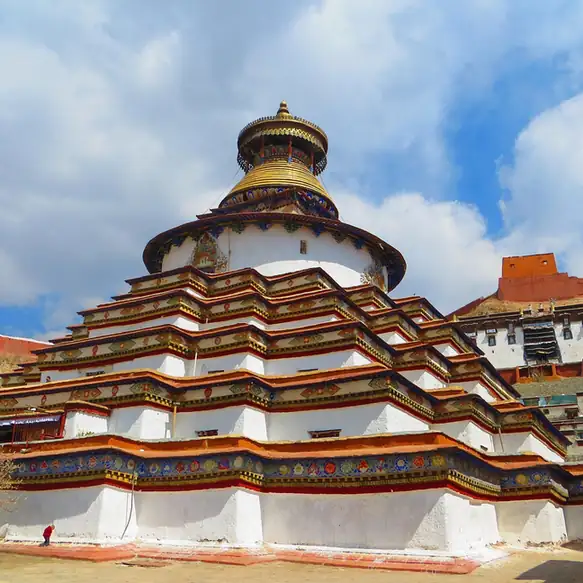
Photo adjustments
EXIF orientation normalized; resized without changing aspect ratio; converted to WebP. No subject edits.
Explore the region
About Pelkor Chode Monastery and Kumbum Stupa
Pelkor Chode Monastery and Kumbum Stupa is Pelkor Chode Monastery and its Kumbum stupa (the 'Thousand Auspicious Gates Stupa') in Gyangzê County, Tibet — the only monastery in Tibet shared by three Buddhist orders, built around a nine-storey stupa carrying more than 27,529 painted images.
Pelkor Chode Monastery sits in a mountain hollow at the northwestern edge of Gyangzê county town, walled on the surrounding ridges with rammed-earth ramparts; its 17 named monastic colleges are shared among the Gelug, Kagyu and Sakya orders, and the 140,000 sq m complex is the largest Tibetan Buddhist monastery in Gyangzê county. It is a National Key Cultural Relics Protection Unit. The monastery's main assembly hall was built between 1418 and 1425.
The Kumbum stupa — known as the 'Thousand Auspicious Gates Stupa' — was founded, according to the Han-Tibetan Historical Collection, in 1427 and completed within a few years afterward. It follows a Tibetan 'Kadam Jodten' style: its base is about 40 m square, its plinth about 62 m in diameter, its total height 42.4 m; it has nine storeys, with chapels on all four sides of floors one through four and a stepped, twenty-cornered exterior that narrows toward the top. The stupa has 108 doors and 77 chapels, holding more than 27,529 painted images of buddhas, bodhisattvas, vajra deities, taras and masters in total — the first floor's 20 chapels alone hold 2,423 painted figures and the fifth floor's four chapels hold 18,886. The monastery's murals are also described as representative of the 'Peizi' school, one of Tibet's three major mural-painting traditions.
What to look for
- the Kumbum stupa's nine storeys and 77 chapels, decorated with more than 27,529 painted images
- the main assembly hall, built 1418-1425
- the monastery's murals, representative of the 'Peizi' painting school
Location & getting there
Getting to Pelkor Chode Monastery and Kumbum Stupa
Check which interiors and courtyards are accessible. Active places of worship and protected monuments may have different visitor rules.
- Search for 白居寺与十万佛塔 with 日喀则市 and 江孜县.
Find Pelkor Chode Monastery and Kumbum Stupa
白居寺与十万佛塔 · 江孜县
No reliable map pin yet: search by the Chinese name.
Sources & visit information
The linked sources support the identity and background described in this introduction. Opening hours, admission, activity availability and exact arrival arrangements have not been comprehensively checked. Confirm current visitor information with the venue; the original catalogue locality and editorial review flag are retained.