

Entry & permits for Tibet (Xizang)
Foreign tourists need Tibet entry approval, commonly called a Tibet Travel Permit, and an organised visit arranged through a specialist travel agency in China. Confirm your approved route before booking transport. Requirements differ for Taiwan residents and for travellers using mainland or Hong Kong/Macao Chinese resident documents; check the document guide before you book.
Check the travel-document requirements →Policy scope verified: 2026-09-06. UK FCDO: China regional travel advice ↗ State Council Taiwan Affairs Office: Tibet entry approval ↗ Xizang Department of Culture and Tourism: Medog border permit notice ↗
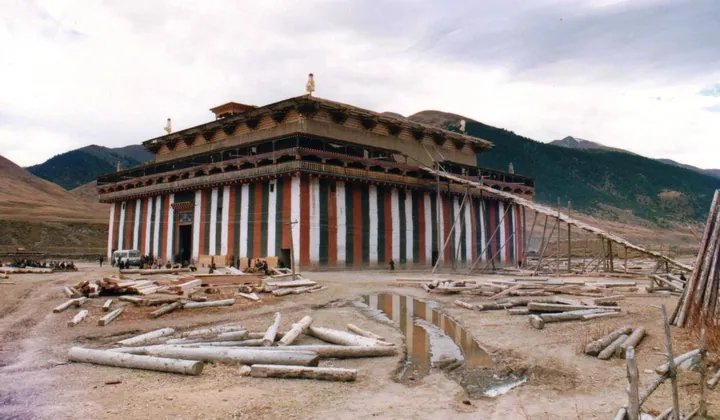
Photo adjustments
Full frame retained; proportionally resized and converted to WebP. No retouching or changes to the photographed subject. Card displays may crop the view.
Explore the region
About Chagyama Great Hall
The hall faces east, is square in its main mass, stands 48 metres high and covers a floor area given as more than 3,000 square metres. Its three storeys step inwards as they rise and each is finished differently: the lowest has earthen walls about two metres thick, painted outside with red, white and black vertical stripes, which is why it is also called the Flower Hall (花殿); the second storey is rock masonry with the outer wall painted red, the Red Hall (红殿); the third is piled stone finished in white, the White Hall (白殿). Above them the roof carries flying eaves, a gilded finish and a large gilded roof-jewel at its centre. Inside and out the building is described as combining Tibetan, Han Chinese and Nepalese architectural forms. The monastery is put at more than 700 years old; by tradition it was founded in 1276 by a senior Taklung Kagyu monk, while the great hall itself was built from 1320 under the monastery's second abbot, who followed the founder's testament and brought in a Nepalese artist and craftsmen including a man from Lhasa.
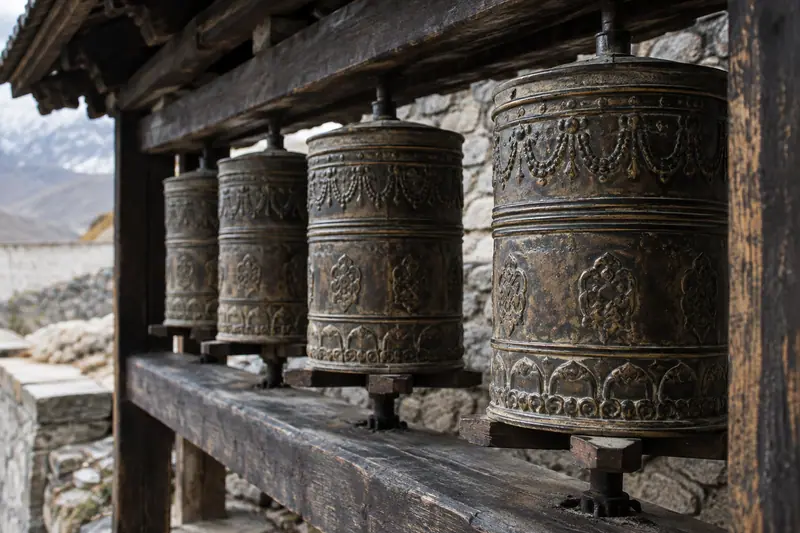
Sixty-four giant pillars stand inside the hall, each timber column reaching 15 metres. The first-storey Flower Hall is ringed by huge 'scripture walls' in which scriptures are kept; the monastery's collection runs to more than 80,000 volumes, most of them written using gold, purple gold, silver and cinnabar. The hall also holds more than 40,000 Tibetan Buddhist images made of gold, silver, black copper and sandalwood. Once the building was complete, Nepalese artists painted murals on the inner walls of its lowest storey and on its outer and inner galleries; several hundred years on these have faded, and the local government has organised local thangka painters to restore them. A red gallery runs right around the outside of the lowest storey and holds a great many golden prayer wheels, which worshippers turn with the right hand as they move clockwise along it reciting scripture.
What to look for
- The three differently finished storeys — the red, white and black stripes of the first-storey Flower Hall, the red-painted Red Hall on the second and the whitewashed White Hall on the third
- The gilded roof with flying eaves and the large gilded roof-jewel set at its centre
- The 64 giant pillars inside the hall, each timber column reaching 15 metres
- The 'scripture walls' ringing the first-storey Flower Hall, and the faded lowest-storey murals painted by Nepalese artists that local thangka painters have been restoring
- The second-storey Red Hall, with paintings of successive Kagyu patriarchs and eminent monks on its high walls and a Shakyamuni 'water-print' image enshrined inside
Location & getting there
Getting to Chagyama Great Hall
Check which interiors and courtyards are accessible. Active places of worship and protected monuments may have different visitor rules.
- Search for 查杰玛大殿 with 昌都市 and 类乌齐县.
Find Chagyama Great Hall
查杰玛大殿 · 类乌齐县
No reliable map pin yet: search by the Chinese name.
Sources & visit information
The linked sources support the identity and background described in this introduction. Opening hours, admission, activity availability and exact arrival arrangements have not been comprehensively checked. Confirm current visitor information with the venue; the original catalogue locality and editorial review flag are retained.