

Entry & permits for Tibet (Xizang)
Foreign tourists need Tibet entry approval, commonly called a Tibet Travel Permit, and an organised visit arranged through a specialist travel agency in China. Confirm your approved route before booking transport. Requirements differ for Taiwan residents and for travellers using mainland or Hong Kong/Macao Chinese resident documents; check the document guide before you book.
Check the travel-document requirements →Policy scope verified: 2026-09-06. UK FCDO: China regional travel advice ↗ State Council Taiwan Affairs Office: Tibet entry approval ↗ Xizang Department of Culture and Tourism: Medog border permit notice ↗
Explore the region
About Dungkar Monastery
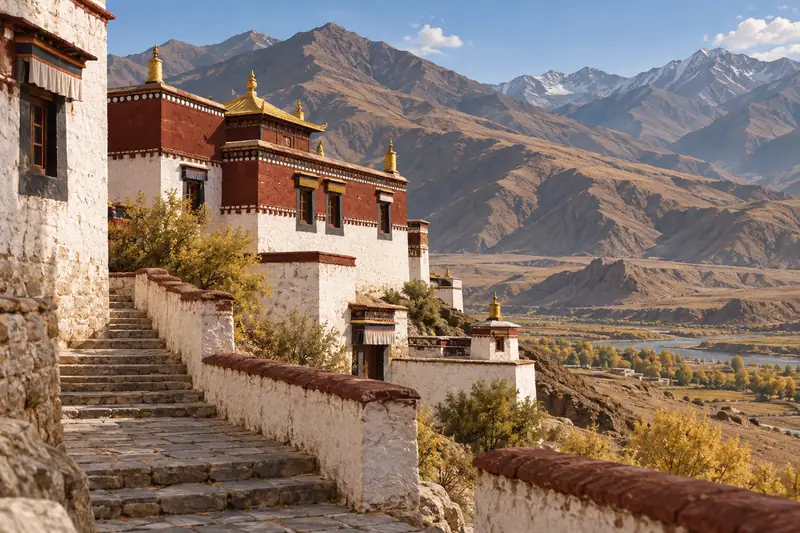
Dungkar Monastery (东嘎寺) is a Gelug (格鲁派) monastery on the slopes of Dongga Mountain (东嘎山) at Rubinggang Village (如丙岗村), Shang Yadong Township (上亚东乡), 13 km from the seat of Yadong County (亚东县) near Tibet's southern border. China Tibet Online lists it as the largest Gelug monastery in the county.
The mountain, and so the monastery, takes its name from its shape, which resembles a conch shell. The full name, Dongga Tashilhunpo Monastery (东嘎·扎什伦布寺), marks its status as a branch of Tashilhunpo (扎什伦布寺) in Shigatse. Its founders, early in the 17th century, followed the Kagyu (噶举派) school and had just one small prayer hall and a handful of monks. A disciple sent to Yadong by the 4th Panchen Lama, Lobsang Chökyi Gyaltsen (罗桑却吉坚赞, 1567-1662), added a second hall and a protector chapel and brought it into the Gelug school. Tashilhunpo repaired it after an earthquake in the early 19th century, and early in the 20th century Awang Gesang Baisangbu (阿旺格桑·白桑布), the first of its reincarnate lamas, enlarged it to about 3,000 m², 62 m north to south and 48 m east to west.
Chinese Wikipedia records that the monastery was known across Tibetan areas for its medicines and monk-doctors, and that it had eleven branch monasteries, four of them near Kalimpong (噶伦堡) and Darjeeling (大吉岭) in India. The second reincarnate lama was born in Sikkim (锡金) in 1937, the son of a Sikkimese minister. The buildings were wrecked in the Cultural Revolution; state funds later paid to rebuild the main assembly hall.
The 14th Dalai Lama arrived in Yadong on 2 January 1951 and stayed at Dungkar. On 16 July 1951 Zhang Jingwu (张经武), sent as representative of the Central People's Government, met him at the monastery, and on 21 July the Dalai Lama's party set out for Lhasa. A statue of Zhang Jingwu stands in front of the monastery, and the Ethnic Affairs Commission of the Tibet Autonomous Region calls the Dongga patriotic education base, built around this meeting, the first such base in Yadong County.
What to look for
- The Tsochen Hall (措钦大殿), two storeys and 20 m square, its lower floor a prayer hall and its upper floor a Buddha chapel, rebuilt with government funds after the Cultural Revolution
- The upper floor of the Tsochen Hall, where Chinese Wikipedia places the 1951 meeting between Zhang Jingwu and the Dalai Lama
- A boulder at the gate carved with Tsongkhapa (宗喀巴) and his two chief disciples seated on lotus thrones, above a blue, bull-headed protector deity
- The statue of Zhang Jingwu in front of the monastery
- A Ming bronze cymbal inscribed as made in the Xuande (宣德) reign, among the relics listed by Chinese Wikipedia
- A late-Qing display thangka, 8 m wide and 10 m long, painted with a seated Sakyamuni
Location & getting there
Getting to Dungkar Monastery
- Search for 东嘎寺 with 日喀则市 and 亚东县.
Find Dungkar Monastery
东嘎寺 · 亚东县
No reliable map pin yet: search by the Chinese name.
Sources & visit information
Written from the linked sources and checked sentence by sentence against quoted extracts by a separate reviewer on 2026-09-23. Opening hours, admission and access arrangements are not covered; confirm current visitor information with the site.
Some facts checked against Wikipedia contributors, "东嘎寺" · CC BY-SA 4.0.