

Entry & permits for Tibet (Xizang)
Foreign tourists need Tibet entry approval, commonly called a Tibet Travel Permit, and an organised visit arranged through a specialist travel agency in China. Confirm your approved route before booking transport. Requirements differ for Taiwan residents and for travellers using mainland or Hong Kong/Macao Chinese resident documents; check the document guide before you book.
Check the travel-document requirements →Policy scope verified: 2026-09-06. UK FCDO: China regional travel advice ↗ State Council Taiwan Affairs Office: Tibet entry approval ↗ Xizang Department of Culture and Tourism: Medog border permit notice ↗
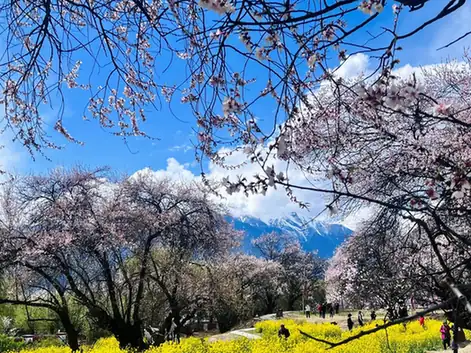
Photo adjustments
EXIF orientation normalized; resized without changing aspect ratio; converted to WebP. No subject edits.
Explore the region
About Gala Peach Blossom Village
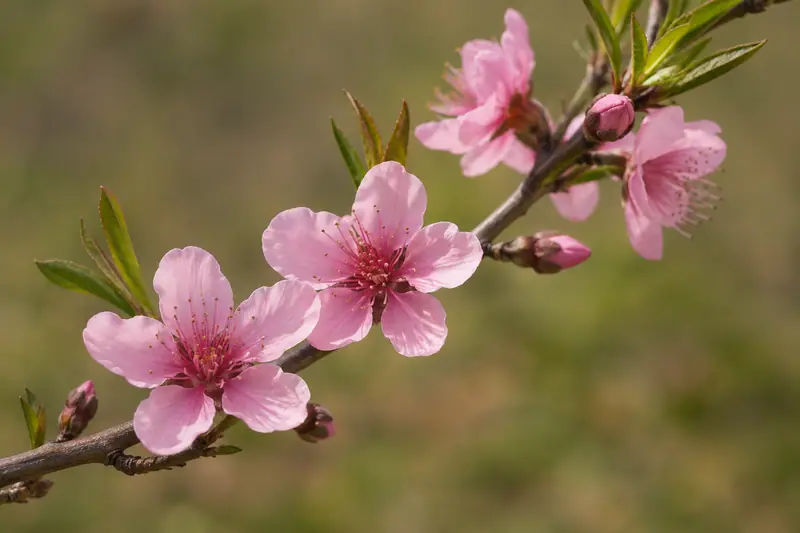
The trees come into blossom in the last third of March, and a member of the village affairs supervision committee, Dawa Caidan, told China Ethnic News that the flowering lasts only about twenty days. The Nyingchi peach-blossom culture and tourism festival has been held here since 2002, and by the 2022 Tibet Daily account had run for twenty consecutive editions; before the village was developed, annual tourism income was under 50,000 yuan. About ten kilometres from Bayi District along National Highway 318, the village now shows red-roofed Tibetan houses, guesthouses and a viewing platform, with rape flowers among the peach blossom, hardened roads, a shop, a village activity room, a clinic and public lavatories.
The change is dated precisely. Tibet Daily puts the turn at 2014, when the village began environmental management and separated people from livestock, then went on to afforestation, courtyard renovation, boardwalks, water channels, mani piles, viewing pavilions, road hardening, buried pipework, greening and lighting, green hedges and fruit-and-vegetable courtyards — work that, in its account, carried Gala over from a village into a scenic area. Guangming Daily dates the Guangdong aid-Tibet work team's scenic-area-leads-the-village model to the same year, with 48 million yuan invested in creating the Gala Taohuayuan 3A-grade scenic area; China Ethnic News puts the combined investment by Bayi District and the Guangdong team since 2014 at more than 48 million yuan. Both report that the villagers formed a tourism cooperative with their land as shares, with 30 per cent of the scenic area's income going to dividends and 30 per cent into ecological protection. In 2021 the festival drew 140,000 visitor arrivals and over 4.6 million yuan in tourism income, with per-capita disposable income of 35,000 yuan; by 2025, on the China Ethnic News account, tourism income was 3.6 million yuan and per-capita disposable income 44,300 yuan.
Around the peach wood the village has built what China Ethnic News describes as an industry cluster: the Taohuayuan scenic area as the pillar, with a farmer-and-herder transport team, a sightseeing and fruit-picking orchard and the Taohua Shanzhuang visitor reception centre alongside it, and a shift from farming and herding into red study tours, folk-custom experience and eco-tourism. In the same sentence in which he gave the twenty-day flowering, Dawa Caidan said the village had brought in a company to make processed products such as peach-blossom cakes and peach-blossom essential oil. The village also has a history museum, whose cases Guangming Daily describes as holding a faded horsewhip, an old horse lantern and worn pulu cloth. Tibet Daily records that in 2021, the seventieth anniversary of the peaceful liberation of Tibet, Xi Jinping came to Gala village on 21 July during an inspection tour of Tibet.
What to look for
- The wild peach wood — more than 1,200 trees over more than 270 mu, in blossom from the last third of March for about twenty days
- The viewing platform and the boardwalks laid out in the village from 2014 onwards
- The village history museum, whose cases hold a faded horsewhip, an old horse lantern and worn pulu cloth
- The Niyang River bank at the village, with snow mountains beyond it
- The rape flowers among the peach blossom and the Gongbu Tibetan houses of the village itself
Location & getting there
Getting to Gala Peach Blossom Village
Check the open visitor route and follow the site’s rules on distance, food and photography. Conservation areas may limit access beyond designated paths.
- Search for 嘎拉桃花村 with 林芝市 and 巴宜区.
Find Gala Peach Blossom Village
嘎拉桃花村 · 巴宜区
No reliable map pin yet: search by the Chinese name.
Sources & visit information
The linked sources support the identity and background described in this introduction. Opening hours, admission, activity availability and exact arrival arrangements have not been comprehensively checked. Confirm current visitor information with the venue; the original catalogue locality and editorial review flag are retained.