

Entry & permits for Tibet (Xizang)
Foreign tourists need Tibet entry approval, commonly called a Tibet Travel Permit, and an organised visit arranged through a specialist travel agency in China. Confirm your approved route before booking transport. Requirements differ for Taiwan residents and for travellers using mainland or Hong Kong/Macao Chinese resident documents; check the document guide before you book.
Check the travel-document requirements →Policy scope verified: 2026-09-06. UK FCDO: China regional travel advice ↗ State Council Taiwan Affairs Office: Tibet entry approval ↗ Xizang Department of Culture and Tourism: Medog border permit notice ↗
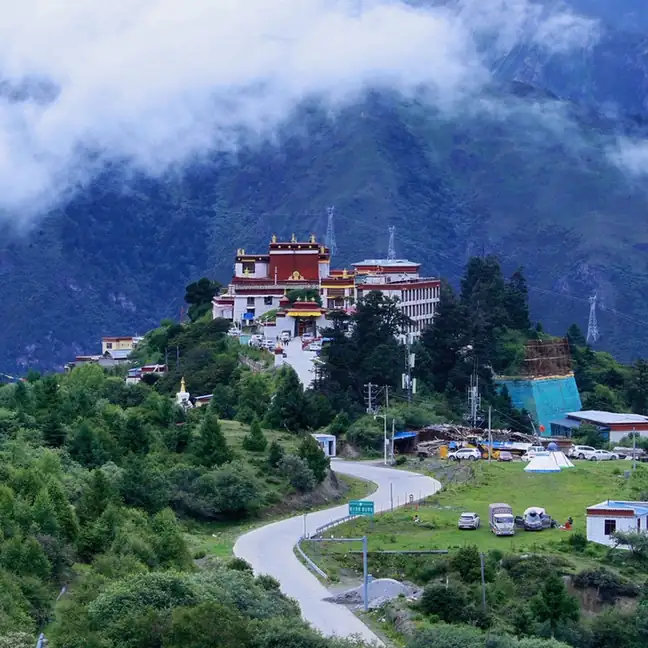
Photo adjustments
EXIF orientation normalized; resized without changing aspect ratio; converted to WebP. No subject edits.
Explore the region
About Kajiu Monastery
The county page names Kajiu as one of the five great hermitage sites of Padmasambhava, gives 朗开宁布 as its main image, places it in the Nyingma school, and calls it the ancestral temple where the successive Nu-clan (努氏) Langkai Ningbu studied the Buddhist canon and practised tantric doctrine. In 2007 the Tibet Autonomous Region People's Government published the monastery in the fourth batch of autonomous-region-level cultural relics protection units. Its address is given as Lakang village in Lakang town. Tradition, the county adds, holds that Padmasambhava buried precious scriptures and rare treasures around the meditation cave at Kajiu and himself built and consecrated a stupa there.
Two dates and two heights sit on the same county page without being reconciled: the opening paragraph says the monastery was built in 1570 and puts it at 4,019 metres, while a later paragraph says construction began in 1568 and gives about 3,996 metres. Both pairs are reported here as the page's own, and neither is adjudicated. The page offers two traditional explanations of the name, both resting on the same gloss — 卡 is Tibetan for rock or castle, meaning rock here, and 久 is Tibetan for water. The Shannan Municipal Tourism Development Bureau repeats that gloss and the same pair of explanations.
For the setting, the county describes hills densely green around the monastery with rich primeval-forest vegetation, and says that from a distance the building looks like a castle in the air. A winter account published by the Shannan municipal tourism bureau places the Kajiu scenic area among the forested peaks behind Lakang town, says it can only be seen properly once the summit is reached, and describes it standing on a cliff ringed by green trees. Neither cited page states which halls or areas of the monastery visitors may enter.
What to look for
- The monastery on its summit, which the county page says looks like a castle in the air when seen from a distance
- The cliff-top setting among the forested peaks behind Lakang town, described by the Shannan municipal tourism bureau
- The meditation cave at Kajiu, around which tradition places scriptures and treasures buried by Padmasambhava, and the stupa he is said to have built and consecrated
- The primeval-forest vegetation on the hills around the monastery, recorded by the county
Location & getting there
Getting to Kajiu Monastery
Check which interiors and courtyards are accessible. Active places of worship and protected monuments may have different visitor rules.
- Search for 卡久寺 with 山南市 and 洛扎县.
Find Kajiu Monastery
卡久寺 · 洛扎县
No reliable map pin yet: search by the Chinese name.
Sources & visit information
The linked sources support the identity and background described in this introduction. Opening hours, admission, activity availability and exact arrival arrangements have not been comprehensively checked. Confirm current visitor information with the venue; the original catalogue locality and editorial review flag are retained.