

Entry & permits for Tibet (Xizang)
Foreign tourists need Tibet entry approval, commonly called a Tibet Travel Permit, and an organised visit arranged through a specialist travel agency in China. Confirm your approved route before booking transport. Requirements differ for Taiwan residents and for travellers using mainland or Hong Kong/Macao Chinese resident documents; check the document guide before you book.
Check the travel-document requirements →Policy scope verified: 2026-09-06. UK FCDO: China regional travel advice ↗ State Council Taiwan Affairs Office: Tibet entry approval ↗ Xizang Department of Culture and Tourism: Medog border permit notice ↗
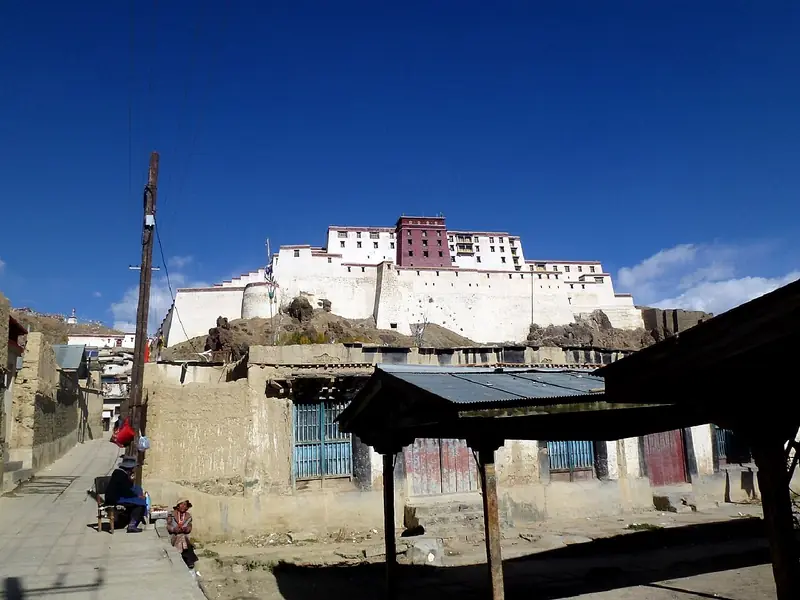
Photo adjustments
EXIF orientation normalized; resized without changing aspect ratio; converted to WebP. No subject edits.
Explore the region
About Shigatse Dzong
Samzhubzê Dzong's history traces back more than 600 years to the Yuan dynasty, when the Yuan-appointed 'Grand Situ' Changchub Gyaltsen divided Tibet into 13 'zong' districts, each given a fortress-palace combining temple and government functions. The Shigatse dzong, governing the Shigatse area, was the last built, completed in 1363, and was the largest of the thirteen, with four storeys and more than 300 rooms: the top floor once served as the Fifth Dalai Lama's bedchamber, where he held an enthronement ceremony; the third floor housed Buddha images and religious items including complete sets of the Kangyur and Tengyur scriptures; the lower two floors held district government offices, guard quarters, judicial offices, a prison and storehouses. Tradition holds that the Fifth Dalai Lama used the Shigatse dzong as a model when rebuilding Lhasa's Potala Palace during the Kangxi era. The dzong measured 280 m east-west and 92 m in height before being progressively ruined by weathering and Cultural Revolution-era destruction, leaving only broken walls of its platform.
Reconstruction began in 2004 as part of Shanghai's fourth round of Tibet-assistance projects, led by Tongji University with architecture professor Chang Qing as design lead. The final design combined the old ruined base with a red-palace/white-palace division, deliberately left about 30 m of unrestored ruins on the dzong's east side to preserve a page of historical authenticity, and matched eaves, windows, staircases and the building's outline to old photographs. The reconstruction's first phase was completed in May 2007, with total investment reaching 48 million yuan; the rebuilt dzong was intended to become a multi-function cultural complex focused on historical exhibition.
What to look for
- the red-palace/white-palace reconstruction, matched to historical photographs
- the roughly 30 m stretch of unrestored original ruins left on the dzong's east side
Location & getting there
Getting to Shigatse Dzong
Check which interiors and courtyards are accessible. Active places of worship and protected monuments may have different visitor rules.
- Search for 日喀则宗山 with 日喀则市 and 桑珠孜区.
Find Shigatse Dzong
日喀则宗山 · 桑珠孜区
No reliable map pin yet: search by the Chinese name.
Sources & visit information
The linked sources support the identity and background described in this introduction. Opening hours, admission, activity availability and exact arrival arrangements have not been comprehensively checked. Confirm current visitor information with the venue; the original catalogue locality and editorial review flag are retained.