

Entry & permits for Tibet (Xizang)
Foreign tourists need Tibet entry approval, commonly called a Tibet Travel Permit, and an organised visit arranged through a specialist travel agency in China. Confirm your approved route before booking transport. Requirements differ for Taiwan residents and for travellers using mainland or Hong Kong/Macao Chinese resident documents; check the document guide before you book.
Check the travel-document requirements →Policy scope verified: 2026-09-06. UK FCDO: China regional travel advice ↗ State Council Taiwan Affairs Office: Tibet entry approval ↗ Xizang Department of Culture and Tourism: Medog border permit notice ↗
Explore the region
About Zandan Monastery
The two sources give different foundation and protection accounts, and neither is preferred here. The Sog County government dates the building to 1667, names Awang Luosang Jiacuo as its founder and states that the monastery is currently rated an autonomous-region-level protected cultural relics unit. The China's Tibet feature says it is now generally held that building began in 1667, but that material supplied by the monastery itself records an initial founding in 1232, after which the house passed through the Nyingma, Kagyu and Gelug schools; the same feature says rebuilding began in 1986, that the monastery was listed as a county-level protected cultural relics unit in 2001, and that from 1996 onwards it was repaired and added to year by year until it reached its present scale.
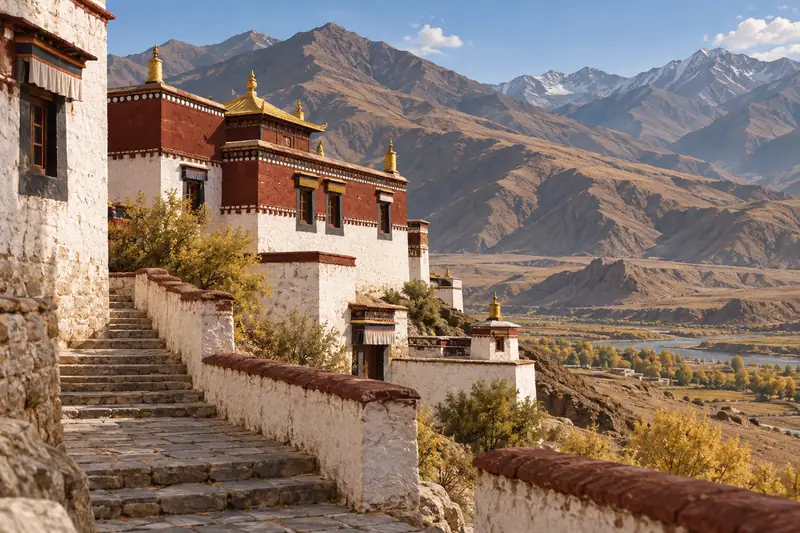
The monastery sits on a hillock that the feature likens to a white recumbent elephant, ringed by the eight-petal lotus mountain and the waters of the Suo Qu. Its main buildings are set against the hill and consist of a White Hall, a Red Hall and monks' quarters, built in interlaced stone and timber; the feature describes a pointed-roof, dense-beam blockhouse structure that follows the ground and rises from the foot of the hill to the summit in six or seven staggered storeys, which enlarges the apparent bulk and height of the whole. Both sources give the total area as 25,975.2 square metres. Quoting 《索县文史资料选辑》, compiled by the local CPPCC, the feature records that before the Democratic Reform the monastery had 650 monks, 47 halls and public rooms, 110 monks' quarters, 50 to 60 mules and horses, 800 yaks, 1,000 sheep and goats, four pastures and 600 to 700 mu of farmland, and that in 1959 the area inside its walls was 45,900 square metres; after the 1986 rebuilding it has 260 scripture halls and monks' rooms and a building volume about a third larger than before it was destroyed.
Inside, the county government records a Jampa Gonpo image about six metres high, many thangkas, and a large holding of statues, murals and printed scriptures; it names the principal deity as Paba Luogexiari and records the house as a branch monastery of Drepung in Lhasa. The deputy head of the monastery's management committee showed the feature's author two sandalwood pillars standing side by side in a special chapel, brought some years before from primeval forest in Medog County in the Nyingchi area, and explained that these are the origin of the monastery's other names, 檀林寺 and 檀香木寺; before 1959 a white sandalwood pillar also stood in the main hall. Legend, as the county government records it, makes the site the palace-fort of King Gesar's queen Senjiang Zhumu, and Yala town is her home place.
What to look for
- The white and red building groups set against the hillside, the whole rising from the foot of the hill to the summit in six or seven staggered storeys
- The two sandalwood pillars standing side by side in a special chapel, brought from primeval forest in Medog County
- The Jampa Gonpo image about six metres high that the county government records inside the monastery
- The thangkas, murals and printed scriptures held there
- The setting the magazine feature describes: a hillock likened to a white recumbent elephant, ringed by the eight-petal lotus mountain and the waters of the Suo Qu
Location & getting there
Getting to Zandan Monastery
Check which interiors and courtyards are accessible. Active places of worship and protected monuments may have different visitor rules.
- Search for 赞丹寺 with 那曲市 and 索县.
Find Zandan Monastery
赞丹寺 · 索县
No reliable map pin yet: search by the Chinese name.
Sources & visit information
The linked sources support the identity and background described in this introduction. Opening hours, admission, activity availability and exact arrival arrangements have not been comprehensively checked. Confirm current visitor information with the venue; the original catalogue locality and editorial review flag are retained.