


Explore the region
About Beihai Wetland
The reserve was approved in 2000 by the former Tengchong county government as a county-level reserve, then upgraded by the Yunnan provincial government in 2005 to provincial-level status, and covers a total area the provincial forestry authority gives as 1,629 hectares (a 2024 resource-registration exercise recorded 1,628.14 hectares). Its protection targets are the inland plateau lake system around the two volcanic lakes, a lakeside 'floating-felt' type marsh wetland ecosystem, aquatic plant communities and wetland biodiversity, together with mid-elevation wet evergreen broadleaf forest and warm-temperate coniferous forest represented by Yunnan pine and Taiwania flousiana stands. The provincial forestry authority describes the thickness of the floating-mat marsh-meadow vegetation and the depth of the lake water as rare nationally, and the reserve protects first- and second-class nationally listed wild species including water chestnut, Ottelia acuminata, water lily and black stork, as well as the narrow-range plant Lysimachia robusta.
Tengchong's own account credits the wetland with an important role in flood storage and drought relief, moderating runoff, regulating climate and controlling pollution.
What to look for
- The Beihai volcanic dammed lake, the core of the reserve and, according to Tengchong's government, the only such lake in southwest China.
- The Qinghai crater lake, the reserve's second core water body.
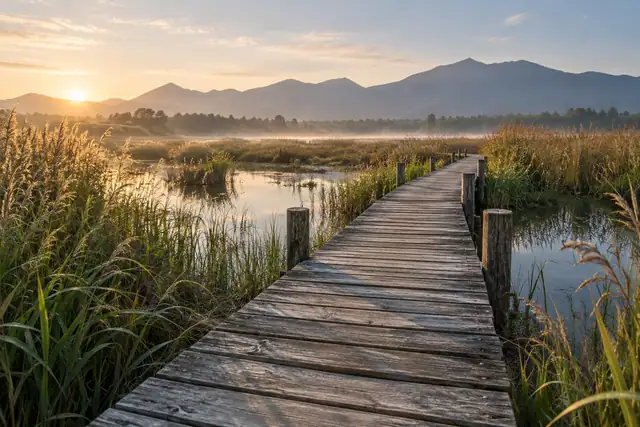
- The lakeside 'floating-felt' marsh vegetation, whose thickness the provincial forestry authority describes as rare nationally.
- Nationally protected wetland species recorded in the reserve, including water chestnut, Ottelia acuminata, water lily and black stork.
Location & getting there
Getting to Beihai Wetland
Check the open visitor route and follow the site’s rules on distance, food and photography. Conservation areas may limit access beyond designated paths.
- Search for 北海湿地 with 保山市 and 腾冲市.
Find Beihai Wetland
北海湿地 · 腾冲市
No reliable map pin yet: search by the Chinese name.
Sources & visit information
The linked sources support the identity and background described in this introduction. Opening hours, admission, activity availability and exact arrival arrangements have not been comprehensively checked. Confirm current visitor information with the venue; the original catalogue locality and editorial review flag are retained.