

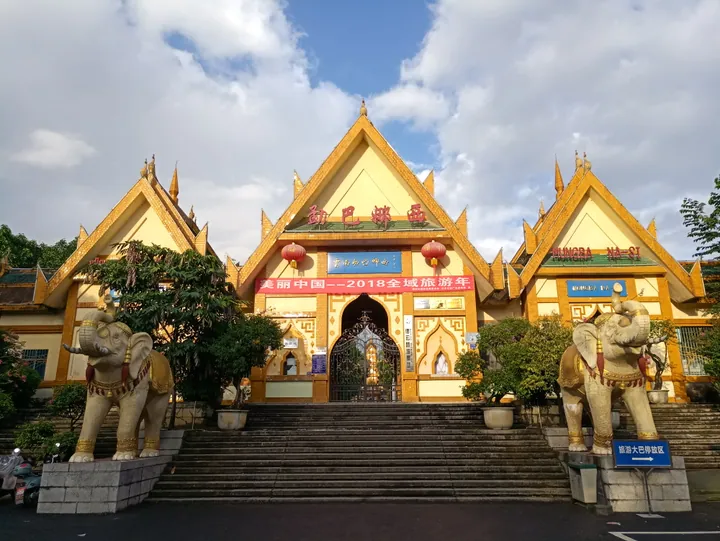
Photo adjustments
Full frame retained; proportionally resized and converted to WebP. No retouching or changes to the photographed subject. Card displays may crop the view.
Explore the region
About Mengbanaxi Rare Plant Garden
Mengbanaxi Rare Plant Garden (勐巴娜西珍奇园) is a landscaped garden of old trees, rare plants and ornamental stones on the southern part of Yonghan Street (勇罕街) in the southeast of Mangshi (芒市), Dehong Dai and Jingpo Autonomous Prefecture (德宏傣族景颇族自治州), Yunnan.
In the Dai language 'Mengbanaxi' means 'a good place'. The grounds were first the Mangshi Ethnic Culture Palace (芒市民族文化宫), a building finished in 1988 in a pointed-tower style, its doorways shaped like gourds. The garden opened in 2001, at first mainly to show and sell unusual fossils, took over the culture palace in September 2003 and was rated a national 4A scenic area in December 2005. It is divided into a front and a rear section.
Two markers stand at the entrance: the White Dragon Pavilion (白龙亭), emblem of the Dai Water-Splashing Festival, and a symbol of the Jingpo Munao Zongge festival (目脑纵歌). The main gate is built in the Southeast Asian Dai style. An avenue of royal palms and elephant-foot palms leads to a memorial pavilion for Premier Zhou Enlai (周恩来), with a white marble statue of Zhou and an inscription in Chinese, Dai and Jingpo. It records December 1956, when Zhou, Vice-Premier He Long (贺龙) and the Burmese prime minister U Ba Swe (吴巴瑞) came to Mangshi to host a gathering of border peoples from both countries.
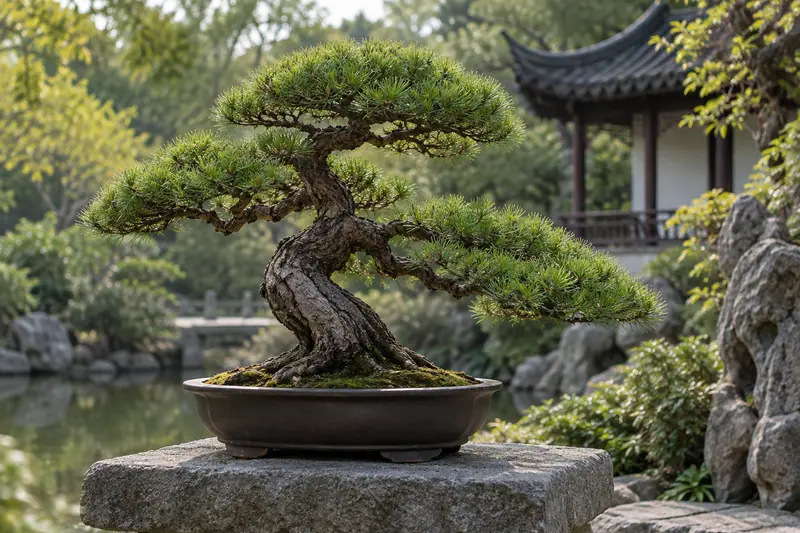
Beyond the pavilion is a grove of phoenix-tail bamboo, and then two large stones, one shaped like a horse and one like a rooster, which Economic Information Daily compares to Kunming's Golden Horse and Jade Rooster emblems. The rear section has themed gardens of osmanthus, bougainvillea, crape myrtle, frangipani, banyan and tree ferns, a bonsai garden and a gallery of stones, and the grounds hold century-old banyans and more than a thousand potted plants such as ginseng ficus and podocarpus. Hundreds of pieces of petrified wood, 'tree jade' (树化玉) and other stones line the paths, and a collection hall displays more than 200 kinds of ornamental stones, fossils and large root carvings from China and abroad.
What to look for
- The Zhou Enlai memorial pavilion, with a white marble statue and an inscription in Chinese, Dai and Jingpo about the 1956 China-Burma border gathering
- The White Dragon Pavilion (白龙亭) and the Munao Zongge (目脑纵歌) marker at the entrance
- The avenue of royal and elephant-foot palms and the phoenix-tail bamboo grove
- Century-old banyans and the bougainvillea, frangipani and tree-fern gardens
- Petrified wood and 'tree jade' (树化玉) along the paths
- The collection hall of more than 200 kinds of stones, fossils and root carvings
Location & getting there
Getting to Mengbanaxi Rare Plant Garden
- Search for 勐巴娜西珍奇园 with 德宏傣族景颇族自治州 and 芒市.
Find Mengbanaxi Rare Plant Garden
勐巴娜西珍奇园 · 芒市
No reliable map pin yet: search by the Chinese name.
Sources & visit information
Written from the linked sources and checked sentence by sentence against quoted extracts by a separate reviewer on 2026-09-23. Opening hours, admission and access arrangements are not covered; confirm current visitor information with the site.
Some facts checked against Wikipedia contributors, "勐巴娜西珍奇园" · CC BY-SA 4.0.