

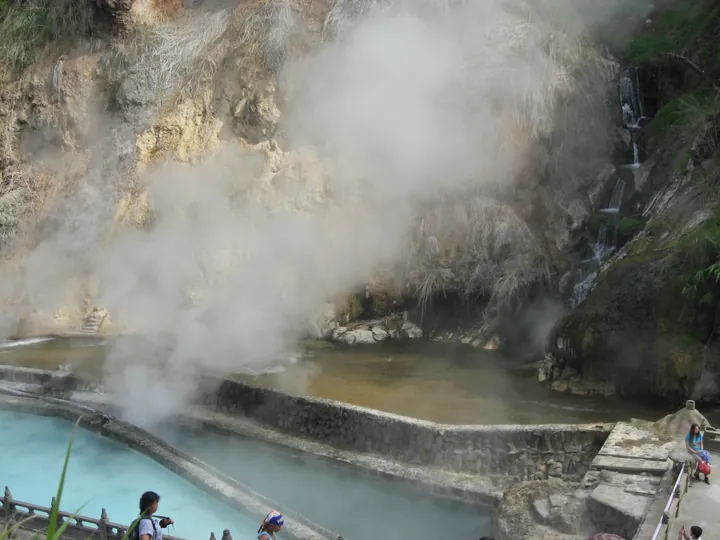
Photo adjustments
Full frame retained; proportionally resized and converted to WebP. No retouching or changes to the photographed subject. Card displays may crop the view.
Explore the region
About Tengchong Rehai Geothermal Area
Tengchong sits near the collision zone of the Eurasian and Indochina plates, where strong underground magmatic activity persists: two magma chambers 10-30 kilometres across remain today at 7-25 kilometres depth, and roughly north-south fault systems continuously release their heat to form the local geothermal field. Rehai, which the tourism authority identifies as the area where this heat is most concentrated, gathers numerous high-temperature hot springs and gas springs and is known locally as a geothermal museum, with a heat flow the tourism authority equates to burning 270,000 tonnes of standard coal a year. The springs carry oxygen, phosphate, bicarbonate, sulphate, chloride, iron, potassium, sodium, calcium, magnesium, iodine and sulphide ions among other trace elements, credited by the authority with good therapeutic value. A 5-kilometre circular visitor route links named natural features including Dagunguo, Huaitai Well, Guming Spring, Eyeglasses Spring, Pearl Spring, a sinter apron, Toad's Mouth and Lion's Head, alongside the Rehai Stone inscribed by Li Genyuan and the Wenguang Pavilion.
Dagunguo, a boiling pool, measures 6.12 metres across and 1.5 metres deep, with water at 96.6 degrees Celsius boiling day and night and one vent sending a steam column 30 centimetres above the surface. A geothermal kitchen nearby uses the natural steam to cook mantou, potatoes, peanuts and eggs, carrying a distinctive sulphur aroma, and local custom holds to a 'three boils' ritual of viewing Dagunguo, eating rice-noodle soup cooked there, and soaking in the springs.
What to look for
- Dagunguo, the 6.12-metre boiling pool at 96.6 degrees Celsius that anchors the area's 'three boils' custom.
- The geothermal kitchen, where natural steam cooks mantou, potatoes, peanuts and eggs.
- Pearl Spring and Toad's Mouth, named spring features on the circular visitor route.
- Huaitai Well and Guming Spring, further named natural features of the route.
- The Rehai Stone inscribed by Li Genyuan and the Wenguang Pavilion, the area's named cultural features.
Location & getting there
Getting to Tengchong Rehai Geothermal Area
Use an authorised visitor route. Cave sections, geological sites and access roads can close independently, so confirm the area that your ticket covers.
- Search for 腾冲热海 with 保山市 and 腾冲市.
Find Tengchong Rehai Geothermal Area
腾冲热海 · 腾冲市
No reliable map pin yet: search by the Chinese name.
Sources & visit information
The linked sources support the identity and background described in this introduction. Opening hours, admission, activity availability and exact arrival arrangements have not been comprehensively checked. Confirm current visitor information with the venue; the original catalogue locality and editorial review flag are retained.