


Explore the region
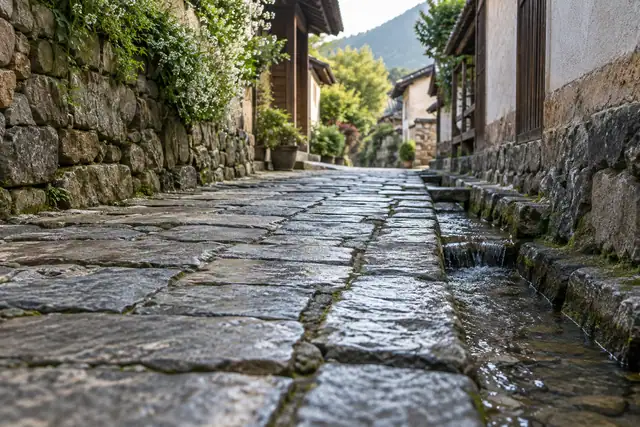
About Jiangdong Ginkgo Village
The oldest of the village's ginkgo trees, called the Ginkgo King, is more than 1,300 years old and, according to the Baoshan tourism authority, the village's only tree of its very rare monoecious kind, standing about 30 metres tall with a trunk about 2 metres across at breast height; it was nominated as the Ginkgo King in 2014. The tourism authority describes the resulting scene as 'village in the forest, trees in the homes, people in a painting'. Nearby stands Shimen, an ancient battlefield site of more than 450 square metres that was once an official road, trade road and military road; two natural boulders beside it form a gate passable by only one person and one horse at a time, giving it the local reputation 'one man guarding the pass, ten thousand cannot get through'.
The village also carries two named craft traditions. Xingyang oil-paper umbrellas are made with ribs cut from water-soaked golden bamboo stripped of its sugar content to resist insect damage. Shadow puppetry was introduced to Tengchong during the Ming Hongwu era by garrison troops sent from the Central Plains, the Guangdong-Guangxi region and elsewhere, and the tourism authority names the Liu family village tradition as the most influential locally; in September 2003 it represented Yunnan at the second national puppet and shadow-play competition, winning a bronze medal and a prize for shadow-figure design, which the tourism authority calls the highest literary and artistic award Tengchong has received to date.
What to look for
- The Ginkgo King, a rare monoecious ginkgo tree more than 1,300 years old, about 30 metres tall with a trunk about 2 metres across.
- Shimen ancient battlefield, a Tea-Horse Road-era pass formed by two natural boulders passable by only one person and horse at a time.
- The village's contiguous ginkgo forest, over 10,000 mu with more than 30,000 trees, over 1,200 of them more than a century old.
- Xingyang oil-paper umbrella craft, made from water-soaked golden bamboo ribs.
- Liu family village shadow puppetry, a Ming-dynasty-origin tradition that won a national prize for shadow-figure design in 2003.
Location & getting there
Getting to Jiangdong Ginkgo Village
Identify the main visitor approach and any separately managed houses, museums or performances. Ask before entering residential spaces or photographing residents.
- Search for 银杏村 with 保山市 and 腾冲市.
Find Jiangdong Ginkgo Village
银杏村 · 腾冲市
No reliable map pin yet: search by the Chinese name.
Sources & visit information
The linked sources support the identity and background described in this introduction. Opening hours, admission, activity availability and exact arrival arrangements have not been comprehensively checked. Confirm current visitor information with the venue; the original catalogue locality and editorial review flag are retained.