

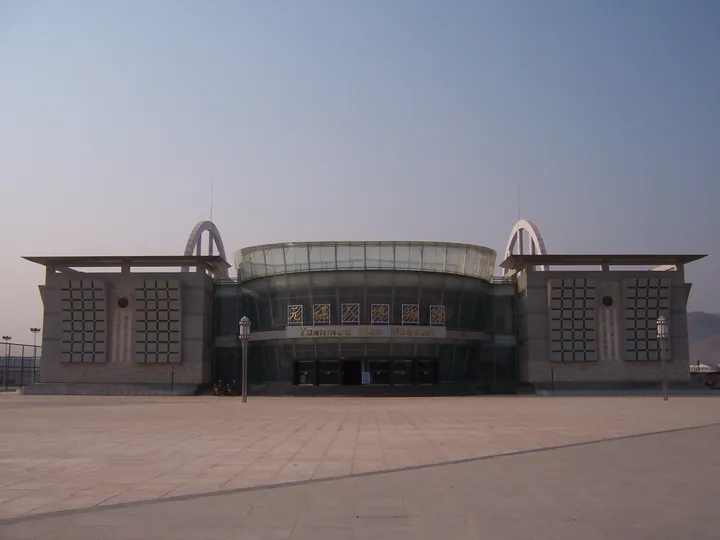
Photo adjustments
Full frame retained; proportionally resized and converted to WebP. No retouching or changes to the photographed subject. Card displays may crop the view.
Explore the region
About Yuanmou Man Museum
On 1965-05-01, Qian Fang of the Institute of Geomechanics, Chinese Academy of Geological Sciences, found two teeth fossils suspected to belong to an ape-man while surveying near Yuanmou during the construction of the Chengdu-Kunming railway. In 1973, China Geological Museum palaeontologist Hu Chengzhi formally named the find Homo erectus yuanmouensis Hu, and paleomagnetic dating placed it at about 1.7 million years old, then the earliest Homo erectus fossil known in China or Asia. Xinhua News Agency announced the discovery on 1972-02-22 and People's Daily reported it the same day as a major find following Peking Man and Lantian Man. From 1965, teams from the Chinese Academy of Sciences' Institute of Vertebrate Paleontology and Paleoanthropology, the China Geological Museum and the Beijing Museum of Natural History carried out three surveys and five excavations at the site, recovering the two incisor fossils along with a tibia fragment, a pointed bone tool, and stone artefacts and bone fragments bearing marks of human working. The original teeth are held by the China Geological Museum; the Yuanmou Man Museum displays replicas of them.
Yuanmou County opened an earlier Yuanmou Man Exhibition Hall in 1989 and built the present Yuanmou Man Museum in 2010, with free admission. The museum is now rated a national second-class museum and a national AAA-grade tourist attraction, and county reporting describes it as one of the few museums nationally devoted specifically to early human and prehistoric culture, receiving more than 300,000 visitors a year. Its permanent exhibition was reorganised into a new five-section display, titled 'From a Million Years of Human History to Five Thousand Years of Civilisation: a Frontier Chapter', which was recognised as a 2024 Yunnan Province Fine Exhibition Design Project: 'Standing Upright in the East' on the Yuanmou Man fossil evidence, 'Farewell to the Apes' on Yuanmou's ancient-ape finds, 'Ceaseless Life' on reconstructed habitat scenes, 'Ancient Footprints' on the basin's Paleolithic-era sites, and 'Torch of Civilisation' on the Neolithic Dadunzi culture.
What to look for
- the replica Yuanmou Man tooth fossils, displayed in a transparent-screen case, with the originals held at the China Geological Museum
- the exhibition's 'tooth wall', 'stone-tool wall' and 'pottery wall' display features
- the 'Farewell to the Apes' section on Yuanmou's ancient-ape fossil finds
- the 'Torch of Civilisation' section on the Neolithic Dadunzi culture and its bone-working industry
Location & getting there
Getting to Yuanmou Man Museum
Confirm the venue or campus, reservation channel and exhibition calendar. A museum name may cover more than one building.
- Search for 元谋人博物馆 with 楚雄彝族自治州 and 元谋县.
Find Yuanmou Man Museum
元谋人博物馆 · 元谋县
No reliable map pin yet: search by the Chinese name.
Sources & visit information
The linked sources support the identity and background described in this introduction. Opening hours, admission, activity availability and exact arrival arrangements have not been comprehensively checked. Confirm current visitor information with the venue; the original catalogue locality and editorial review flag are retained.