

Photo adjustments
Full frame retained; EXIF orientation normalized, proportionally resized to at most 800 pixels and converted to WebP. No generated pixels or subject changes. Cards may crop the display.
Explore the region
About Yuanyang Hani Rice Terraces
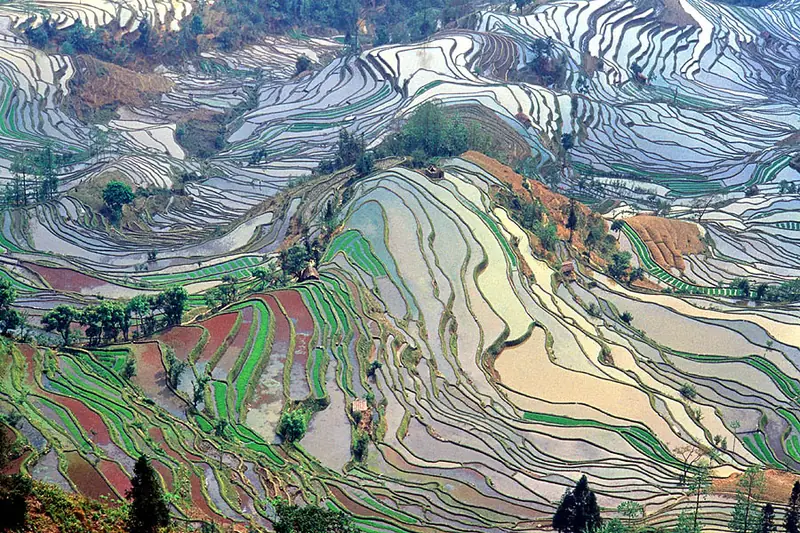
According to Yuanyang county government, the wider Red River Hani terraces spread across Yuanyang, Honghe, Jinping and Lüchun counties, totalling about 1 million mu, with 170,000 mu in Yuanyang county alone; the terraces follow the mountain terrain, ranging from plots of several mu down to patches as small as a winnowing basket. Yuanyang's terraces form the core area of the wider heritage site, which was inscribed on the UNESCO World Heritage List on 2013-06-22 at the 37th session of the World Heritage Committee, becoming China's 45th World Heritage Site. A Ministry of Ecology and Environment feature, citing the Yuanyang Hani Terraces Management Committee, describes the terraces as the world's only living agricultural cultural heritage site named after an ethnic group and themed on rice-farming civilisation; the heritage zone was named a Ministry of Ecology and Environment 'lucid waters and lush mountains' practice-innovation base in December 2018.
The same source describes the terraces' defining ecological structure as forest on the upper slopes, village settlements in the middle, terraced paddies below, and a water system running through all three, giving the area its characteristic forest-village-terrace-water 'four elements' integrated system. Azheke village, within the heritage zone, is named as a traditional Hani settlement with over 160 years of history and one of five key villages named in the site's World Heritage nomination; its more than 60 surviving traditional 'mushroom house' dwellings are described by experts as Yuanyang county's best-preserved Hani architectural complex.
What to look for
- the terraced paddies themselves, following the mountain terrain from plots of several mu down to patches the size of a winnowing basket
- the forest-village-terrace-water structure visible from a viewpoint over the terraces
- Azheke village's more than 60 surviving traditional 'mushroom house' dwellings
Location & getting there
Getting to Yuanyang Hani Rice Terraces
Check the open visitor route and follow the site’s rules on distance, food and photography. Conservation areas may limit access beyond designated paths.
- Search for 元阳哈尼梯田 with 红河哈尼族彝族自治州 and 元阳县.

Find Yuanyang Hani Rice Terraces
元阳哈尼梯田 · 元阳县
No reliable map pin yet: search by the Chinese name.
Sources & visit information
The linked sources support the identity and background described in this introduction. Opening hours, admission, activity availability and exact arrival arrangements have not been comprehensively checked. Confirm current visitor information with the venue; the original catalogue locality and editorial review flag are retained.