

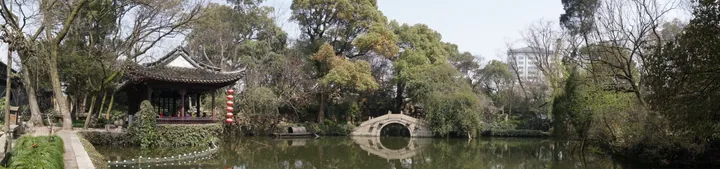
Photo adjustments
Full frame retained; proportionally resized and converted to WebP. No retouching or changes to the photographed subject. Card displays may crop the view.
Explore the region
About Qiyuan Garden
Qiyuan Garden (绮园), known locally as the Feng family garden (冯家花园), is a Qing-dynasty private garden and residence at 44 Haibin East Road (海滨东路) in Wuyuan Subdistrict (武原街道), Haiyan County (海盐县), Jiaxing (嘉兴), Zhejiang.
The owner, Feng Zuanzhai (冯缵斋, about 1840 to 1887), came from a family that made its money brewing soy sauce for the Shanghai market. His wife Huang Xiu (黄琇) was the second daughter of the poet and playwright Huang Xieqing (黄燮清), who had owned two older gardens, Zhuoyi Garden (拙宜园) and Yan Garden (砚园). Both were ruined by war in the Xianfeng reign, and in the Tongzhi reign Feng built a new garden from their best rocks, naming it after the phrase "妆奁绮丽" (a splendid dowry). Chinese Wikipedia dates the house to 1870 and the garden to the following year. After 1949 the Feng descendants gave house and garden to the government; it opened to the public in 1963, was renamed People's Park in 1967 and took back its old name in June 1985. The State Council listed it as a national key cultural relics protection unit on 25 June 2001.
Zhejiang Online counts 33 recorded gardens in Haiyan from the Jin to the Qing dynasty, of which only Qiyuan survives. The garden scholar Chen Congzhou (陈从周) of Tongji University surveyed it in 1960 and 1983 and, among Zhejiang's few surviving gardens, ranked it first. The head of the garden's management office names its main difference from many Jiangnan private gardens: the garden is laid out apart from the house rather than woven through it. The garden lies northeast of the house on about 10,000 square metres, about 2,000 of them water, and is longer north to south than east to west, narrow at the front and wide at the back. Instead of buildings, three rockery hills and two pools divide the space; there are close to 1,000 trees, more than 60 of them old or notable, including Chinese honey locust, wisteria, camphor, boxwood and ginkgo.
In the southern part, the four-sided Tanying Hall (潭影轩) faces a pool crossed by a zigzag bridge that leads onto the hill paths. The northern part is an open scene of water and hills: three bridges and two causeways cross its pool, the Fenghe waterside pavilion (风荷轩) stands on the northwest shore, and a gorge in the northwest corner holds a pool with an island. The Dream of the Red Chamber television series of 1987 was filmed in the garden.
What to look for
- Xiaoyin Pavilion (小隐亭), the six-sided pavilion on the main rockery peak and the highest point in the garden
- Tanying Hall (潭影轩), the four-sided hall facing the southern pool and its zigzag bridge
- The northern pool with the Nine-Turn (九曲桥), Four Swords (四剑桥) and Yanhua (罨画桥) bridges
- Fenghe Pavilion (风荷轩), the waterside pavilion on the northwest shore
- The deep gorge in the northwest corner, with a pool and an island
- The surviving rear hall of the Feng house, seven bays wide and two storeys high, with a brick-carved gateway inscribed "竹苞松茂" (bamboo dense, pines flourishing)
- Old trees among nearly 1,000 in the garden, including honey locust, wisteria and ginkgo
Location & getting there
Getting to Qiyuan Garden
- Search for 绮园 with 嘉兴市 and 海盐县.
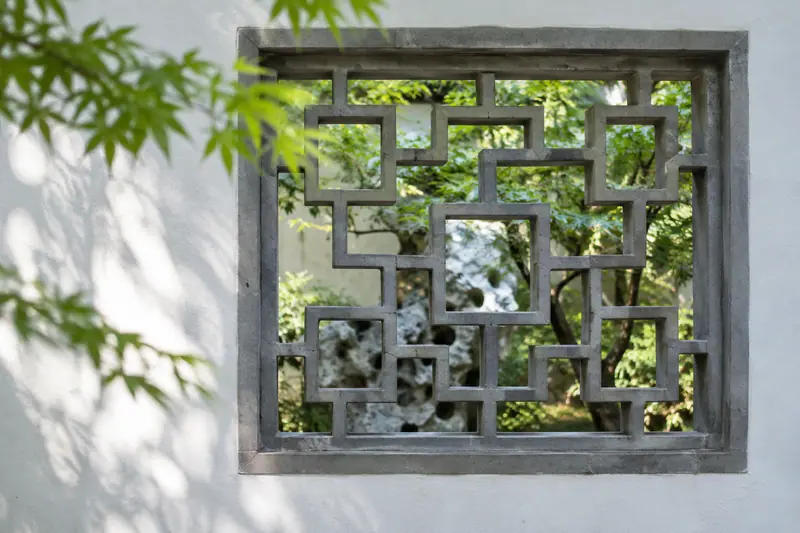
Find Qiyuan Garden
绮园 · 海盐县
No reliable map pin yet: search by the Chinese name.
Sources & visit information
Written from the linked sources and checked sentence by sentence against quoted extracts by a separate reviewer on 2026-09-23. Opening hours, admission and access arrangements are not covered; confirm current visitor information with the site.
Some facts checked against Wikipedia contributors, "绮园" · CC BY-SA 4.0.