

Photo adjustments
Full frame retained; proportionally resized and converted to WebP. No retouching or changes to the photographed subject. Card displays may crop the view.
Explore the region
About Tashan Weir
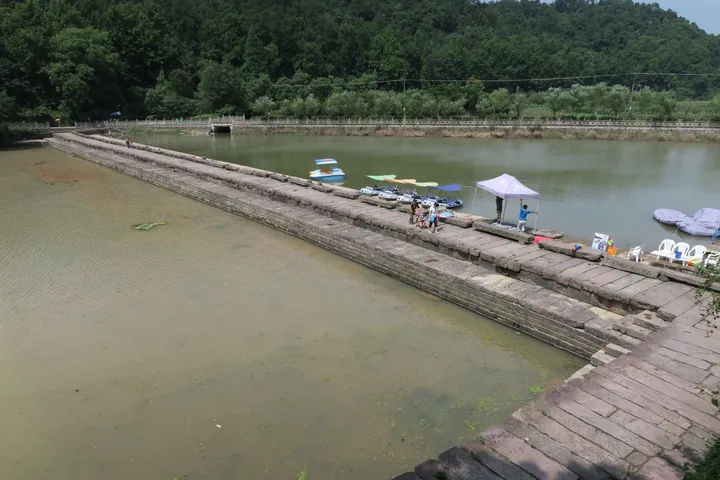
Tashan Weir (它山堰) is a Tang-dynasty stone weir on the Yinjiang River (鄞江) at Tashanyan village in Yinjiang Town (鄞江镇), Haishu District (海曙区), Ningbo (宁波), and it is still used for irrigation, flood drainage and environmental water for the city.
The weir sits where the Zhangxi stream (樟溪) leaves the hills for the plain, between Jiang Hill (绛山) to the south and Tashan hill (它山) to the north, from which it takes its name; locally the first character is read tuō, a pronunciation thought to survive from the old Yue language. Before it existed, tides from the Fenghua River (奉化江) pushed salt water up the Yinjiang while fresh water ran off to the sea. The weir splits the flow: to the south the Yinjiang runs on to the Fenghua River, and to the north the Tang River (塘河) carries fresh water to farmland and to the city. A Southern Song saying held that in floods seven parts of the water go to the river and three to the canal, and in drought the reverse. The canal entered the walled city of Mingzhou (明州), today's Ningbo, and formed its Sun and Moon lakes (日湖, 月湖).
The county magistrate Wang Yuanwei (王元暐) chose the site in 833 and the weir was finished about three years later. It is 113.7 metres long, built of stone blocks 2 to 3 metres long weighing about a tonne each, with 36 steps on each side. In plan it bows slightly upstream to steer floodwater away from the banks, it is thickest in the middle, and its base tilts upstream to resist sliding. From the Song to the Qing, sluices and embankments were added until the late Qing system counted nine sluices, five weirs and thirteen embankments. The weir became a county-protected site in 1982, joined the third list of national key cultural relics protection units in 1988, and was named a World Heritage Irrigation Structure by the International Commission on Irrigation and Drainage in October 2015.
On the hilltop beside the weir, the Tashan Yide Temple (它山遗德庙), built in its present form in 1948, holds a statue of Wang Yuanwei and now houses a water-conservancy exhibition. Three times a year, on the dates remembered for the weir's groundbreaking (tenth day of the tenth lunar month), sand dredging (sixth of the sixth) and completion (third of the third), local people hold the Yinjiang temple fair (鄞江庙会) with dragon dances, waist-drum plays and opera.
What to look for
- The 113.7-metre stepped stone weir, bowed slightly upstream across the Yinjiang
- The split between the Yinjiang and the Tang River canal that feeds the plain
- Tashan Yide Temple (它山遗德庙) on the hilltop, with its water-conservancy exhibition
- The Pianshi Liuxiang (片石留香) stele pavilion east of the temple, with a stele from 1806
- The site of the Huisha sluice (回沙闸) upstream of the weir
- Yinjiang temple fairs on the third day of the third lunar month, the sixth of the sixth and the tenth of the tenth
Location & getting there
Getting to Tashan Weir
- Search for 它山堰 with 宁波市 and 海曙区.
Find Tashan Weir
它山堰 · 海曙区
No reliable map pin yet: search by the Chinese name.
Sources & visit information
Written from the linked sources and checked sentence by sentence against quoted extracts by a separate reviewer on 2026-09-23. Opening hours, admission and access arrangements are not covered; confirm current visitor information with the site.
Some facts checked against Wikipedia contributors, "它山堰" · CC BY-SA 4.0.