

Photo adjustments
Full frame retained; proportionally resized and converted to WebP. No retouching or changes to the photographed subject. Card displays may crop the view.
Explore the region
About Xiandu Scenic Area
Xiandu Scenic Area (仙都) is a national 5A scenic area in Xiandu Subdistrict (仙都街道), Jinyun County (缙云县), Lishui (丽水), built around Dinghu Peak (鼎湖峰), a lone rock pillar in the valley of the Haoxi stream (好溪).
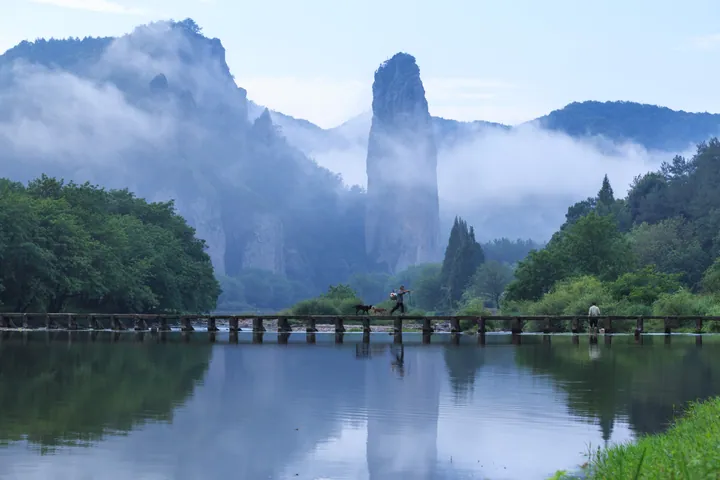
The area usually meant by the name is the Dinghu Peak section, about 7 km from the Jinyun county town, covering 76 square kilometres on the northern flank of the Kuocang Mountains (括苍山) along the middle course of the Haoxi, in the upper Ou River (瓯江) basin. The Haoxi was once called the 'evil stream' (恶溪) for its floods and was renamed the 'good stream' after centuries of dredging. Dinghu Peak rises about 170 metres from a base of 2,400 square metres; People's Weekly describes it as a rhyolite platform left by volcanic outpourings and shaped by weathering. A hollow on its summit, shaped like a tripod cauldron (鼎), gives it its name, and locals call it the Stone Bamboo Shoot (石笋). At its foot a Qing-dynasty bridge of tuff slabs, 115 metres long on 75 stone piers, crosses the Lianxi (练溪) close to the water.
In 748 Emperor Xuanzong (唐玄宗) renamed Jinyun Mountain (缙云山) as Xiandu Mountain, the 'capital of immortals', after the local prefect reported phoenixes gathering there. The Yellow Emperor Temple (黄帝祠宇), also called Xuanyuan Hall (轩辕殿), is a three-courtyard complex on the slope of Buxu Hill (步虚山); People's Weekly dates its founding to the Eastern Jin, and it is paired with the Yellow Emperor's mausoleum in the north as the 'northern tomb and southern shrine'. Public rites to the Yellow Emperor have taken place there each Qingming and Double Ninth festival since 1998, and the Jinyun Xuanyuan ritual (缙云轩辕祭典) joined the third national list of intangible cultural heritage in 2011. Taoist tradition counts Xiandu among the 36 grotto-heavens (洞天).
Niweng Cave (倪翁洞), the largest of Xiandu's caves, carries a seal-script name said to be written by the Tang calligrapher Li Yangbing (李阳冰) when he was county magistrate; it holds the densest group of cliff inscriptions in the area and is a national key cultural relics protection unit. Nearby, Dufeng Academy (独峰书院) faces the Haoxi on the site where the philosopher Zhu Xi (朱熹) taught in 1182, and a ginkgo more than 800 years old grows in its courtyard. The area has served as a location for 500 films and television productions up to March 2020.
What to look for
- Dinghu Peak (鼎湖峰), a rock pillar about 170 metres high with a cauldron-shaped hollow on top
- The Qing-dynasty tuff slab bridge of 75 piers across the Lianxi below Dinghu Peak
- The Yellow Emperor Temple (黄帝祠宇) on Buxu Hill, scene of the Qingming and Double Ninth rites
- Niweng Cave (倪翁洞) and its cliff inscriptions, including the seal-script name attributed to Li Yangbing
- Dufeng Academy (独峰书院), where Zhu Xi taught in 1182, with its ginkgo of more than 800 years
- Furong Gorge (芙蓉峡) and Xiaochibi (小赤壁), two of the area's named sights
Location & getting there
Getting to Xiandu Scenic Area
- Search for 仙都 with 丽水市 and 缙云县.
Find Xiandu Scenic Area
仙都 · 缙云县
No reliable map pin yet: search by the Chinese name.
Sources & visit information
Written from the linked sources and checked sentence by sentence against quoted extracts by a separate reviewer on 2026-09-23. Opening hours, admission and access arrangements are not covered; confirm current visitor information with the site.
Some facts checked against Wikipedia contributors, "仙都" · CC BY-SA 4.0.