

Zhenjiang Sesame Oil Fried Dough Twists 镇江麻油馓子
Zhenjiang Sesame Oil Fried Dough Twists is featured among the local specialties of Jiangsu.

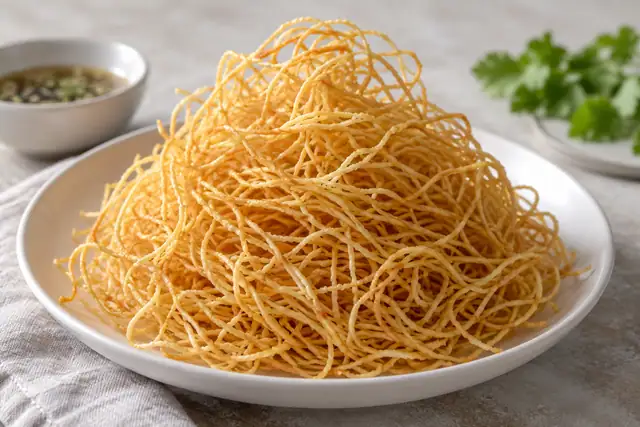
Zhenjiang Sesame Oil Fried Dough Twists (镇江麻油馓子) are the Zhenjiang (镇江) version of sanzi (馓子), a fried snack of noodle-thin strands of dough, made with the city's own stone-ground sesame oil. Writing in the Xinmin Evening News (新民晚报) in 2019, the writer Xi Po (西坡) says the best-known home of sesame-oil sanzi is not northern Jiangsu (苏北) but Zhenjiang.
How it is made
Sanzi are made all over China, but Xi Po points out that not all of them are made with sesame oil. Zhenjiang makers use the local stone-ground sesame oil (小磨麻油), which he credits for the snack's strong fragrance and its reputation. Chinese Wikipedia describes modern sanzi as a lattice of strands as fine as noodles, and quotes the Compendium of Materia Medica (本草纲目) of Li Shizhen (李时珍): dough worked with glutinous-rice flour and a little salt, pulled into cords, twisted into bracelet-like rings and fried in oil. Xi Po adds that women who made sanzi once showed off by stretching the dough into long thin strands and winding them round and round their fingers or arm before throwing them into the hot oil.
Where it comes from
An old Zhenjiang saying warns that anyone who does not eat qi'er (脐儿) and sanzi at Qingming (清明) will be beaten by the King of Hell (阎王) after death. Xi Po takes two things from it: Zhenjiang people are fond of sanzi, and sanzi are a Qingming snack. The snack itself is ancient. Its older names include zhanghuang (餦餭), hanju (寒具) and niantou (捻头), and it appears no later than the Summons of the Soul (招魂) in the Songs of Chu (楚辞). Chinese Wikipedia notes that it was once a cold food tied to the Cold Food Festival (寒食节). Xi Po also suggests that the sanzi prized in Song-era Jinling (金陵, today's Nanjing) most likely came from Zhenjiang.
How it is eaten
Sanzi can be eaten dry, snapped off one strand at a time as a snack. Xi Po also describes the Zhenjiang way of steeping sesame-oil sanzi in boiling water, which lets them be eaten much like instant noodles; a colleague of Shandong origin told him the same trick works even better with broth.
Sources & reading
Written from the linked sources and fact-checked against them on 2026-09-24. Recipes and servings vary between kitchens.