

Anhai Sea Worm Jelly 安海土笋冻
Anhai Sea Worm Jelly is featured among the local specialties of Fujian.
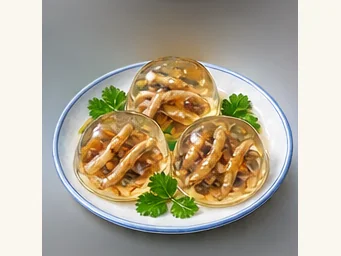
Anhai Sea Worm Jelly (安海土笋冻) is a cold savoury jelly made from a small burrowing sea worm, eaten in Anhai (安海) in Jinjiang (晋江), part of Quanzhou (泉州) in southern Fujian. The Jinjiang city government names Donghai (东海) and Anhai as the places where it is best known and calls it perhaps the most famous of Jinjiang's snacks. The tusun (土笋, 'earth shoot') in the name is not a bamboo shoot: it is a peanut worm, Phascolosoma esculenta, of the phylum Sipuncula.
Ingredients
The worm burrows into the mud, is also called 'soil drill' (土钻) and lives wild on mudflats where river water meets the sea. It is shaped like an earthworm and greyish white, from the thickness of a rice stalk up to that of a finger. The worms from Anhai are larger and slightly yellow-skinned, unlike the small, dark worms that old Xiamen (厦门) residents call the best. With demand rising and fewer worms left on the Jinjiang coast, Jinjiang makers now bring worms in from Fu'an (福安), Fuding (福鼎) and Pingtan (平潭) for processing.
How it is made
After digging, the worms are kept for a day to purge themselves, then worked under a stone roller to squeeze out the remaining mud. They are washed and boiled in salted water; once it boils, the worms and liquid are ladled into small porcelain bowls and left overnight in an open courtyard, where they cool and set into a jelly. In summer the bowls go into the refrigerator instead. It could once be had only in winter and is now available all year.
How it is eaten
Each bowl holds white, glossy worms set in the jelly, eaten cold with aged vinegar, soy sauce, mashed garlic and shredded ginger. The jelly is greyish white and translucent, tender with a slight crunch and springy. In Jinjiang it is sold in streets and lanes, served in restaurants and now also appears at weddings and other celebrations. The city portal names Xi'an village (西垵) in Anhai as the place for the best jelly. The village has made it for at least seventy to eighty years, and in the 1930s and 1940s villagers sold it from bamboo trays carried on the arm.
Where it comes from
Zhou Lianggong (周亮工), Left Administration Commissioner of Fujian in the Shunzhi reign (顺治) of the Qing dynasty, tasted it on a tour of the south; in his Min Xiao Ji (闽小记, 'Short Notes on Fujian') he wrote that he often ate it in Fujian and found it unusually fresh in flavour. A local story links it to Koxinga (郑成功): while his troops were stationed at Shijing (石井) and short of grain, they are said to have dug up the worms and eaten them once the boiled worms had cooled.
Sources & reading
Written from the linked sources and fact-checked against them on 2026-09-23. Recipes and servings vary between kitchens.
Recipes and servings vary between kitchens.