

Quick-Poached Xishi Tongue Clams 汆西施舌
Quick-Poached Xishi Tongue Clams is featured among the local specialties of Shandong.
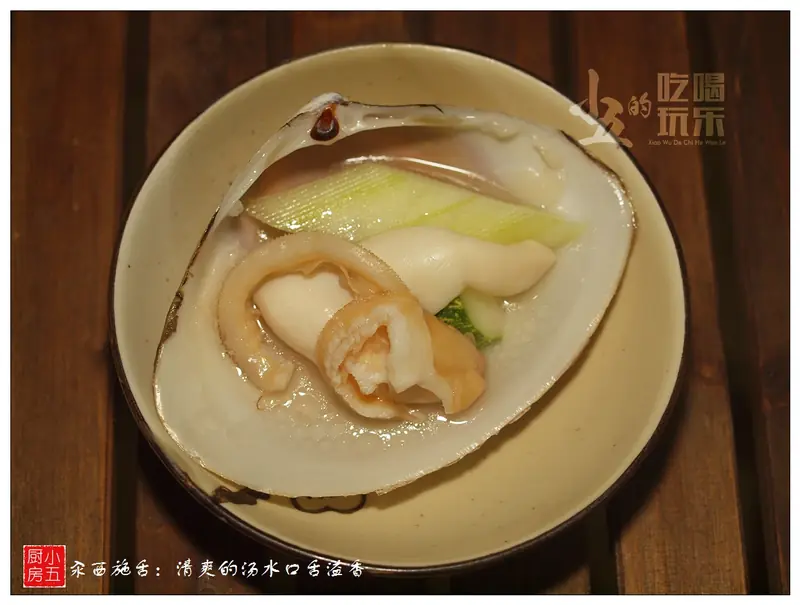
Image notes
Resized for the web; the photo itself has not been edited.
Quick-Poached Xishi Tongue Clams (汆西施舌) is a Qingdao (青岛) soup in which thin slices of xishi tongue clam (西施舌), a small Qingdao shellfish shaped like a large clam with white, soft but springy meat, are dropped into boiling clear stock and eaten straight away. In December 2024 it was named one of the ten 'classic heritage dishes of Qingdao' (青岛十大经典传承菜), and Qingdao News lists it among the signature dishes of the old Chunhelou (春和楼) restaurant.
How it is made
The key is the stock, which should be a clear stock; a specialist quoted by Qingdao News allows broth from boiled clams and xishi tongue clams as a substitute. The clam meat has its skirt removed and is cut into thin slices and washed. The stock is brought to the boil with salt and chicken fat, and the slices are tipped in in front of the diners. Finely chopped coriander stalks and chive greens, ground pepper and vinegar come to the table in separate dishes.
Dazhong News describes a refined way of serving it that uses only the larger part of the tongue-shaped tip of the meat, cooked gently in clear stock together with the clam's own juice.
How it is eaten
The dish has to be eaten hot: once the soup cools a little, the clam meat turns tough. It can also be served as a small hotpot, with each diner holding an empty bowl and swishing slices through the stock seven or eight times before eating them. In a 2019 tasting, Qingdao Evening News found poaching showed off the clam better than steaming or stir-frying, and noted that chicken stock keeps its heat and tastes richer, while clam broth cools quickly. At one Qingdao restaurant the paper describes, chicken and clam broths are mixed, the slices are poured in at the table and ladled out at once, so the meat stays crisp-tender and sweet.
Where it comes from
The writer Liang Shiqiu (梁实秋) first ate xishi tongue clam in the 1930s at Qingdao's Shunxinglou (顺兴楼) restaurant, and recalled a bowl of clear soup with pointed white pieces floating on top that felt smooth and tender in the mouth. He held that the clam is best poached in clear stock rather than fried. Clams from Boli (泊里) in the city's West Coast New Area (西海岸新区) were listed as a national geographical-indication product by the Ministry of Agriculture in November 2010.
Sources & reading
Written from the linked sources and fact-checked against them on 2026-09-24. Recipes and servings vary between kitchens.