

Noodles with Thick Seafood Gravy 海鲜卤面
Noodles with Thick Seafood Gravy is featured among the local specialties of Shandong.
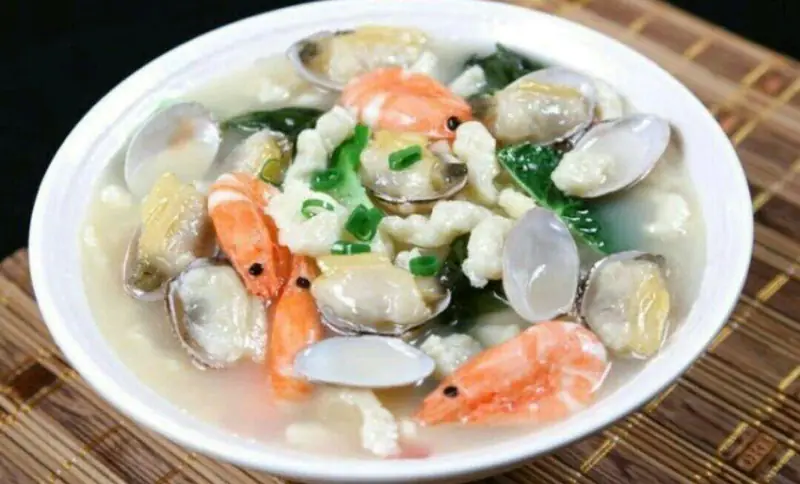
Image notes
Resized for the web; the photo itself has not been edited.
Noodles with Thick Seafood Gravy (海鲜卤面) are noodles served under a lu (卤), a topping of seafood cooked down with vegetables and egg, and they are one of the everyday noodle dishes of Qingdao (青岛) and the wider Jiaodong (胶东) coast. Qingdao Daily lists clam and green bean noodles, prawn gravy noodles and red-head fish gravy noodles among the city's seafood dishes.
How it is made
The commonest household version in Qingdao is clam and green bean noodles (蛤蜊芸豆面), a summer dish. Writer Cui Yan (崔燕) describes it in the Economic Observer: live clams are left to spit out their sand, boiled in water, and the clean cooking liquid is left to settle while the meat is picked out. Spring onion and ginger go into hot oil, diced green beans are fried until half cooked, the clam liquid is poured in, and once it boils the clam meat is added and beaten egg is trickled in. Only salt is used to season it. Clams from Hongdao (红岛) with thin shells are rated best, and the local laolaishao (老来少) variety of green bean is preferred.
Two more laborious versions, made with small lixia shrimp (蛎虾) or with mantis shrimp (虾虎), came to the city from well-off families in Jiaozhou (胶州). The shellfish are peeled, the shells crushed and boiled for stock, and the meat is stir-fried with spring onion and ginger, then made into the gravy with wood-ear fungus, lean pork, egg and garlic chives; spring is the best season for them. In cold months, when little fresh seafood was around, Qingdao cooks used soaked dried cuttlefish with pork belly, wood-ear and day lily buds, thickening the gravy with starch before adding egg and chives.
How it is eaten
Qingdao News describes the Jiaodong seafood version as a gravy of diced meat, wood-ear fungus and, in season, cabbage, with whatever seafood the cook likes, such as prawns, clams, scallops, abalone, sea cucumber or oysters, over hand-rolled noodles that are neither too thick nor too thin and have some bite. Cui Yan writes that the best versions are made at home rather than in restaurants, because the dish takes time and needs very fresh seafood.
Sources & reading
Written from the linked sources and fact-checked against them on 2026-09-24. Recipes and servings vary between kitchens.