

Weishi Smoked Chicken 魏氏熏鸡
Weishi Smoked Chicken is featured among the local specialties of Shandong.
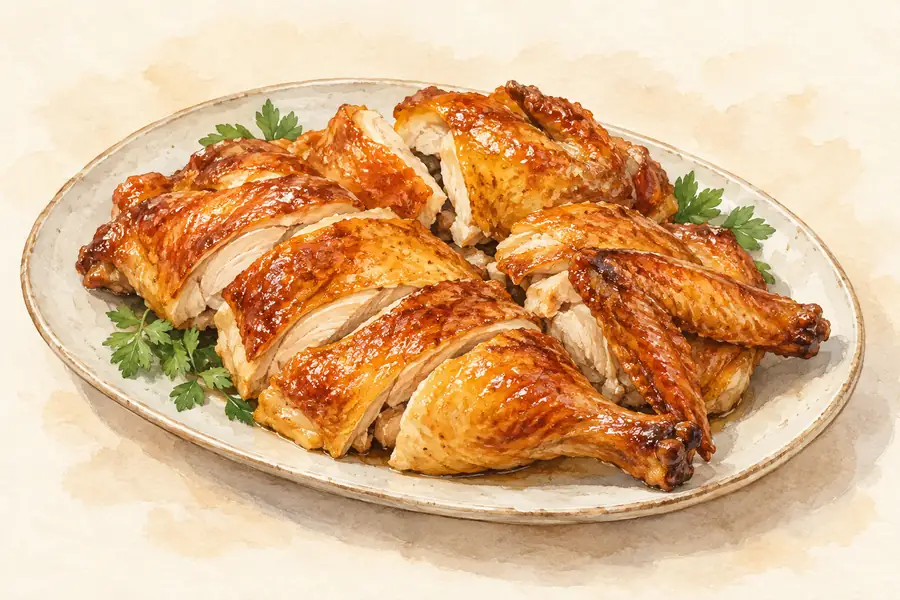
Weishi Smoked Chicken (魏氏熏鸡) is a whole chicken braised in spiced stock and then smoked over sawdust, a Wei family recipe from Dongchangfu (东昌府) in Liaocheng (聊城), Shandong. The Dongchangfu District government dates the recipe to 1810, the 15th year of the Jiaqing reign (嘉庆) of the Qing dynasty, when it was created by the family ancestor Wei Yongtai (魏永泰). It also goes by the nickname "Liaocheng Iron Rooster" (聊城铁公鸡), given to it by the writer Lao She (老舍).
Where it comes from
According to Dazhong News (大众新闻), the Wei family of Dongchangfu first made braised chicken. The family story is that in 1810 a Wei mother, whose son served on the grain boats of the Grand Canal (京杭大运河) and was away for months, smoked the braised chicken over pine shavings and fruitwood so it would keep. Smoked six times and aired six times, it lasted more than six months. The smoked chicken then travelled the canal to markets across the country.
In the summer of 1935 Lao She tasted one with the scholar Xiao Difei (萧涤非), a Shandong University professor. He likened its dark, purple-tinged skin and hard frame to the black-faced Judge Bao of Peking opera, recalled the shrine on the north shore of Daming Lake (大明湖) in Jinan (济南) to the early-Ming commander Tie Xuan (铁铉), and proposed the name Iron Rooster. The making technique entered Shandong's second provincial intangible cultural heritage list in 2009.
How it is made
The district government describes plump live birds braised in stock and then smoked in sawdust smoke. The Weilaoliu (魏老六) company buys live hens of about two years old directly from farmers; they are killed, cleaned and folded into a crouching shape, go into the pot within half an hour, and are braised in an old master stock with seventeen spices. The birds are then smoked and aired six times over sawdust, chiefly of willow, red pine and fruitwood. The company keeps to live birds because it found that frozen chickens came out soft after braising and smoking.
Flavour and texture
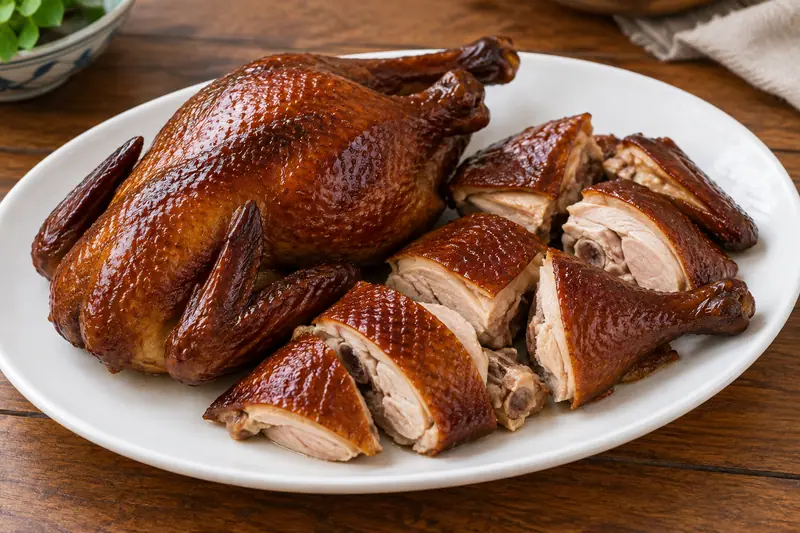
When finished, the skin shrinks and splits to show the breast and leg meat, and the colour is chestnut red. The meat is firm and chewy, pulls apart into distinct shreds and leaves a lingering aroma. Dazhong notes that visitors from elsewhere tasting it for the first time often find it too salty and hard, and Weilaoliu has added a lower-salt version and hand-shredded breast meat sold in small packs. The district government describes it as good with liquor or with tea and as a choice dish for banquets and gifts.
Sources & reading
Written from the linked sources and fact-checked against them on 2026-09-24. Recipes and servings vary between kitchens.