

Pan-Fried Buns 水煎包
Pan-Fried Buns is featured among the local specialties of Shandong.
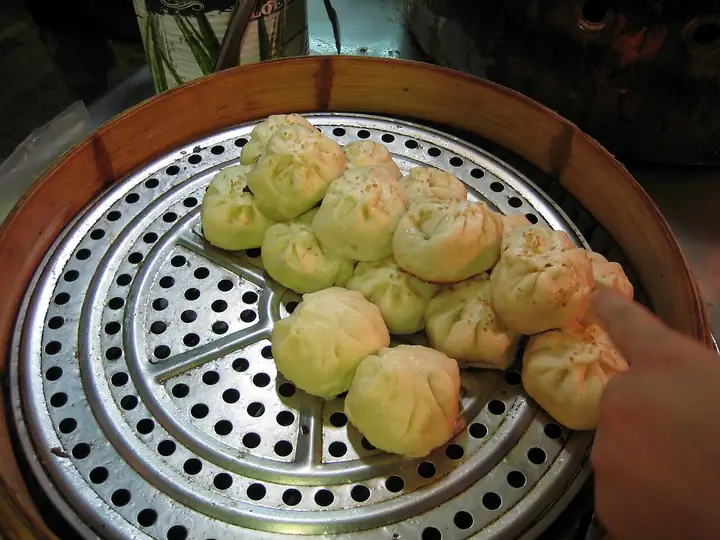
Pan-Fried Buns (水煎包) in Heze (菏泽), Shandong, are buns that combine cooking in water with frying in oil. China News Service's Shandong channel calls the Caozhou (曹州, the old name of Heze) version a century-old taste of the city.
Ingredients
Heze makes more than ten kinds, meat and meatless. Meat buns are filled mainly with pork, mutton, shrimp, sea cucumber or Chinese cabbage; meatless ones with garlic chives, glass noodles, fried tofu, wild greens or carrot. The Heze culture and tourism bureau lists mutton, pork and vegetable fillings seasoned with spring onion, ginger and five-spice powder. The China News Service feature singles out mutton with spring onion and ginger, and chives with tofu, wrapped in a soft, fluffy dough.
How it is made
In the bureau's description, the buns are laid flat in an oiled pan for a short time, then flour-and-water batter is added, sesame oil is poured over and the buns are turned once before they come out. China News Service says the key is to pour sesame oil over twice. The buns first fry to a golden, crisp base, and then the remaining heat cooks a crust (饹馇, gege) as thin as a cicada's wing.
Flavour and texture
The buns are crisp outside and fresh-tasting within. The filling holds together in a tight ball with a rich juice, and when the buns are bitten open the meat juice and sesame oil hit the nose together; the meatless ones taste fresh from the wild greens.
Where it comes from
A local legend holds that Liu Bang (刘邦), founder of the Han dynasty, tasted the buns in Caozhou while on the run, after which they became a palace snack.
Sources & reading
Written from the linked sources and fact-checked against them on 2026-09-24. Recipes and servings vary between kitchens.
Image credits & notes (1)
- A common version of Pan-Fried Buns · 水煎包常见做法参考照片。Photo: (WT-en) SuperMidget at English Wikivoyage · Public domainResized for the web; the photo itself has not been edited.
