

Gaocun Mung Bean Starch Sheets 高村粉皮
Gaocun Mung Bean Starch Sheets is featured among the local specialties of Henan.
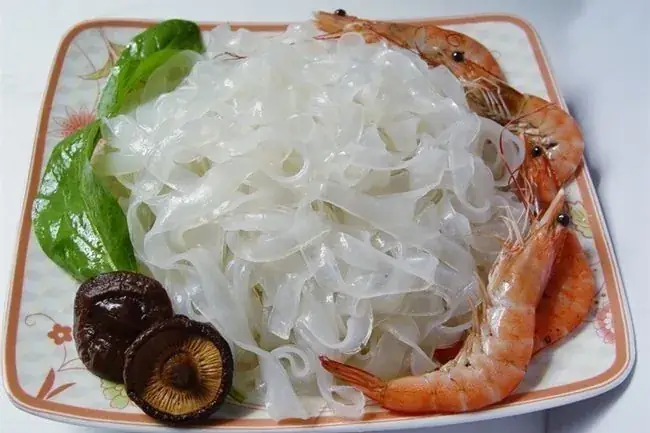
Image notes
Resized for the web; the photo itself has not been edited.
Gaocun Mung Bean Starch Sheets (高村粉皮) is a mung-bean starch sheet made in Gaocun, a village in Changyuan, Xinxiang. It is a village craft rather than a restaurant recipe: the sheets are thin, translucent and chewy.
A village starch craft
The Henan county-economy report describes Gaocun as a village where nearly half the households process mung-bean starch into fenpi. Starch sheets of this kind are made by setting a thin layer of starch and water and then drying or cooling it, and the village version is known locally for sheets that hold together.
The report's own focus is the shift from household selling to organised production. A cooperative was set up to unify raw-material supply, product certification, packaging, trademark and sales channels under what the report calls a five-in-one service.
Clear colour, chewy bite
Henan County Economy Network (Henan Broadcasting System) names the two qualities locals judge the sheets by: a colour that is bright and clear rather than cloudy, and a bite that is chewy rather than soft.
Mung-bean starch is what gives fenpi its translucent look and its springy texture. That is also why it works as a cold dish on its own and as an ingredient that keeps its shape in a cooked dish.
One village, one product
Gaocun sits about ten kilometres from the Changyuan county seat and has roughly 400 households, around half of which make fenpi according to Henan County Economy Network (Henan Broadcasting System). Before the cooperative, sheets were sold loose, without packaging, brand or sales channel, and reached only the villages nearby.
Henan County Economy Network (Henan Broadcasting System) says that registering the Gaocun trademark turned the product around and sent it as far as Beijing and Tianjin, that more than 160 households joined the cooperative, and that fenpi alone now generates an annual output value in the tens of millions of yuan for the village.
Starch and water
The raw material named for the Gaocun sheets is mung bean; Henan County Economy Network (Henan Broadcasting System) calls them mung-bean fenpi, which is the specific version of the wider fenpi family.
Because fenpi is essentially starch and water, the questions worth asking are about the starch and about what the sheet is dressed or cooked with, not about fillings. There is nothing inside a sheet.
Buying the sheets
It is bought by weight as a dry or fresh sheet rather than ordered as a cooked dish, which is why packaging and labelling matter to buyers here: a sheet with a mark and a date is easier to trust than a loose bundle.
Dried sheets need soaking before use, while fresh ones are eaten within a short time of purchase. Buyers outside the county mostly meet the product in its packed form.
How fenpi is used
Fenpi is normally served cold and dressed, or slipped into a hot dish where it absorbs sauce without breaking up. Its job on the plate is texture: cool, slippery and chewy against stronger flavours.
In Changyuan the sheets are a household food and a gift as much as a restaurant ingredient, and Henan County Economy Network (Henan Broadcasting System) presents the village trade as a year-round source of income rather than a seasonal one.
More dishes to compare
Explore related local specialties and compare their names, preparation notes and ordering guidance.
Ruzhou Mung Bean Starch Sheets 汝州粉皮 →
Ruzhou fenpi belongs to a county with its own reputation for the sheet; Gaocun fenpi is the output of a single village in Changyuan where around half the households make it. The basic idea is the same starch sheet. The difference between the two is scale, organisation and how far the product travels.
Questions before you order
What is fenpi made from?
Starch and water. The Gaocun version uses mung-bean starch, which is why it is described locally as mung-bean fenpi.
Is Gaocun fenpi made in factories?
Henan County Economy Network (Henan Broadcasting System) describes household processing across the village, later organised through a cooperative that unified raw materials, certification, packaging, trademark and sales.
Sources & reading
The supplied food list supports this name and regional association. The culinary terms below are explained as menu vocabulary; a local recipe, origin story and venue availability have not been independently verified.