

Photo adjustments
Converted to WebP and resized without changing the subject or cropping the source frame.
Explore the region
About Temple of Confucius, Beijing
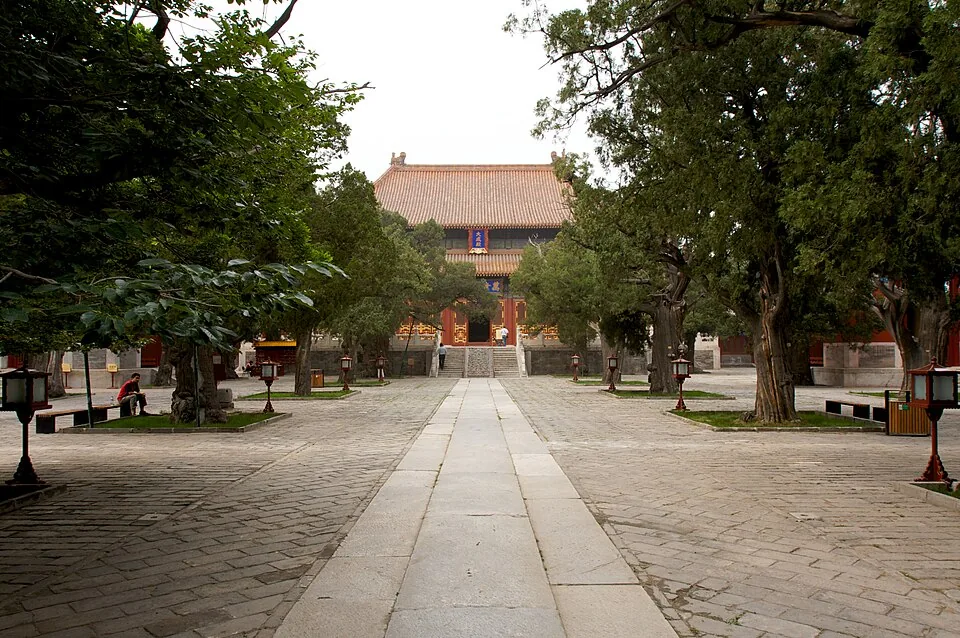
Xianshi Gate, Dacheng Gate, Dacheng Hall, and Chongsheng Temple organize the main axis, while the inscription steles connect the place with scholarly achievement and the imperial examination tradition. The architecture makes the act of honoring Confucius visible through a progression of thresholds and ritual spaces. Follow that sequence before crossing to Guozijian, where Biyong Hall adds the teaching and ceremonial lecture side of the same scholarly neighborhood.
The temple was first built in 1302, during the Yuan dynasty, and completed in 1306; the following year Confucius was posthumously granted the title 'Great Accomplishment, Ultimate Sage, Culture-Propagating King' (大成至圣文宣王), the edict for which still stands on a stone stele before the temple gate. The temple fell into disrepair amid wars at the end of the Yuan dynasty, was renovated in 1411, and had the Chongsheng Shrine (崇圣祠) added in 1530.
In 1906 the ritual honoring Confucius was elevated to a grand sacrifice, and the Dacheng Hall was enlarged from seven bays to nine in a renovation completed by 1916; the temple first opened to the public in 1928. It was named a Major Historical and Cultural Site Protected at the National Level (全国重点文物保护单位) in 1988, and housed the Capital Museum from 1979 until that museum's move to Baiyun Road in 2006.
Behind the temple stands a forest of nearly two hundred stone steles inscribed with the Thirteen Confucian Classics, copied over twelve years by Jiang Heng (蒋衡), a tribute student from Jintan, Jiangsu. Before the steps of Dacheng Hall grows a cypress nearly 700 years old, planted by the Yuan-dynasty scholar Xu Heng (许衡) and known, according to legend, as the 'Touch-Evil Cypress' (触奸柏) for knocking the cap off a corrupt Ming minister.
What to look for
- Dacheng Hall and axial gates: read the increasingly formal sequence through the temple courts.
- Jinshi inscription stele forest: connect the stone records with the examination and scholarly traditions commemorated here.
Location & getting there
Getting to Temple of Confucius, Beijing
The temple stands on Guozijian Street, east of the imperial academy, with a connecting side gate between the compounds.
- Use Temple of Confucius and Guozijian Museum as the destination, distinguishing it from Yonghe Temple in the same wider neighborhood.
Combine your visit
Suggested order within this visit:
-
Xianshi Gate and front court
Begin with the entrance and inscription setting.
-
Dacheng Hall
Focus on the central Confucian ritual building.
-
Guozijian国子监
Continue to the academy to compare worship with formal learning.
This sequence is an editorial suggestion based on the features described in the sources. Access to individual buildings or areas should be checked locally; no travel time or shared admission is implied.
Find Temple of Confucius, Beijing
北京孔庙 · 东城区
The pin marks the area, not the entrance.
More places nearby
Approximate straight-line distances between map pins, not travel distances.
Guozijian 国子监
Less than 1 km awayBeijing Guozijian was the imperial academy and education-administration center of the Yuan, Ming, and Qing periods. It stands immediately west of the Temple of Confucius, joining formal learning with the ritual honoring of the…
View guide →Yonghe Temple 雍和宫
Less than 1 km awayYonghe Temple, also called the Lama Temple, began as a Qing prince’s residence and later became a Tibetan Buddhist monastery. That history is visible in the procession of courtyards and major halls along a north–south axis…
View guide →Temple of Earth 地坛
Less than 1 km awayThe Temple of Earth, or Ditan, stands outside the northern edge of Beijing’s former inner city near Andingmen. Its central Fangze Altar uses a square plan to express the traditional association between the earth and that shape…
View guide →Sources & visit information
The sources below support the place-specific description and arrival information. Suggested combinations are editorial planning ideas; confirm current opening, entry arrangements and transport services for your date.
- Beijing government: Confucius Temple layout ↗
- Temple and academy study tour: named features ↗
- Guozijian and adjoining temple location ↗
- Chinese Wikipedia: 北京孔庙 (revision 94082293, 2026-08-28) ↗
- English Wikipedia: Beijing Temple of Confucius (revision 1357369780, 2026-06-02) ↗
Background paragraphs translated and condensed from Wikipedia contributors, "北京孔庙", Chinese Wikipedia · CC BY-SA 4.0. Source revision 94082293.
Background paragraphs condensed from Wikipedia contributors, "Beijing Temple of Confucius", English Wikipedia · CC BY-SA 4.0. Source revision 1357369780.