

Explore the region
An academy beside a temple
Guozijian was the central state school and an education-administration institution during the Yuan, Ming and Qing dynasties. The neighboring Confucian Temple served a different purpose: imperial rites honoring Confucius. Together the two compounds formed the traditional “temple on the left, school on the right” arrangement, but they are not the same historic site. Guozijian’s courtyards and teaching halls tell the academy’s story; the temple’s altars and halls belong to a separate ritual setting.
Today both are presented by the Confucian Temple and Imperial College Museum. Treat the academy as one part of that joint museum visit, not as an unrelated street monument. The museum’s official page lists an adult ticket at CNY 30 and a student ticket at CNY 15 for eligible full-time university and college students with a valid student card. Check the live ticket notice for current eligibility and any other concessions.
Read the academy from its main axis
Start at the south entrance on Guozijian Street and look north along the central line. The sequence runs through Jixian Gate and Taixue Gate, the glazed archway, Biyong Hall, Yilun Hall and Jingyi Pavilion. Side halls flank the axis in a balanced layout. The arrangement makes the visit legible: thresholds lead inward from the street, a ceremonial arch marks the approach to the central hall, and the teaching spaces continue farther into the compound.
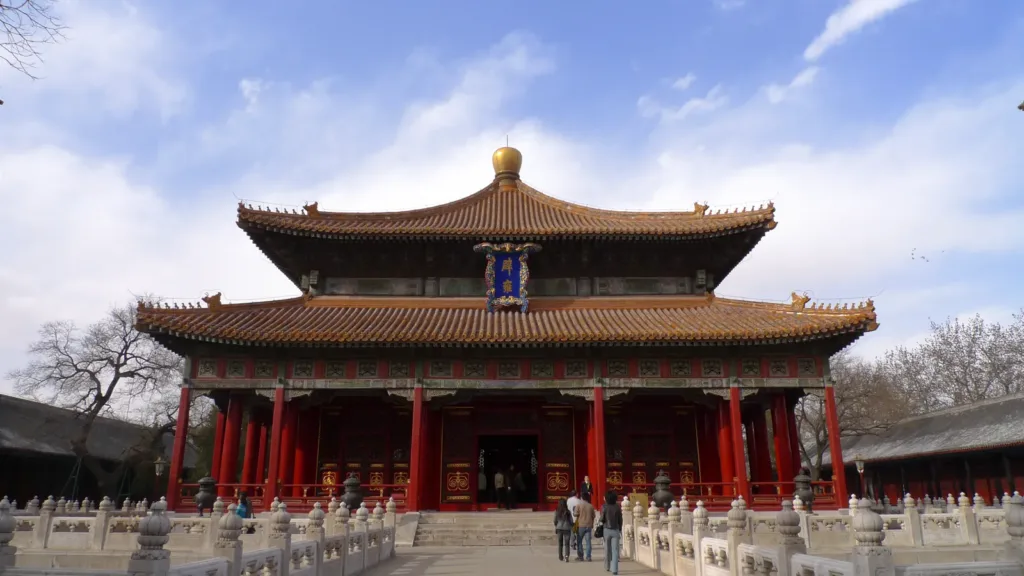
The most distinctive building is Biyong Hall (辟雍), completed in 1783 during the Qianlong reign. Its double-eaved roof is covered with yellow glazed tiles; a pool surrounds the raised square hall, with bridges linking its four sides. The museum describes it as a hall built for imperial lectures. Look for the contrast between the pavilion-like hall and the ring of water, and notice how the open approaches frame it from several directions.
North of Biyong, Yilun Hall (彝伦堂) represents the academy’s teaching life. The glazed archway and bell-and-drum pavilions give the central route a ceremonial threshold before the lecture hall. These details are more useful than treating the site as a row of old roofs: the plan combines an educational institution with architecture that displayed imperial authority and respect for learning.
A practical route, with the repair notice in mind
The museum’s visitor guide gives the address as No. 15 Guozijian Street, Dongcheng District. Enter through the museum’s signed visitor entrance at that address and follow current on-site directions. Its published guide does not set out a guaranteed one-way entrance-and-exit route; do not assume an internal side gate will be open.
A museum notice dated 12 April 2026 says repair work would proceed in stages on Yilun Hall, Biyong Hall, the glazed archway and Taixue Gate, and that the affected work areas would be closed during construction. The notice gives no completion date. Check the museum’s latest announcement before travelling, and be prepared to view these buildings only from accessible boundaries or to find that a planned section is closed.
If the central route is open, an editorial 45–75 minutes is a reasonable allowance for a focused academy visit; take longer if you read the inscriptions and exhibitions. This is a planning suggestion, not an official duration. Add time separately for the adjacent Confucian Temple, which has its own sequence of courtyards and ritual buildings.
Opening, tickets and arrival
The museum currently lists opening hours of 09:00–17:00, with last admission at 16:30. It closes on Mondays except during holiday periods. Adult admission is CNY 30; eligible full-time university and college students pay CNY 15 with a valid student card. The museum directs visitors to its official WeChat account’s “票务服务” ticketing menu; tickets for visits within the next three days, including same-day tickets, are offered there, with dates updated at 19:00. The museum says it has not authorized third parties to sell tickets. Confirm availability and the day’s conditions in the official channel.
For public transport, the museum lists Yonghegong on Metro Lines 2 and 5. It also lists bus stops at Guozijian, Yonghegong and Andingmennei; routes can change, so check a current transit app for the final approach. The guide gives no station-exit letter or walking time, so follow current street signs rather than relying on an unverified exit number.
For a wider neighborhood walk, pair the academy with the adjoining Confucian Temple, then choose other nearby cultural stops according to your map and available time. Yonghe Temple is a separate religious site with its own visitor arrangements; it is not part of the Guozijian compound or ticket information described here.
Combine your visit
Suggested order within this visit:
-
Academy courtyards
Begin with the institution’s educational setting.
-
Biyong Hall
Concentrate on the imperial lecture and ceremonial focus.
-
Temple of Confucius北京孔庙
Compare the adjoining ritual purpose with the academy’s teaching role.
This sequence is an editorial suggestion based on the features described in the sources. Access to individual buildings or areas should be checked locally; no travel time or shared admission is implied.
Find Guozijian
国子监 · 东城区
The pin marks the area, not the entrance.
More places nearby
Approximate straight-line distances between map pins, not travel distances.
Temple of Confucius, Beijing 北京孔庙
Less than 1 km awayBeijing’s Temple of Confucius occupies a sequence of enclosed courtyards beside the imperial academy on Guozijian Street. Xianshi Gate, Dacheng Gate, Dacheng Hall, and Chongsheng Temple organize the main axis, while the…
View guide →Yonghe Temple 雍和宫
Less than 1 km awayYonghe Temple, also called the Lama Temple, began as a Qing prince’s residence and later became a Tibetan Buddhist monastery. That history is visible in the procession of courtyards and major halls along a north–south axis…
View guide →Temple of Earth 地坛
Less than 1 km awayThe Temple of Earth, or Ditan, stands outside the northern edge of Beijing’s former inner city near Andingmen. Its central Fangze Altar uses a square plan to express the traditional association between the earth and that shape…
View guide →Sources & visit information
Visitor details checked on 21 October 2026. Hours, tickets, reservations and transport can change; confirm with the operator before you go.
- Confucian Temple and Imperial College Museum visitor guide ↗
- Piyong Hall — museum architectural description ↗
- Confucian Temple and Imperial College Museum — historic overview ↗
- Beijing municipal government: Confucian Temple and Imperial College Museum ↗
- Confucian Temple and Imperial College — museum English overview ↗
- Guozijian central-courtyard repair notice, 12 April 2026 ↗
Image credits & notes (1)
- Piyong Hall stands on a raised platform at the heart of the academy. Photo: Peiyu LiuPhoto: CC BY-SA 2.0