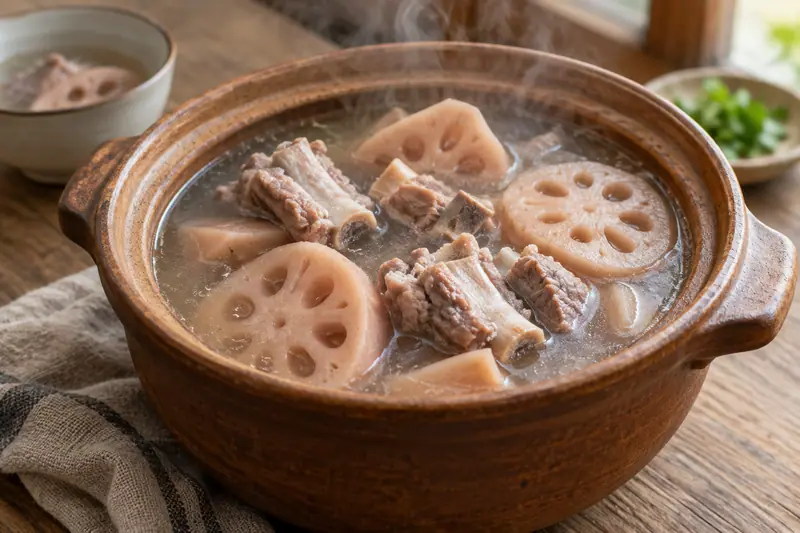
Slow-Simmered Pork Ribs with Lotus Root 莲藕煨排骨
Slow-Simmered Pork Ribs with Lotus Root is featured among the local specialties of Hubei.
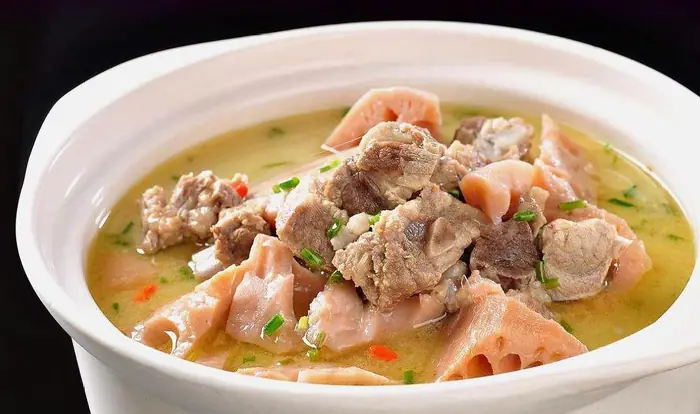
Image notes
Resized for the web; the photo itself has not been edited.
Slow-Simmered Pork Ribs with Lotus Root (莲藕煨排骨) puts the Hubei cooking verb first: lotus root and pork ribs, simmered slowly, as the dish is understood in Ezhou in south-eastern Hubei.
What wei means here
Wei is one of the techniques Hubei cooking is built on, along with steaming, frying, braising and stir-frying. It means a long, gentle simmer in a heavy pot rather than a rolling boil: the liquid barely moves, and the point is to let root and bone give up their flavour without the meat toughening.
The classic vessel for this in Hubei is the wide-bodied clay pot called a diaozi. Ribs and lotus root go in together, water is added, and the pot is left for hours until the meat loosens from the bone and the root softens and thickens the liquid. Everything about the dish is decided by time rather than by added seasoning.
What it tastes like
The pairing is deliberately plain. Pork ribs give a clean, slightly sweet meat base, and lotus root gives body and a faint earthy sweetness as it breaks down. Seasoning is limited to salt and a little ginger in the plainest version.
Compared with a bowl of soup, this reading of the dish is tighter and less liquid: the sauce coats the ribs instead of filling a bowl. That is why the technique is in the name — ordering it signals a braise rather than a soup course.
Where it belongs
Ezhou is in the south-eastern part of Hubei, the same general corner that the province's cuisine literature groups around Huanggang, Xishui and Xianning, an area that leans on vegetables, beans and grain rather than on banquet seafood. Rice and freshwater produce are the everyday staples, and lotus root from the region's lakes is an ordinary kitchen vegetable.
That is the setting for a dish like this: a household pot built from a cheap cut of pork and a root vegetable, cooked long enough that both become soft. It is not a restaurant invention and has no fixed recipe beyond the pairing.
Ingredients and dietary questions
Ribs, lotus root and water are the core, with salt and ginger as seasoning. Some cooks add a little rice wine, a few peppercorns or a piece of kelp; others add nothing at all.
Ask whether the kitchen uses ribs or a fattier cut, since that decides how rich the pot is. The dish is a meat braise and is not suitable for vegetarians, and lotus root is a starchy vegetable rather than a low-carbohydrate one.
How to order it
Say lian ou wei pai gu (莲藕煨排骨). In Ezhou and the surrounding part of Hubei it appears with the clay-pot and home-cooking dishes, and it is ordered for sharing.
Ask whether the pot comes with broth or is cooked down, because the name is used loosely: some kitchens serve it as a soup, others as a tight braise. If you want the root soft, ask whether the kitchen is using winter lotus root.
How it reaches the table
The pot arrives at the centre of the table, and diners take ribs and root into their own bowls, spooning a little of the cooking liquid over rice. The root is best eaten while hot, when it is at its softest.
For a shared meal, one clay pot plus a stir-fried green vegetable and a cold dish is a comfortable order for two or three people. Served on its own it is a light meal rather than a full one.
More dishes to compare
Explore related local specialties and compare their names, preparation notes and ordering guidance.
Lotus Root and Pork Rib Soup 莲藕排骨汤 →
Lotus Root and Pork Rib Soup names the finished soup, and it is the dish that Hubei's own signature-dish list includes. Lian Ou Wei Pai Gu names the cooking method — wei, the long low simmer — and is used in Ezhou for the same lotus-root and rib pairing. When they meet on one menu, the reliable difference is how much liquid the kitchen leaves in the pot and how much the root has broken down, so ask before choosing.
Questions before you order
Is Slow-Simmered Pork Ribs with Lotus Root a soup or a braise?
It is usually a braise with some liquid rather than a soup course, because wei describes slow simmering and the name does not promise broth. Kitchens vary, so ask whether the pot is served wet or cooked down.
Does it need special lotus root?
Winter lotus root is preferred in Hubei for slow cooking because the segments are fatter and higher in starch, and they soften instead of staying crisp. Outside that season the root will be firmer.
Source introduction: Wikipedia contributors: 楚菜 · CC BY-SA 4.0 (Wikipedia text, attribution required). English guide adapted from the cited material, with additional preparation and ordering guidance.
Source introduction: Wikipedia contributors: 煨汤 · CC BY-SA 4.0 (Wikipedia text, attribution required). English guide adapted from the cited material, with additional preparation and ordering guidance.