

Cantonese Sweet and Sour Pork 咕噜肉
Cantonese Sweet and Sour Pork is featured among the local specialties of Guangdong.
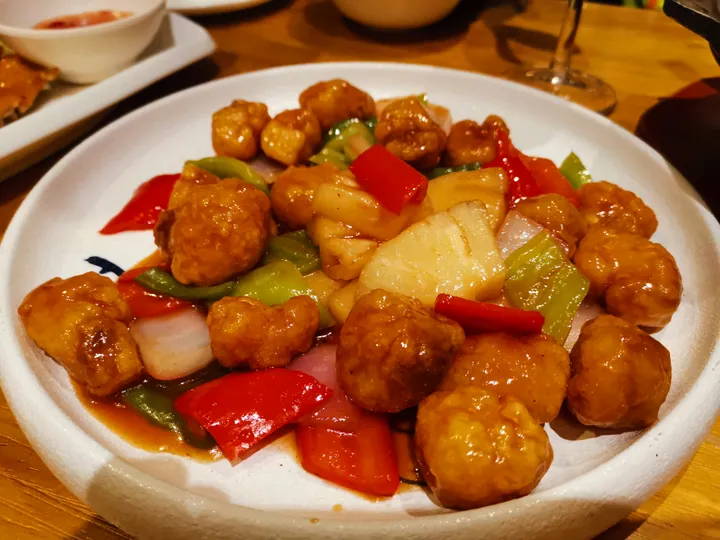

Photo adjustments
Full frame retained; proportionally resized and converted to WebP. No retouching or changes to the photographed subject. Card displays may crop the view.
Cantonese Sweet and Sour Pork (咕噜肉) is a Cantonese dish of boneless pork that is fried crisp and coated in a sweet-and-sour sauce. It is also called gulao rou (古老肉, "old pork"). The Guangzhou city government lists it among the city's specialty dishes and dates it to the Qing dynasty.
Where it comes from
The Guangzhou city and Guangdong provincial governments tell the same story. In the Qing dynasty many foreigners living in Guangzhou liked sweet-and-sour spare ribs but were not used to spitting out bones, so Cantonese cooks mixed boneless lean pork with seasoning and starch, shaped it into large balls, deep-fried them until crisp and coated them in sweet-and-sour sauce. The reworked dish was renamed "old pork", and foreigners who could not pronounce the name turned it into "gulu rou"; the two names have been used side by side ever since.
The Guangdong provincial government adds that during the Qing, Europeans and Americans in China came into contact with Guangdong, and so with Cantonese food, before other regions and liked its sweet-sour taste, and that Cantonese emigrants later opened restaurants in Europe and America. Many Chinatown restaurants around the world serve the dish, usually with plain or fried rice, and it is a common dish in Hong Kong restaurants, cha chaan teng cafes and fast-food shops.
How it is made
The Guangdong government recipe uses pork tenderloin cut into 1.5 cm cubes and marinated for 30 minutes in soy sauce, black pepper, salt, starch and oil. The cubes are coated in beaten egg, rolled in flour and deep-fried over medium heat for three to five minutes. The sauce is ketchup, rice vinegar, soy sauce, sugar and water, brought to the boil and thickened with starch; the pork goes back into the wok with chunks of pineapple and green and red pepper and is tossed quickly until coated. The Guangzhou city government notes that the version most often seen is made with tinned pineapple.
Flavour and texture
The Guangzhou city government describes it as sweet and sour, with a springy bite. Chinese Wikipedia sets out what a well-made plate looks like: the glaze just coats the meat and leaves no thin sauce on the plate, lifting a piece with chopsticks pulls the glaze into threads, and the outside of the pork stays crisp instead of turning soggy. The same article says the dish is usually made with pork shoulder, and that the method also gives dishes such as sweet-and-sour chicken, prawns and fish.