

Jun'an Steamed Whole Pig 均安蒸猪
Jun'an Steamed Whole Pig is featured among the local specialties of Guangdong.
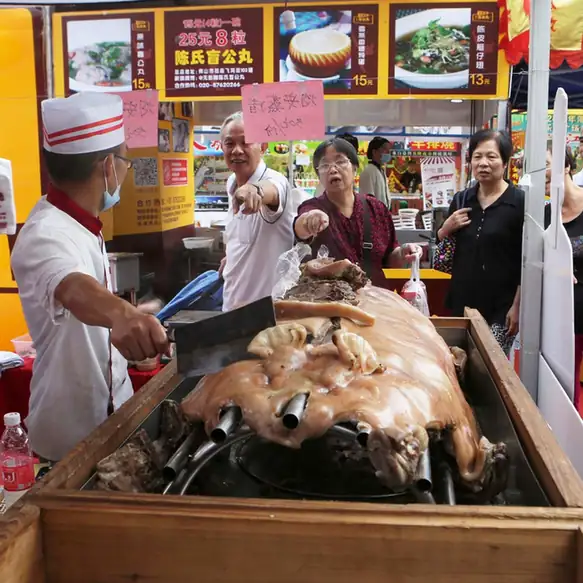
Photo adjustments
EXIF orientation normalized; resized without changing aspect ratio; converted to WebP. No subject edits.
Jun'an Steamed Whole Pig (均安蒸猪) is a whole pig, boned and seasoned, then steamed in one piece in a wooden box over a wood-fired wok. It comes from Jun'an (均安) in Shunde (顺德), where it has been made for more than a century. Yangcheng Evening News (羊城晚报) reported in 2019 that it was once eaten mainly at ancestral-hall rites. It has become one of the dishes seen most often in Shunde, served at village banquets as well as in upmarket restaurants.
Where it comes from
A widely told local story traces the dish to Li Wentian (李文田), a Qing-dynasty scholar-official from Jun'an who served in the north and, on retiring, brought home the Manchu practice of offering pork in sacrifice. Steamed pig then became a regular part of Jun'an's ancestral-hall rites, including the spring and autumn rites held at Qingming and Chongyang, after which the pork is shared out among the lineage's men. The Shunde Jun'an gazetteer (顺德均安志) notes that most of Shunde used roast pig for these rites, while Jiangwei (江尾), today's Jun'an, used steamed pig.
Shunde set a written standard for making it in 2016. The technique was listed at Shunde district level and, in September 2019, entered Foshan's seventh municipal list of intangible cultural heritage.
How it is made
Li Yaosu (李耀苏), fourth generation of a Jun'an steamed-pig family, describes the traditional method. A pig of about a hundred jin (roughly 50 kg), neither too fat nor too lean, is slaughtered and boned, then opened from the belly and cut into large pieces that stay joined together. It is washed and hung until dry, sprinkled evenly with a seasoning of salt, sugar, five-spice powder and the master's own additions, and left for about two hours. Stray bristles are then singed off the skin.
The pig lies on an arched, slatted rack inside a rectangular China-fir box with four small vents around the base and a large round hole in the middle. The box sits in an extra-wide iron wok over a wood fire, and steam from the boiling water below rises into it; the heat stays high throughout. The step Li counts as most important is releasing the fat, which the oldest method did not have: during steaming the cook uses steel needles to release the excess fat, then rinses the pig with cold water. A pig of over a hundred jin ends up at less than half its starting weight.
Flavour and texture
The skin is crisp and the meat smooth and tender, fatty without tasting greasy, with the five-spice seasoning soaked right through. It is eaten with sesame.
Sources & reading
Written from the linked sources and checked sentence by sentence against quoted extracts by a separate reviewer on 2026-09-23. Recipes and servings vary between kitchens.