

Gaoming Pressed Rice Noodles 高明濑粉
Gaoming Pressed Rice Noodles is featured among the local specialties of Guangdong.
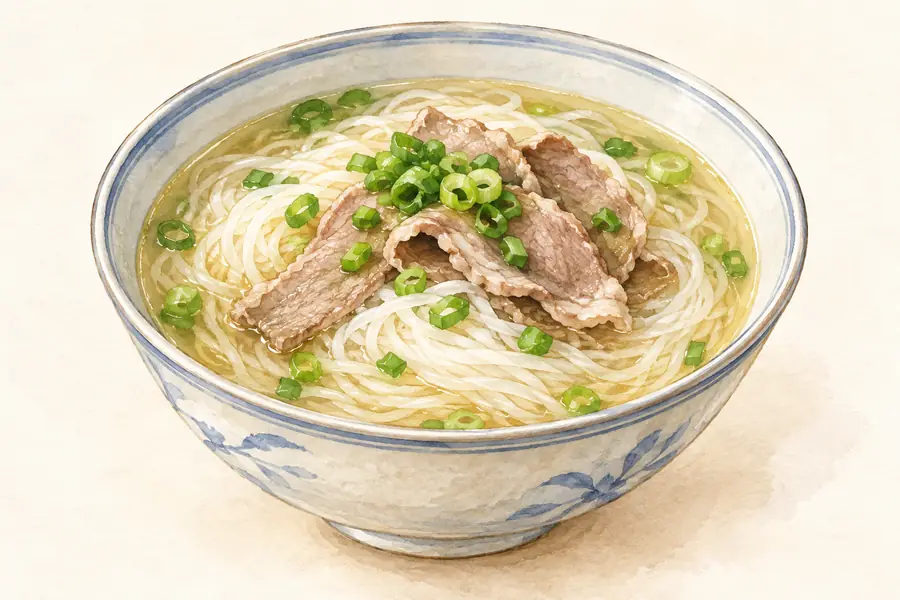
Gaoming Pressed Rice Noodles (高明濑粉) are long, soft rice noodles from Gaoming District (高明区) of Foshan (佛山), Guangdong, served in a slow-simmered broth. The lai (濑) in the name is taken from the image of water running over fine sand. Most Gaoming families make them for festivals.
How it is made
The noodles are made from non-glutinous rice flour. The craft has six stages, among them milling blended flour, working the dough (开粉), testing the batter and streaming the noodles; a good batch takes three to four hours. Working the dough gives a very elastic batter, which is poured through a seven-holed bowl, wide at the mouth and narrow at the base, so that strands drop into water kept just below the boil, "shrimp-eye water" (虾眼水). Once cooked, the noodles are soaked in cold water. In the villages, newly harvested late-season rice is pounded into flour after November, dried and sealed in jars to keep for the year's celebrations.
How it is eaten
A bowl of laifen is dressed with shredded meat, egg ribbons and shredded ginger in a stock slow-cooked from pig's liver, lean pork and bones, then finished with a handful of peanuts, a little minced garlic and chopped spring onion and ginger. The strands are long and soft but springy and slippery. Because laifen stands for a long and happy life, laifen is a fixture at Gaoming celebration banquets and is still eaten in the villages at weddings, when a child goes on to further study, at the Mid-Autumn Festival and on New Year's Eve.
Where it comes from
One local story says that in the Chenghua reign (成化) of the Ming dynasty, when Yao (瑶) and Han people lived side by side in the Gaoming area, the Han learned laifen from their Yao neighbours. The Nanfang+ report on its heritage listing instead dates the craft to the Jiajing reign (嘉靖), close to 500 years ago. Gaoming has held a Ten-Thousand-Person Laifen Festival (万人濑粉节) every year since 2007, and the Gaoming laifen making technique (高明濑粉制作技艺) entered Foshan's eighth list of municipal intangible cultural heritage in 2024.
Sources & reading
Written from the linked sources and checked sentence by sentence against quoted extracts by a separate reviewer on 2026-09-23. Recipes and servings vary between kitchens.