

Mugwort Rice Cakes 艾粄
Mugwort Rice Cakes is featured among the local specialties of Guangdong.
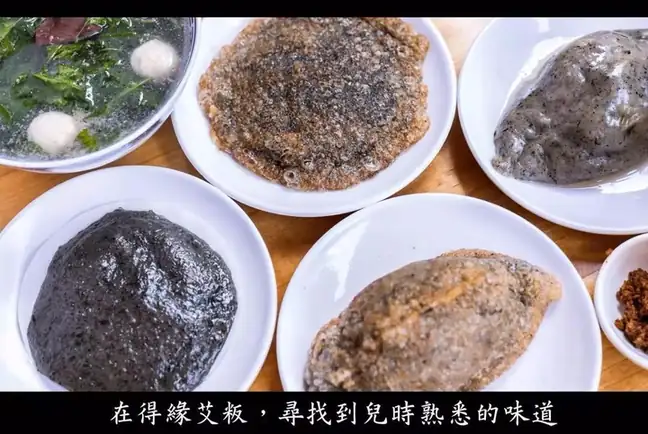
Photo adjustments
EXIF orientation normalized; resized without changing aspect ratio; converted to WebP. No subject edits.
Mugwort Rice Cakes (艾粄) are steamed cakes of glutinous rice flour coloured and flavoured with young mugwort leaves, eaten in Huizhou (惠州), Guangdong, around the Qingming (清明) festival. Huizhou people also call them aiciba (艾糍粑), and a saying long current in Hakka areas holds that eating them around Qingming keeps you from falling ill all year.
How it is made
Spring, around Qingming, is when mugwort grows best. People pick only the tenderest tips of the leaves, blanch and chop them into a green mash (艾绒, airong), and knead it with glutinous rice flour and sugar into a dough; some cooks add ordinary rice flour as well. A piece of dough is shaped into a wrapper around the filling, rolled round and pressed a little flat, and the cakes are steamed on banana leaves, for about 20 minutes according to a China Overseas Chinese Network (中国侨网) report from a Huizhou market.
Traditionally the fresh leaves are rubbed hard on a clean scoop basket to work out the bitter juice. A stallholder in Huicheng District (惠城区) told the same report that she skips this and blends the leaves with boiled water in a juicer, because she prefers the plant's own flavour; those who dislike the bitterness can scald the leaves in boiling water first.
Ingredients
Plain cakes are just mugwort, sugar and glutinous rice dough, pressed flat and steamed. Sweet fillings are toasted sesame with sugar, or ground sesame and peanuts; savoury ones use shredded radish, shallots and cured meats (腊味). At a market in Ma'an town (马安镇) the flat round cakes sat on green bamboo leaves beside aijiao (艾角), a mugwort dumpling shaped like a large jiaozi, with plain, radish and mung bean versions: the plain and mung bean ones sweet, the radish one savoury.
Flavour and texture
Freshly steamed, the cakes smell strongly of mugwort, with a thin, soft, sticky skin around a generous filling. The leaves give a grassy aroma, and the China Overseas Chinese Network report describes the taste as mellow at first, then sweet.
Where it comes from
Making and eating the cakes at Qingming goes along with honouring ancestors in Huizhou. In Suolao village (酥醪村), Changning town (长宁镇), Boluo County (博罗县), every household makes them for the festival; they have become one of the local foods visitors to the Luofu Mountain (罗浮山) scenic area most like to buy, and their making technique entered the Boluo County intangible cultural heritage list in 2022.
Sources & reading
Written from the linked sources and checked sentence by sentence against quoted extracts by a separate reviewer on 2026-09-23. Recipes and servings vary between kitchens.