

Pomelo Peel Pork Belly with Badu Bamboo Shoots 柚皮渡笋扣
Pomelo Peel Pork Belly with Badu Bamboo Shoots is featured among the local specialties of Guangxi.
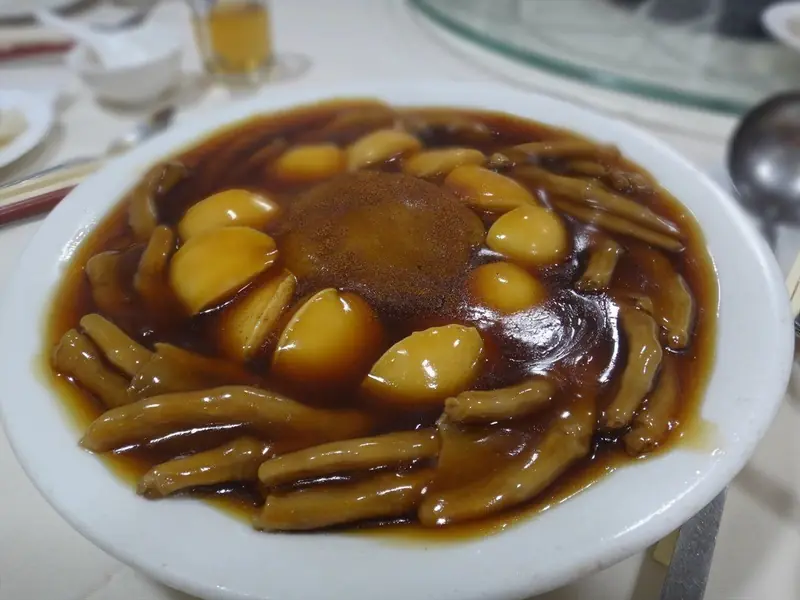
Image notes
Resized for the web; the photo itself has not been edited.
Pomelo Peel Pork Belly with Badu Bamboo Shoots (柚皮渡笋扣) joins two Guangxi specialities in one dish: the pomelo-peel pork of Rong County (容县) in Yulin (玉林), known as youpi kou (柚皮扣), and the Badu bamboo shoots (八渡笋) of Tianlin County (田林县) in Baise (百色). Yulin Daily (玉林日报) reports that the combined dish was named one of Guangxi's ten classic dishes at the "Chinese Cuisine" (中国菜) food festival in Zhengzhou in September 2018.
How it is made
The pomelo-peel pork at the heart of the dish starts with the peel of a fresh shatian pomelo (沙田柚), ideally a full, thick-skinned fruit. The peel is cut into pieces and the hard outer skin is pared away, leaving the spongy middle layer, which turns soft and chewy when cooked. This pith is blanched and soaked in fresh water again and again to draw out its bitterness; blanched too briefly it stays bitter, too long and it falls apart. Pork belly is fried into kourou (扣肉, pork belly for a layered dish), cut to the size of the peel pieces and marinated with soy sauce, sugar, cooking wine, ginger and spring onion. Peel and pork are then stacked in alternate layers in a clay pot, stock and seasoning are added, and the pot is simmered slowly over low heat. As it simmers, the pork fat soaks into the pith while the peel lends the pork its own fragrance.
Flavour and texture
Yulin Daily describes pomelo-peel pork as savoury, soft and rich without being greasy. The golden peel and glossy red pork come to the table in layers; the peel is soft with a little bite and keeps its fresh scent, and the pork melts in the mouth.
Where it comes from
Rong County's pomelo-peel pork dates back to the Qianlong reign (1736–1795) of the Qing dynasty, more than 200 years ago, and carries the elegant name "snow over a five-storey tower" (雪盖五层楼). In Rong County it is always on the table at Spring Festival and Mid-Autumn meals, weddings and house-warmings. The combined dish also took one of ten gold awards for speciality dishes at the Guangxi culture and tourism department's 2021 intangible-heritage food competition, held over the Zhuang Sanyuesan (三月三) festival, where it was entered by a restaurant in Youjiang District (右江区), Baise.
Sources & reading
Written from the linked sources and fact-checked against them on 2026-09-26. Recipes and servings vary between kitchens.