

Raw-Ingredient Rice Noodle Soup 生料粉
Raw-Ingredient Rice Noodle Soup is featured among the local specialties of Guangxi.
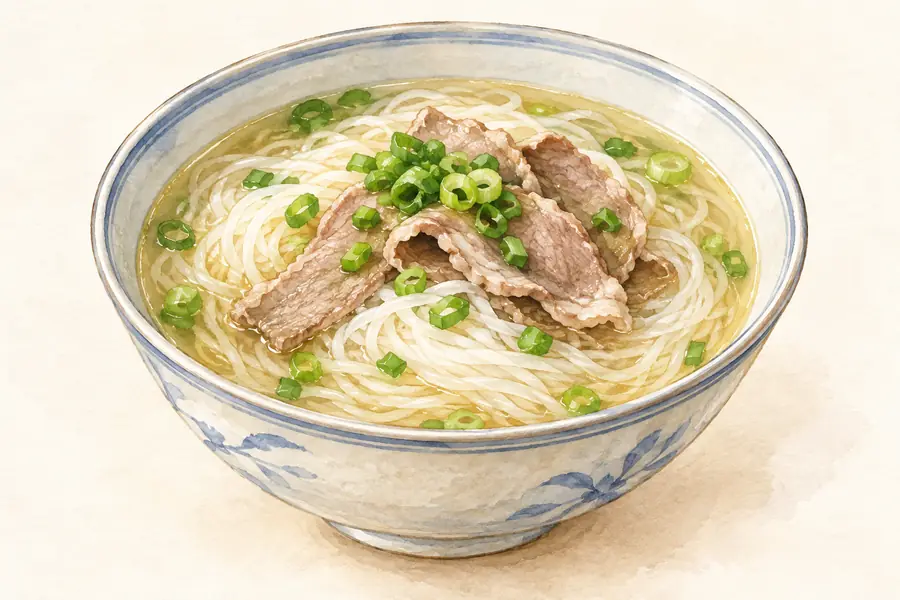
Raw-Ingredient Rice Noodle Soup (生料粉) is a Yulin (玉林) rice-noodle soup in which raw pork offal, lean pork or fish slices are blanched in pork-bone stock and cooked with the noodles one bowl at a time. The Yulin city government's food pages present it as a traditional local dish known above all for freshness.
How it is made
The raw toppings must be bought the same day. They are usually pork liver, pork intestine, pork kidney, lean pork and fish slices, and shopkeepers start buying and preparing them in the small hours. Before cooking they are marinated in local rice wine, which is slightly sweet with a clear rice aroma; it takes away the raw smell of the meat and offal and adds a fragrance of its own. The Yulin city government's feature names this marinade as an important mark that sets the dish apart from other local noodle snacks.
Each portion is cooked in its own iron ladle-shaped pot. The raw toppings go into boiling pork-bone stock for a quick blanch, then the rice noodles go in and are stirred briefly so they take up the stock; the bowl is ready after about four or five minutes.
Flavour and texture
Yang Tong'an, head of the Yuzhou District (玉州区) cooking association, calls the pork-bone stock the soul of the dish: it is rich and mellow without greasiness, and whether it tastes fresh and sweet is one of the standards by which a bowl is judged. Every shop or stall sets out pickled radish, pickled papaya, coriander, lemon and chilli, to be eaten between mouthfuls of noodles.
Where it comes from
Local tradition dates the dish to the late Qing and early Republic, first at the Chuanbu wharf (船埠码头) in what is now Fumian (福绵). The wharf was then a salt-trading market town, and dockers and porters wanted a quick, cheap, filling meal: fresh offal or beef cut to order, scalded in stock and scattered with spring onion. Porters carrying goods into Yulin town took the habit with them. By the 1930s and 1940s it had spread across the five counties then under Yulin, with toppings varying by local taste. A local saying calls a bowl of it "half of Yulin's history" (一碗生料粉,半部玉林史).
The range of toppings keeps widening. One large Yulin noodle shop offers more than ten kinds of fresh toppings, among them pork tongue, pork brain, bone marrow, yellow catfish, crucian carp and beef intestine, with a choice of thick rice noodles, flat he fen or ordinary rice noodles.
More dishes to compare
Explore related local specialties and compare their names, preparation notes and ordering guidance.
Guilin rice noodles 桂林米粉 →
Both are Guangxi rice-noodle dishes; the Yulin bowl is cooked one pot per customer, with raw toppings marinated in rice wine and blanched in pork-bone stock just before the noodles go in.
Sources & reading
Written from the linked sources and fact-checked against them on 2026-09-24. Recipes and servings vary between kitchens.