

Explore the region
A garden exposition with a life after the fair
The 2019 China Beijing International Horticultural Exhibition ran from 29 April to 7 October 2019, a 162-day event. After it closed, the site was renamed Beijing Expo Park in April 2020 and retained major buildings, outdoor gardens and public green space. The park occupies 503 hectares in southwest Yanqing; 132 hectares are water, and the Gui River crosses the grounds against the Haotuo mountain backdrop. This is a substantial landscape park, not a compact group of halls.
Read the buildings as part of the garden
Start with the China Pavilion, the main national exhibition hall. The operator frames its design through “splendid horticultural feeling” and a “Ruyi China dream,” and its exhibition concept around “ever-growing life” and a “splendid China”: ecological culture, regional horticulture, plant-related research and traditional flower arranging were presented through a mix of objects and immersive media. These describe the exhibition concept, not a guarantee that the same rooms or displays remain open today.
The International Pavilion offers a different architectural reading. Its roof is formed by 94 umbrella-like structures, giving the building a flower- or snowflake-like outline when seen from the gardens. Look at it from outside as well as from any currently accessible interior: its open, repeated canopy makes the international exhibition hall feel lighter than the China Pavilion.
The Botanical Pavilion turns the building itself into an ecological idea. The operator describes its “rising horizon” form and a plant-growth narrative that begins with the force of roots. The Living Experience Pavilion was conceived as a “rural market,” with intersecting paths and a flexible, garden-meets-city layout. The Guirui Theatre’s flowing, butterfly-like form sits by Gui Lake. Together, these buildings show how a horticultural fair used architecture, plants and water as one exhibition rather than as separate attractions.
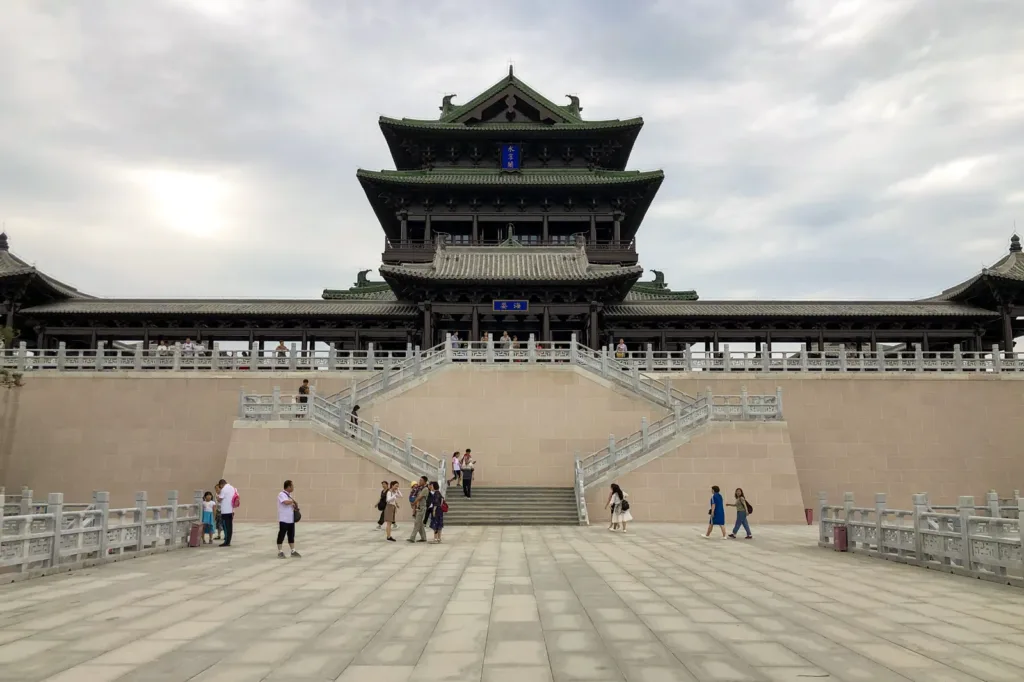
For a change of scale, walk or ride to Yongning Pavilion, on the hill at the park’s northwest side. The operator describes this roughly 27-metre, multi-tiered tower as a high point from which visitors can look south toward the Great Wall, north toward the mountains and down over the river and park. Confirm that the route and tower access are open on the day; do not make an interior climb the sole reason for visiting.
How to explore a very large site
A half-day is a sensible starting point. The Beijing tourism listing recommends four to five hours; treat that as a planning reference, not a fixed visit duration. A practical editorial route is to begin at the entrance printed on the current ticket, spend the first part of the visit among the accessible central pavilions and garden plots, and reserve the hilltop Yongning Pavilion for the end if the park map, weather and operating notices support the extra walk. The grounds cover 503 hectares, so trying to see every garden and building on foot can turn the visit into a long-distance march.
Use the outdoor regional gardens to notice differences in planting, layout and local horticultural motifs; the exposition’s landscape retains Chinese and international garden areas as well as its principal buildings. Indoor halls and temporary exhibitions have separate operating needs, so treat each as an optional branch rather than assuming that a pavilion exterior means its galleries are open. Check the current park map and notices before choosing a route.
The park’s published daytime listing gives operating hours of 09:00–17:00, with ticket inspection until 16:30. It lists a separate 17:00–22:00 night-operation period, which should be treated as program-dependent rather than as a promise that every evening or every indoor venue is open. The adult admission listed on the Beijing tourism page checked for this article is CNY 60. Prices, reservation requirements, event tickets and pavilion access can change; use the operator’s current online ticketing and notice pages for the date you plan to go. The city’s park-service record classifies entry as reservation-required and paid, but it is a service listing rather than a live booking calendar.
Getting there and choosing a gate
The official address is 1 Baikang Road, Yanqing Town, Yanqing District, Beijing. The park is in the city’s northwestern ecological-conservation area, about 74 km from central Beijing according to the municipal park listing; allow for a substantial intercity journey rather than planning it as a quick central-city stop.
For a recent public-transport approach to the resort, Beijing Daily reported that visitors can take the Beijing–Zhangjiakou high-speed railway to Yanqing Station, or take the 919 Express bus to Yanqing Nancaiyuan and continue by taxi to Gate 4. That report was written for a venue inside the resort, so confirm that Gate 4 is the gate assigned for your park ticket or event. It also reported Gate 4 as the closest approach to that venue, not as a universal entrance for every attraction.
The resort has multiple gates and a large internal landscape. Check the gate printed on the ticket or named in the event notice, and confirm the exit arrangement before committing to a one-way walk toward a distant pavilion. Do not use transport instructions from the 2019 exposition as a current shuttle timetable.
Combine your visit
Suggested order within this visit:
-
China Pavilion exterior
Begin with the principal retained exposition landmark.
-
Outdoor regional gardens
Continue through a selected group of garden plots between the major buildings.
-
International Pavilion exterior
Finish with the contrasting flower-canopy architecture; interior events have their own access arrangements.
This is an editorial sequence among documented features. Gallery access, temporary displays and admission arrangements should be checked with the venue.
Find Beijing Expo Park
北京世园公园 · 延庆区
The pin marks the area, not the entrance.
More places nearby
Approximate straight-line distances between map pins, not travel distances.
Badaling 八达岭长城
11 km awayBadaling is a restored mountain section of the Great Wall in Yanqing, guarding the approach toward the Juyongguan corridor. Its broad masonry, crenellations and successive watchtowers make the wall's defensive design easy to…
View guide →Longqing Gorge 龙庆峡
14 km awayLongqing Gorge is a reservoir-filled canyon near Gucheng village in Yanqing. Narrow rock faces rise above the water, so the landscape is read from the dam and the gorge rather than from a broad open lake shore. A distinctive…
View guide →Guyaju Caves 古崖居
15 km awayGuyaju preserves chambers cut into a cliff face near Dongmenying in Yanqing. The close-packed openings occupy several levels, creating an appearance more like a stone-built settlement than a single cave. Some spaces are simple…
View guide →Sources & visit information
Visitor details checked on 21 October 2026. Hours, tickets, reservations and transport can change; confirm with the operator before you go.
- Beijing Expo Park — Beijing Municipal Forestry and Parks Service ↗
- Park guide — Beijing Expo International Tourism Resort ↗
- China Pavilion — Beijing Expo International Tourism Resort ↗
- Beijing Expo Park — Visit Beijing ↗
- Transport guide to a venue inside Beijing Expo International Tourism Resort — Beijing Daily ↗
- 2026 Beijing Road Cycling Open — Beijing Municipal Government ↗
Image credits & notes (1)
- Yongning Pavilion at the 2019 Beijing horticultural exposition site, now Beijing Expo Park. Photo: N509FZPhoto: CC BY-SA 4.0