

Fuling Red-Heart Radish Stewed with Cured Pork 涪陵红心萝卜炖腊肉
A Fuling-associated winter dish pairing vivid, locally distinctive red-heart radish with the salty depth of Chinese cured pork. In a gentle stew, the radish softens and the meat seasons the broth; recipes and the amount of smoke, fat and seasoning vary by household and kitchen.
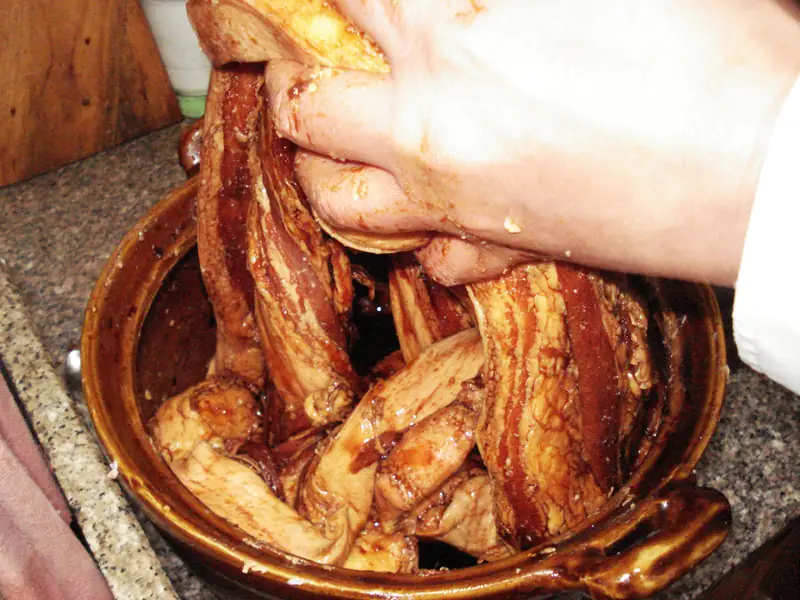
A Fuling ingredient, not a single fixed recipe
The name 涪陵红心萝卜炖腊肉 (Fuling red-heart radish stewed with cured pork) joins two ingredients: Fuling’s red-heart radish, also called 胭脂萝卜 (rouge radish), and 腊肉 (làròu), pork preserved by curing. The radish is a recognized Fuling specialty and a Chongqing geographical-indication agricultural product. Its skin and flesh are red, and the crop is grown chiefly in Fuling District. It is better known locally as a pickle ingredient than as a dish with one documented, standard recipe. The original food listing places this named preparation among Fuling specialties, but does not establish how widely it is served or a canonical formula.
The radish is harvested in batches from late September into February, making it especially associated with the cool-season table. That is a crop season, not a promise that a restaurant will have the fresh vegetable or this dish on a particular day.
What goes into the pot
At its simplest, the dish uses red-heart radish, cured pork and water or stock. A home-style method for radish stewed with Sichuan cured pork first simmers the meat, then cooks cut radish in some of that savory liquid before returning the pork to finish; ginger and scallion may be used, and added salt depends on how salty the pork is. This is a useful description of one common cooking approach, not proof of a fixed Fuling recipe. A kitchen may instead brown the pork, use larger chunks, add aromatics, or season the broth differently.
Slow, moist cooking lets the radish turn tender while the pork’s salt, rendered fat and cured aroma move into the broth. Expect a mellow, lightly sweet vegetable against a more assertive, savory piece of meat; the exact balance depends on the cut and cure. The red vegetable may lend color to the cooking liquid, but the broth’s shade is not a reliable test of authenticity. Some versions are clear and lightly seasoned; others are richer or more aromatic.
How to enjoy it
Eat it hot, alternating radish and pork, and spoon a little broth over rice if the kitchen serves it as a shared stew. Since cured pork can be quite salty, taste the broth before adding any extra seasoning. Ask whether the kitchen uses fresh 涪陵红心萝卜 or another radish, and whether the pork is smoked; neither the exact meat cure nor side ingredients can be assumed from the dish name alone.
Look for the Chinese name 涪陵红心萝卜炖腊肉 on menus in Fuling District, but treat it as a lead rather than a guarantee of current availability. This is a regional food description, not a recommendation for one fixed restaurant.
More dishes to compare
Explore related local specialties and compare their names, preparation notes and ordering guidance.
Gan Shui Luo Bo Gan Chao La Rou 赶水萝卜干炒腊肉 →
Gan Shui Luo Bo Gan Chao La Rou (赶水萝卜干炒腊肉) is listed among the local specialties of Qijiang District, Chongqing. 腊 describes curing.
Cheng Kou Tu Dou Dun La Rou 城口土豆炖腊肉 →
Cheng Kou Tu Dou Dun La Rou (城口土豆炖腊肉) is listed among the local specialties of Chengkou County, Chongqing. The name includes 土豆 (potato). 腊 describes curing.
Chengkou smoked cured pork 城口老腊肉 →
Traditional Chengkou production uses slow smoking in a raised curing space. The cured meat is subsequently cooked and sliced or incorporated into a hot dish. The pork has a concentrated smoky aroma and a firmer bite than fresh pork. Fatty and lean cuts offer quite different textures.
Sources & reading
Image credits & notes (1)
- Reference photo of a similar dish · 同类菜品参考照片A similar preparation is pictured; the local version may differ. 同类菜品参考照片,当地做法可能不同。Photo: sharon1987720 · CC0Resized for the web; the photo itself has not been edited. Thumbnails may show a cropped view.
