

Pingquan lamb soup 平泉羊汤
Pingquan lamb soup is a Pingquan City specialty built around lamb offal simmered with lamb bones and head, served with adjustable seasonings and Pingquan baked bread; its preparation technique is listed as a provincial intangible cultural heritage of Hebei.
Tap any red Chinese text to hear it in Mandarin.
Pingquan lamb soup is a local food of Pingquan City, the county-level city administered by Chengde. It was formerly called Bagou lamb offal soup (八沟羊杂汤), a name that still explains its central ingredient: assorted lamb offal rather than a plain lamb-meat broth. Local government descriptions pair it with baked bread and place its history in the old Bagou name; the claim of more than three centuries is a local tradition, not a precise date that can be independently fixed.
The bowl is defined by preparation as much as by its ingredients. Local accounts describe lamb offal cooked together with lamb bones and lamb head, with careful selection, fine cutting, a mature broth and a full set of accompaniments summed up by the phrase “选料精、入锅细、汤要老、辅料全.” The technique was reported as one of the projects in the sixth batch of Hebei provincial intangible cultural heritage in 2017; an earlier report records it in Chengde’s city-level heritage list in 2015. These listings recognize a preparation tradition, not one fixed recipe used by every shop.
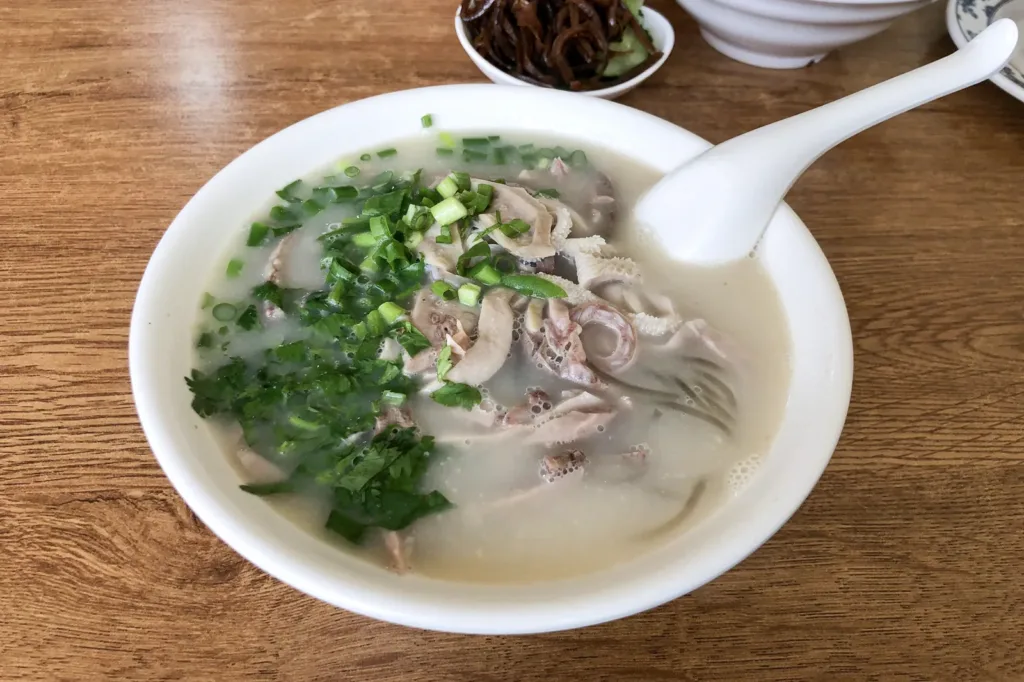
What to look for in the bowl
The local tourism account distinguishes 清汤 (a clearer soup) from 肥汤, in which lamb fat gives the broth a richer profile. Fresh coriander, pepper or chilli oil may be added when the bowl is assembled, and the usual partner is a hot baked bread that can be torn into the soup. Kitchens differ, so treat these as documented local styles rather than compulsory ingredients.
This is an offal-based meat dish, not a vegetarian option. Ask which cuts are included if you do not eat organ meats, and ask about the seasonings if you have an allergy. Historical accounts connect the technique with Pingquan’s Hui Muslim culinary tradition, but that history is not a substitute for checking a particular shop’s current food-handling or certification information.
Ordering and location
Show the Chinese name 平泉羊汤 Píng Quán Yáng Tāng when ordering. You can also ask for 清汤 Qīng Tāng or 肥汤 Féi Tāng, and ask whether the bowl will contain the offal you want. This entry describes a regional culinary tradition, not a verified current restaurant or a single branded serving. Individual shops, hours and ingredients therefore need to be checked locally on the day.
Pingquan is a separate county-level city within Chengde’s administrative area, not the urban centre of Chengde. The Pingquan government describes the city as a mountainous place at the Hebei–Liaoning–Inner Mongolia junction.
Where to eat it
You can find Pingquan lamb soup all over Hebei, so there is no need to seek out one particular restaurant. To find one near you, search for “平泉羊汤” in Meituan (美团) or Amap (高德地图) and check recent reviews, distance and opening hours.
More dishes to compare
Explore related local specialties and compare their names, preparation notes and ordering guidance.
Baiyunzhang-style buns 白运章包子 →
Seasoned beef or lamb is mixed with vegetables, aromatics and sesame oil, enclosed in thin wheat wrappers and steamed. The filling is worked with liquid so it stays juicy inside the pleated skin. A thin, tender wrapper surrounds a generous savory filling, with sesame fragrance and rich meat juices. The contrast is filling-led rather than bread-heavy.
Beef zhaobing 牛肉罩饼 →
Slices of cooked beef and pieces of flatbread are brought together with hot beef broth. The repeated contact with broth warms the bread and lets it absorb the meat's seasoning. The contrast is between tender beef, softened bread and a deeply savory liquid. The bread should retain some structure rather than disappear into a smooth porridge.
Sources & reading
Recipes and servings vary between kitchens.
Image credits & notes (1)
- A bowl of lamb offal soup photographed in Beijing, included only as a regional dish illustration for Pingquan lamb soup—not as a Pingquan shop photograph. Photo: N509FZ (Wikimedia Commons user)Photo: CC BY-SA 4.0