

Chengde fried buckwheat jelly 二仙居煎碗坨
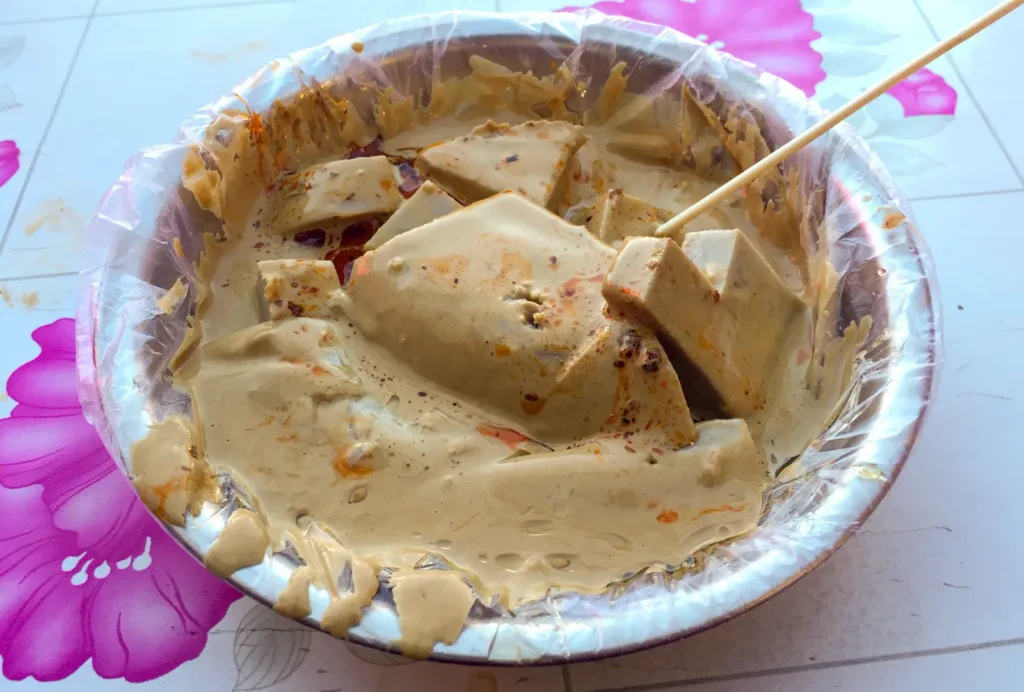
Erxianju jian wantuo (二仙居煎碗坨) is a Chengde snack made by cooking a buckwheat-and-mung-bean mixture into a firm set cake, slicing it, and pan-frying the pieces. Its smooth, springy bite is finished with sesame paste, garlic, vinegar and other seasonings; some versions use pig blood, so ask about the batch if that matters to you.
Tap any red Chinese text to hear it in Mandarin.
What to look for
The traditional mixture is based on buckwheat flour and mung-bean flour, with five-spice powder and ground Sichuan pepper. A maker wets and kneads the flours into a batter, cooks it while stirring until thick, then lets it cool and set. The set cake is cut into thin pieces and fried through on a griddle. Pig blood may be added in some versions; the local account specifically notes that it can be omitted for Hui diners.
The finished pieces are not a bowl of long buckwheat noodles. They are firm, smooth and slightly springy, with the direct heat of the griddle and a sharp-savoury dressing providing the contrast. Common accompaniments recorded in local sources are sesame paste, garlic juice, vinegar, soy sauce and sesame oil. Eat it hot and freshly dressed, before the sauce has softened the fried surface.
Why it belongs to Chengde
Chengde government and local tourism sources describe wantuo as a traditional Chengde snack linked to the city’s buckwheat-growing food culture and to the Erxianju area of the old city. They also preserve a Qing-era story in which the snack was carried to the Summer Resort during imperial visits. That court anecdote is best read as local food history; it does not turn every modern serving into a palace recipe.
The name to show when ordering is 二仙居煎碗坨 (Erxianju jian wantuo).
Dietary questions
This is not automatically vegetarian: pig blood is an explicitly documented optional ingredient, and the seasoning may include soy-based products and sesame. Ask 有没有猪血? Yǒu méiyǒu zhū xuè? (有没有猪血?, “Does it contain pig blood?”) and 能不能不放猪血? Néng bùnéngbù fàng zhū xuè? (能不能不放猪血?, “Can you leave out the pig blood?”). Also ask what is in the sauce if you have an allergy; recipes and toppings vary between kitchens.
Where to eat it
You can find Erxianju jian wantuo all over Hebei, so there is no need to seek out one particular restaurant. To find one near you, search for “二仙居煎碗坨” in Meituan (美团) or Amap (高德地图) and check recent reviews, distance and opening hours.
More dishes to compare
Explore related local specialties and compare their names, preparation notes and ordering guidance.
Donkey huoshao 驴肉火烧 →
Cooked donkey meat is chopped and packed into a split huoshao, a baked wheat bread. Baoding and other Hebei centers have differing bread shapes and serving habits. The bread provides a flaky or crisp edge against juicy, strongly savory meat, with added vegetables or peppers varying by seller.
Qizi shaobing 棋子烧饼 →
Small pieces of layered wheat pastry are filled, commonly with a savory meat mixture, and baked until browned. Their compact round shape gives them a resemblance to game pieces. The surface and layers are crisp and crumbly, enclosing a concentrated savory center. Sweet variants should be identified separately rather than assumed to taste the same.
Sources & reading
Recipes and servings vary between kitchens.
Image credits & notes (1)
- Wantuo in Jizhou, Tianjin, a regional buckwheat-based snack shown as a visual reference for the sliced, fried jelly described in the Chengde dish entry; this photograph is not of Chengde Erxianju jian wantuo. Photo: N509FZPhoto: CC BY-SA 4.0