

Crossing-the-bridge rice noodles 过桥米线
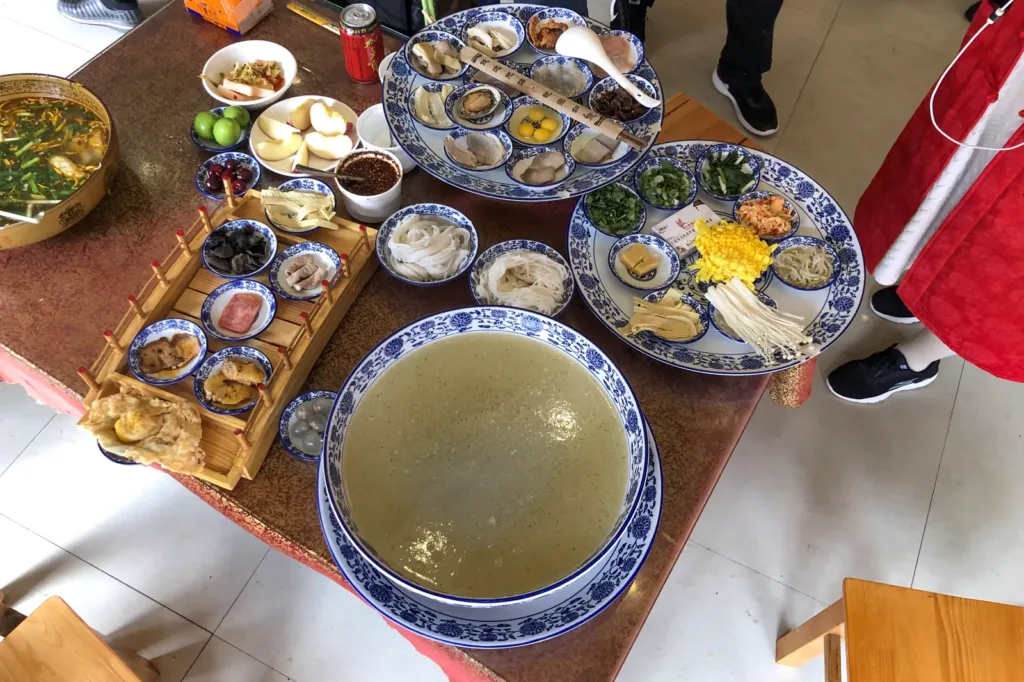
Crossing-the-bridge rice noodles, or guoqiao mixian (过桥米线), is a Yunnan meal built around very hot broth, smooth rice noodles, and separately served accompaniments. The style is associated with Mengzi in southern Yunnan rather than being a dish invented by Kunming; in Kunming it is a familiar Yunnan menu item.
Tap any red Chinese text to hear it in Mandarin.
What arrives at the table
A traditional set is easiest to understand as three parts: rice noodles, broth, and accompaniments. A Honghe government guide describes the noodles as fine, white, resilient and smooth, with a brief blanch before serving. The stock is commonly made with chicken and pork bones, and a layer of oil on top helps it retain heat.
That surface is part of the dish’s practical character. A bowl can look quiet while remaining extremely hot beneath the oil, so taste the broth cautiously and let the first spoonful cool. The old guide also advises following the restaurant’s instructions when the ingredients arrive separately.
Ingredients, texture and variation
The traditional ingredient list is not a single fixed recipe. The local account names thin slices of chicken breast, pork loin, liver, kidney, fresh fish and ham, alongside vegetables such as pea shoots, bean sprouts, chives, spinach and Chinese cabbage. Bean-curd skin, bamboo shoots, scallions and other accompaniments may also appear. An English Yunnan tourism guide gives the same broad structure as stewed chicken or goose soup, pork or fish slices, vegetables and rice noodles.
The contrast is the point: smooth, springy noodles meet a savory stock, while thin slices and greens change the texture as they cook. Some sets add seasonal or regional items such as grass buds or chrysanthemum petals, and modern restaurants may offer a shorter list of accompaniments. Treat the menu in front of you as the actual recipe rather than expecting every bowl to contain the full traditional list.
How to order and eat it
Show 过桥米线 Guòqiáo Mǐxiàn when ordering. Restaurants may bring the broth, noodles and accompaniments in separate dishes. Ask staff which items are already cooked, which should go into the broth first, and whether they will assemble the bowl for you. Do not assume that a raw-looking slice of meat or fish is safe to eat merely because it is served with hot soup; follow the restaurant’s preparation instructions and make sure it is fully cooked.
Crossing-the-bridge rice noodles are not vegetarian by default. Chicken, pork, fish, egg and animal-based stock can all occur, and a particular set may include ingredients not obvious from the name. Tell the staff about allergies or dietary restrictions and ask about the broth, every topping and possible cross-contact rather than relying on the appearance of the noodles.
Mengzi roots and Kunming context
The dish is strongly associated with Mengzi in Honghe, southern Yunnan. The familiar story says that a wife carried a hot meal across a bridge to a scholar on an island; the oil-topped broth and separate bowls kept the meal warm. It is a local food legend, not proof of one historical inventor. The Ministry of Culture and Tourism records “Yunnan Mengzi Cross-the-bridge Rice Noodles” as a project in the fourth batch of the national representative list of intangible cultural heritage, announced in 2014.
In Kunming, order it as a Yunnan regional specialty rather than as a dish that originated in the city. The Chinese name is the most useful thing to keep ready when looking for a current bowl.
Where to eat it
You can find Crossing-the-bridge rice noodles, or guoqiao mixian all over Yunnan, so there is no need to seek out one particular restaurant. To find one near you, search for “过桥米线” in Meituan (美团) or Amap (高德地图) and check recent reviews, distance and opening hours.
More dishes to compare
Explore related local specialties and compare their names, preparation notes and ordering guidance.
Kunming small-pot rice noodles 昆明小锅米线 →
Rice noodles are simmered in a small individual pot with minced meat, greens and other seasonings. Pickled vegetables can add the characteristic sour note, while chili contributes heat. The broth is savory and lively, with smooth noodles and small tender meat pieces throughout. Cooking each bowl separately helps the ingredients mingle directly in its soup.
Zhaotong rice-cake and fritter wrap 昭通油糕饵块 →
A rice-cake sheet is grilled until pliable and wrapped around a freshly fried potato cake with savory condiments. The wrap is assembled to order so the inner fritter retains some crunch. Soft, chewy rice cake contrasts with the crisp fritter and moist potato center. Pickles or sauces add sharpness and salt.
Sources & reading
Recipes and servings vary between kitchens.
Image credits & notes (1)
- A full serving of crossing-the-bridge rice noodles with hot broth, noodles, and separate accompaniments in Mengzi, southern Yunnan. Photo: N509FZPhoto: CC BY-SA 4.0