

Matsutake with Green Chilies 青椒松茸
Matsutake with Green Chilies is featured among the local specialties of Yunnan.
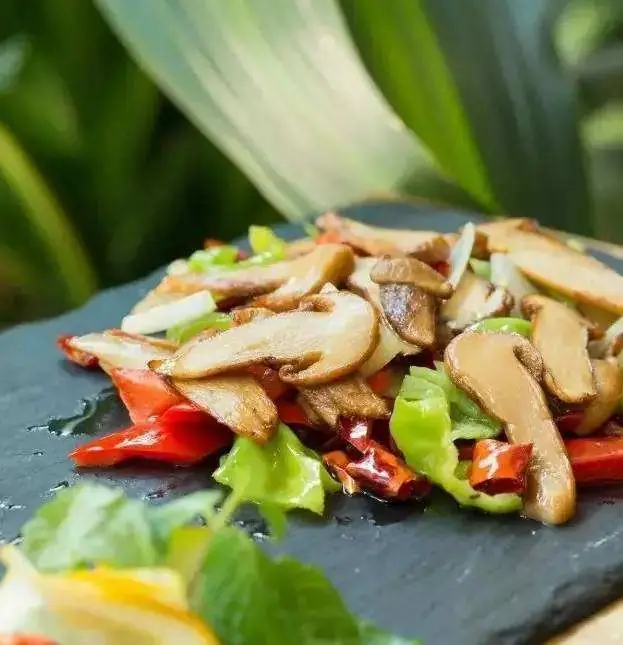
Photo adjustments
EXIF orientation normalized; resized without changing aspect ratio; converted to WebP. No subject edits.
Matsutake with Green Chilies (青椒松茸) is a Yunnan dish of matsutake mushrooms cooked with fresh green chillies. The mushroom is the expensive part: it fruits in upland forests in autumn and is picked by hand.
Handling a mushroom that loses its aroma
Matsutake, known in Chinese as 松茸 or 松口蘑, is prized for a deep, distinctive aroma. The smell fades quickly once the cap opens, which is why pickers take the mushroom as soon as it breaks the surface and why kitchens cook it soon after it arrives.
For the green-chilli version the mushrooms are sliced and stir-fried with fresh chillies. The cooking is deliberately short and the seasoning light, so that the aroma is not cooked away; the exact oil, heat and timing belong to the kitchen rather than to a fixed formula.
Aroma first, heat second
The mushroom tastes savoury and faintly pine-like, with a firm, meaty texture that holds up in a quick fry. Green chillies add a clean, grassy heat rather than the smoky depth of dried chilli.
Matsutake is not a mushroom you want buried under sauce. The dish is usually seasoned with salt, a little oil and perhaps garlic, and the chilli is played against the aroma rather than over it.
Where the mushrooms come from
In Yunnan the matsutake trade is centred on Diqing Tibetan Autonomous Prefecture, where the mushrooms come out of forests above 3000 metres and are moved quickly to buyers at home and abroad. 香格里拉 matsutake products hold Chinese geographical-indication status.
The mushroom grows in cool conifer and mixed forest between roughly 1600 and 2600 metres and appears in autumn, forming a relationship with pine roots rather than growing on dead wood. Commercial cultivation has not replaced foraging, so almost all matsutake on the market is collected by hand.
Ingredients and questions to ask
The core is matsutake, green chilli, oil and salt, with garlic or a little soy sauce in some kitchens. If you avoid pork, ask whether lard is used, since Yunnan stir-fries often use it.
Matsutake is a wild mushroom, so it must be cleaned and cooked properly; travellers with mushroom allergies should treat this dish as they would any wild-mushroom plate and ask what else is in the pan.
How to order
Ask for 青椒松茸 (qīng jiāo sōng róng). It appears in autumn on the menus of Yunnan mushroom restaurants, especially in Kunming, and in Diqing during the harvest.
Ask whether the mushrooms are fresh or rehydrated dried ones, because the price and the aroma differ sharply. If you want the mushroom on its own, ask for 松茸刺身 (sashimi) or simply fried 松茸 and compare it with the chilli version.
At the table
Serve it hot and eat it early in the meal, before stronger dishes dull your sense of smell. It works as a shared plate with rice and a plain soup rather than as a heavy main course.
One plate usually serves two or three people as part of a meal. Since fresh matsutake is sold by weight and prices move with the season, ask for the current price before the kitchen starts cooking.
More dishes to compare
Explore related local specialties and compare their names, preparation notes and ordering guidance.
Granny's Potatoes 老奶洋芋 →
老奶洋芋 is Yunnan mashed potato, soft and comforting and made to be eaten with rice. 青椒松茸 runs on the opposite texture, firm mushroom slices lifted by green chilli, yet both are plates where Yunnan cooking holds back on sauce and lets one ingredient speak.
Questions before you order
What is 松茸?
It is the matsutake mushroom, a wild fungus with a strong aroma that grows in cool upland forests and is harvested by hand rather than farmed.
When is 青椒松茸 in season?
Matsutake fruits in autumn, and the Yunnan harvest is associated with Diqing prefecture, so fresh versions are most common in the autumn months.
Source introduction: Wikipedia contributors: 松口蘑 · CC BY-SA 4.0 (see https://creativecommons.org/licenses/by-sa/4.0/). English guide adapted from the cited material, with additional preparation and ordering guidance.
Source introduction: Wikipedia contributors: 松口蘑 · CC BY-SA 4.0 (see https://creativecommons.org/licenses/by-sa/4.0/). English guide adapted from the cited material, with additional preparation and ordering guidance.
Source introduction: Wikipedia contributors: 松口蘑 · CC BY-SA 4.0 (see https://creativecommons.org/licenses/by-sa/4.0/). English guide adapted from the cited material, with additional preparation and ordering guidance.
Source introduction: Wikipedia contributors: 香格里拉市 · CC BY-SA 4.0 (see https://creativecommons.org/licenses/by-sa/4.0/). English guide adapted from the cited material, with additional preparation and ordering guidance.
Sources & reading
The supplied food list supports this name and regional association. The culinary terms below are explained as menu vocabulary; a local recipe, origin story and venue availability have not been independently verified.