

Gejiu Barbecue 个旧烧烤
Gejiu barbecue is a charcoal-grilled pork-skewer tradition from Gejiu in Honghe, best known for small, alternating lean-and-fat pieces that may be rolled in sugar powder after grilling. Ask specifically for 糖粉小肉串 if you want the sweet-and-spicy version; supply, seasoning and texture vary by kitchen.
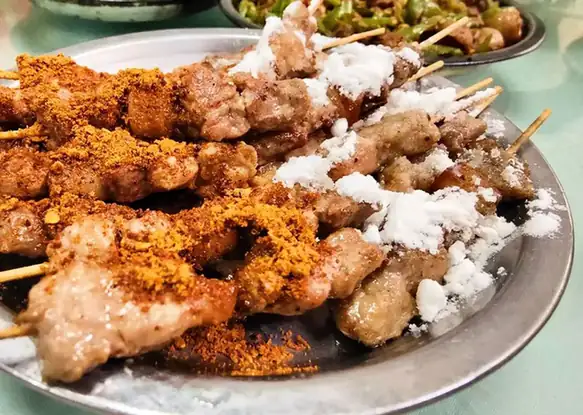
Image notes
Resized for the web; the photo itself has not been edited.
Tap any red Chinese text to hear it in Mandarin.
In brief: Gejiu barbecue is a charcoal-grilled pork-skewer tradition from Gejiu in Honghe, best known for small, alternating lean-and-fat pieces that may be rolled in sugar powder after grilling. Ask specifically for 糖粉小肉串 Tángfěn Xiǎo Ròuchuàn if you want the sweet-and-spicy version; supply, seasoning and texture vary by kitchen.
What it is in Gejiu
个旧烧烤 is not one restaurant dish with one standard recipe or address. It describes a local barbecue table in Gejiu, where small pork skewers are treated as the main item in local accounts. The most distinctive version is 糖粉小肉串 Tángfěn Xiǎo Ròuchuàn: grilled pork finished with a coating of powdered sugar, so the first impression is smoky and savoury, followed by sweetness and chilli.
This sweet finish is a useful reason to seek out the Gejiu style rather than ordering an unspecified “Yunnan barbecue” elsewhere. It is also not a promise that every skewer in Gejiu is sweet. Ask whether the stall is serving 糖粉小肉串 Tángfěn Xiǎo Ròuchuàn, and ask how the batch is seasoned today.
Ingredients, making and what to notice
The documented small skewers use fresh pork cut into pieces about the size of a rock sugar crystal. A 2023 Gejiu report describes roughly four or five pieces on a bamboo skewer about 10 centimetres long, with lean and fatty pork—specified there as pork leg—alternating along the stick. A 2025 account likewise describes small, pre-marinated pork pieces arranged in alternating lean-and-fat order.
Watch the grill rather than relying on a menu description. The skewers are arranged over charcoal and turned repeatedly so the pieces cook evenly. As the fat renders, the surface becomes glossy and golden, while chilli powder and cumin can be added according to taste. After grilling, the sweet version is rolled in sugar powder. The result should combine a tender, juicy centre with browned, smoky edges; the sugar brings a quick sweetness, while chilli and cumin keep the finish savoury and hot.
The size matters to the experience. These are small bites designed to be eaten one skewer at a time, not a large kebab meant to be sliced at the table. Order a small amount first if you are unsure about the sugar-and-chilli combination, then adjust the spice level and quantity.
Related barbecue variants
Local descriptions place the small pork skewers alongside other Gejiu barbecue items. 蜂蜜牛肉串 Fēngmì Niúròuchuàn uses beef, honey, chilli and other seasonings for a softer, sweet-and-spicy beef skewer. 疙瘩肠 Gēda Cháng is pork small intestine tied into knots, seasoned and grilled with colourful peppers. 倘甸烤鱼 Tǎngdiàn Kǎoyú is a village-associated grilled fish prepared with oil and seasonings. These are related items on the broader barbecue table, not ingredients that should be folded into every serving of 糖粉小肉串.
For dietary questions, treat the dish as pork-based unless the seller tells you otherwise. The sources do not establish a single marinade, a complete allergen list or protection from cross-contact on a shared grill. Ask about pork, honey, chilli, cumin and any marinade when relevant to your diet; do not infer that a skewer is vegetarian or allergen-free from its appearance.
Keep the Chinese names 个旧烧烤 Gèjiù Shāokǎo, 糖粉小肉串 Tángfěn Xiǎo Ròuchuàn and 个旧糖粉小肉串 Gèjiù Tángfěn Xiǎo Ròuchuàn ready. Search those terms on Meituan (美团) or Amap / Gaode Maps (高德地图) to find nearby current listings. Check the menu, recent reviews, opening information, same-day supply, ingredients and payment options yourself. A map result or ranking is a way to locate a possibility, not a quality endorsement.
Access and return
This is a dish rather than a venue, so it has no verified ticketed entrance, fixed restaurant address, dish-specific bus stop or guaranteed serving hour. First reach Gejiu, then use the Chinese searches above and confirm the actual public place serving it that day. Do not navigate to a single address copied from a generic food result.
From Mengzi, a July 2024 notice from the Mengzi transport authority lists a bidirectional 蒙自—个旧城际公交 Méngzì — Gèjiù Chéngjì Gōngjiāo corridor. The published stops include 天源大酒店 Tiānyuán Dàjiǔdiàn, 州行政中心 Zhōu Xíngzhèng Zhōngxīn, 蒙自市汽车客运站 Méngzì Shì Qìchē Kèyùnzhàn, 云霞路 Yúnxiá Lù, 北京路 Běijīng Lù, 红河州中心医院(州一中) and 个旧市 Gèjiù Shì. The notice lists service from 06:30 to 21:00, with a 15-minute interval from 06:30 to 19:00 and a 25-minute interval from 19:00 to 21:00. Because that notice is dated 2024-07-19 rather than a travel-day timetable, confirm the current departure and final return service at the boarding point.
If your itinerary arrives at 个旧火车站 Gèjiù Huǒchēzhàn, a 2025 municipal transport listing records a city shuttle to the downtown area via named stops including 乍甸路口 Zhàdiàn Lùkǒu, 个旧汽车客运站 Gèjiù Qìchē Kèyùnzhàn and 百货大楼 Bǎihuò Dàlóu. Its listed downtown-bound departures are 07:00, 09:00, 13:00, 14:00 and 19:00; the reverse service is described as running according to train arrival time. This is a way into the city, not a claim that the dish is sold at the station or that a train is currently operating on your date.
For the return, leave the actual food venue by the current taxi, ride-hailing or city-transit option shown in Amap, and confirm the last intercity departure before sitting down to eat. No station exit, walking-minute estimate or fixed return route is stated because the food location can change.