

Grain-flour jiaotuan 搅团
A soft, glossy stirred-grain paste eaten across Shaanxi and the wider northwest. In Xi’an, it belongs to the shared Guanzhong food tradition rather than being a dish unique to the city. Try it hot with a sharp, savory dressing, or ask whether a kitchen offers a cooled or soup-based version.
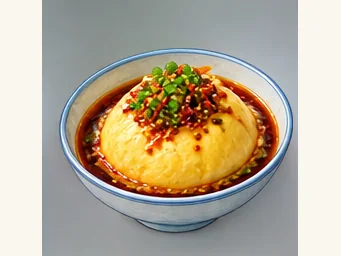
Jiaotuan (搅团) is a cooked grain paste, not a single fixed recipe. In the Guanzhong plain around Xi’an, maize flour is a familiar base; wheat and buckwheat versions are also found. The food is shared across Shaanxi and neighboring parts of the northwest, so it is better understood as regional home cooking than as a Xi’an invention.
To make it, the cook gradually scatters flour into hot water while stirring firmly and continuously in one direction. This keeps lumps from forming. The paste is cooked and worked until smooth, thick, cohesive and glossy. A good spoonful holds together but is soft and elastic, with a mild, warm grain flavor and a satisfying chew. China Daily describes a common finish of sour soup and red chili oil, while Shaanxi reporting also describes garlic-and-vinegar water, scallions or chives, and fermented sour-vegetable soup called jiangshui (浆水). These toppings bring contrasting acidity, chili warmth, savory depth and fresh allium aroma; the bowl’s exact seasoning varies by household and shop.
Ask for 搅团 (jiaotuan) and, if helpful, ask which flour is used: “是玉米面的吗?” means “Is it made with corn flour?” A hot serving with chili oil and sour dressing is a useful first taste. Regional preparations include shui wei cheng (水围城), hot paste surrounded by a sour-spicy sauce; yu-yu (鱼鱼), in which hot paste is pressed through a perforations into small fish-shaped pieces and cooled in water; and a cooled set paste sliced for a cold dish. Some households also cook leftover set jiaotuan with jiangshui the next day. These are meaningful variations, not guaranteed menu options at every restaurant.
Ask for 搅团 (jiaotuan) and, if helpful, ask which flour is used: “是玉米面的吗?” means “Is it made with corn flour?” A hot serving with chili oil and sour dressing is a useful first taste. Regional preparations include shui wei cheng (水围城), hot paste surrounded by a sour-spicy sauce; yu-yu (鱼鱼), in which hot paste is pressed through a perforated ladle into small fish-shaped pieces and cooled in water; and a cooled set paste sliced for a cold dish. Some households also cook leftover set jiaotuan with jiangshui the next day. These are meaningful variations, not guaranteed menu options at every restaurant.
Where to eat it
You can find Grain-flour jiaotuan all over Xi’an, so there is no need to seek out one particular restaurant. To find one near you, search for “搅团” in Meituan (美团) or Amap (高德地图) and check recent reviews, distance and opening hours.
More dishes to compare
Explore related local specialties and compare their names, preparation notes and ordering guidance.
Butter-mixed tsampa 酥油糌粑 →
Roasted barley flour is mixed with butter tea until it can be gathered into a soft, dense dough. Diners may mix a small portion themselves, adjusting the liquid gradually. The taste is toasted, grainy and savory-rich, with butter smoothing the dry flour into a cohesive mouthful.
Qinghai mingxi grain spirit 青海酩醯酒 →
Fermentation and distillation create a clear spirit that is distinct from a bowl of sweet fermented grain. The flavour is concentrated and alcoholic rather than a mild sweet porridge. Aroma varies by grain and process.
Sources & reading
Recipes and servings vary between kitchens.