

Knife-shaved noodles 刀削面
Knife-shaved noodles (刀削面, dāoxiāomiàn) are a Shanxi wheat-noodle style also listed in Datong’s local dining guide. Their defining feature is the making: a firm block of dough is shaved straight into boiling water, leaving irregular edges that hold broth. Datong has a documented local “Datong knife-shaved noodles” production standard, but the dish is a wider Shanxi tradition rather than a Datong-only recipe.
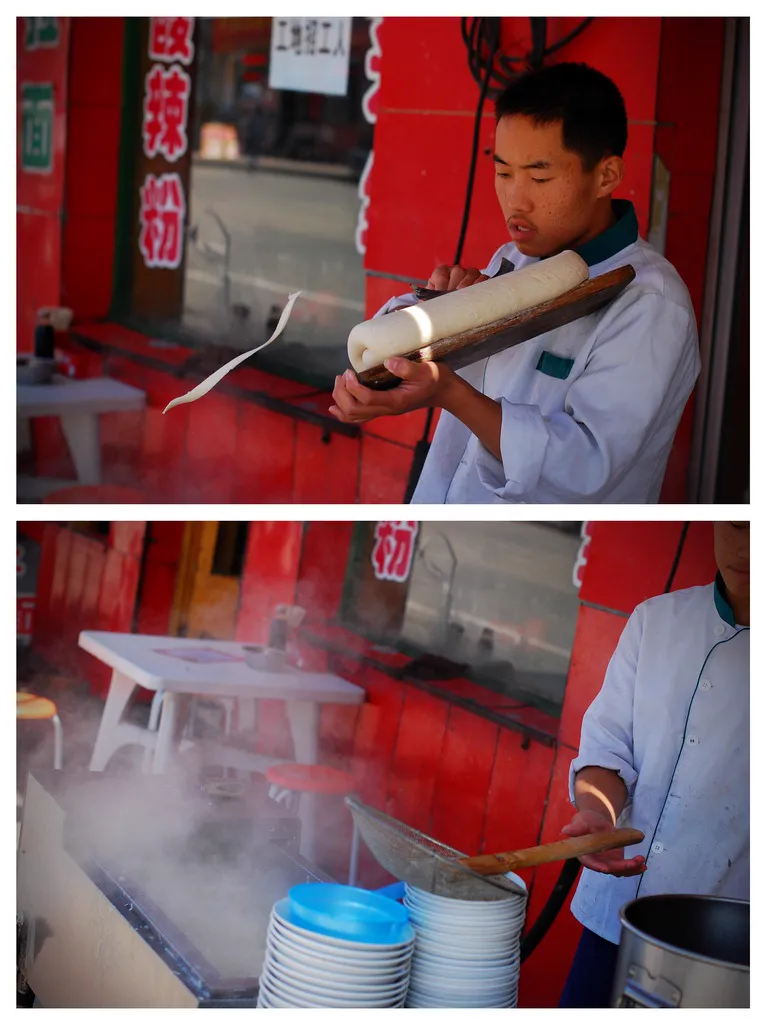
Tap any red Chinese text to hear it in Mandarin.
What makes the noodle distinctive
The dough is wheat-based. A cook shapes it into a firm, elongated block, then uses a special knife to shave pieces from the surface directly into a pot of boiling water. China’s National Intangible Cultural Heritage website describes the cooked pieces as three-sided and leaf-like; an English government food guide emphasizes the jagged edges that catch broth and chilli oil. The point is not a perfectly uniform strand: look for a substantial centre, tapered edges and the quick hand movement at the pot when a shop prepares it in front of you.
Knife-shaved noodles are not the same as hand-pulled noodles. The dough is cut from the block rather than stretched into strands, so the bite comes from the changing thickness and rougher surface. They are commonly served in soup; a government English guide specifically mentions beef or mutton broth, while toppings and sauces vary by kitchen.
Why Datong is a useful place to try it
The Datong local dining page lists Knife-cut noodles (Dao Xiao Mian) among the city’s food entries, and China Daily describes Datong knife-cut noodles as one of Shanxi’s well-known noodle dishes. This supports looking for the dish in Datong without turning a broad Shanxi food into a claim of exclusive local invention.
A further Datong connection is the 2021 publication of a production standard for “Datong knife-shaved noodles” at a world noodle-industry summit held in Datong. The report says the standard addressed definitions, equipment and tools, and even adjusted the flour-to-water proportions for summer and winter. That is evidence of a named Datong style and an effort to make its production more consistent, not proof that every bowl in the city follows one identical formula.
How to order and what to ask
Keep 刀削面 Dāoxiāomiàn handy when ordering. Ask which topping and broth are available that day, and whether the bowl is served as soup noodles or tossed with sauce where that choice is offered. The noodle itself is made from wheat flour and water; a particular bowl may add salt, meat, egg, mushrooms, soy-based seasoning, sesame or chilli depending on the kitchen.
If you need a meat-free bowl, ask about both the broth and the topping rather than relying on the noodle’s name. Wheat flour also makes the base unsuitable for a gluten-free diet. A dish name cannot guarantee vegetarian status or the absence of allergens.
Where to eat it
You can find Knife-shaved noodles all over Shanxi, so there is no need to seek out one particular restaurant. To find one near you, search for “刀削面” in Meituan (美团) or Amap (高德地图) and check recent reviews, distance and opening hours.
More dishes to compare
Explore related local specialties and compare their names, preparation notes and ordering guidance.
Yuanping oat-dough fish noodles 原平莜面鱼鱼 →
Small portions of dough are rolled to pointed ends and cooked before being served with a dressing or gravy. The shape accounts for the fish-like name. Oat dough has a firm, slightly coarse bite and a pronounced grain flavour. A moist sauce helps separate and coat the pieces.
Tijian noodles 剔尖 →
Soft dough is held on a board or plate and flicked into boiling water in short, tapered pieces. The cooked noodles are lifted into broth or combined with a sauce and toppings. Their irregular thickness creates both tender edges and a more substantial center. The surface holds a modest amount of sauce without becoming uniformly smooth.
Sources & reading
Recipes and servings vary between kitchens.
Image credits & notes (1)
- A chef shaves knife-cut noodles from a dough roll into a boiling pot in Datong, Shanxi (photographed 24 August 2010). Photo: 齐健 (Flickr user timquijano)Photo: CC BY 2.0