

Hot Grass Jelly 烧仙草
Hot Grass Jelly is featured among the local specialties of Taiwan.
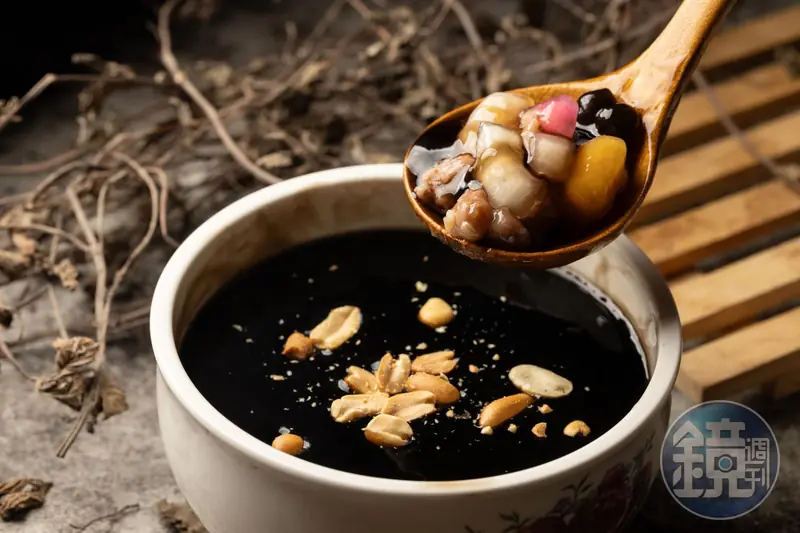
Image notes
Resized for the web; the photo itself has not been edited.
Hot Grass Jelly (烧仙草), set down for Taipei City, is grass jelly: a dark gel boiled from the plant 仙草 (Platostoma palustre) and served in Taiwan as a sweet bowl or drink.
Boiled from the plant into a gel
The source gives two routes to the same gel. In the authentic old method the plant itself is boiled down, which is what releases the substances that set the liquid; in the other, grass-jelly powder or grass-jelly liquid is used instead. Either way the result is a jelly, and it is the boiling stage – not a setting agent bought separately – that the source treats as the heart of the process.
A herbal jelly, not a fruit one
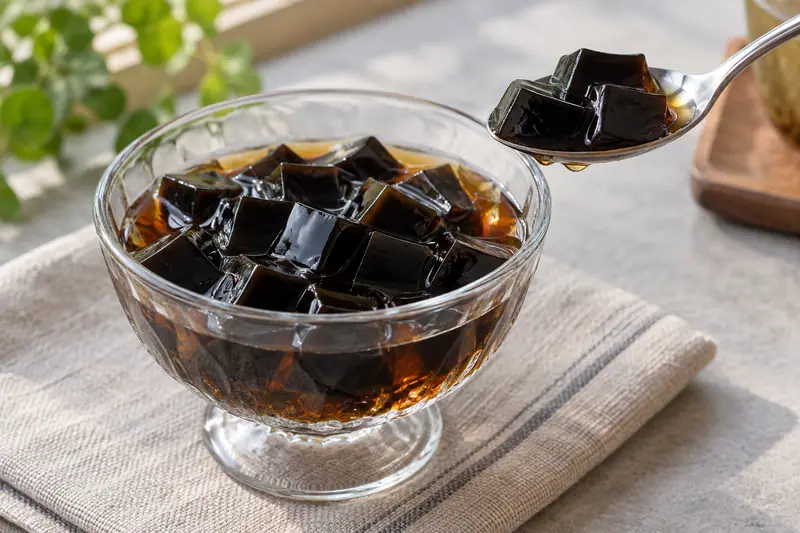
Grass jelly is a herbal food: the source calls it a medicinal herb and notes its resemblance in appearance and texture to 龟苓膏, the turtle-jelly-style medicinal dessert of Guangdong and Guangxi, while stressing that the taste, the method and the ingredients are different. Expect a faintly bitter, herbal flavour rather than a fruit sweetness, with a firm, cool gel that is usually served with syrup, honey or milk to soften the edge.
Many names, wide reach
The gel travels under different names: 仙人粄 among Hakka speakers, 凉粉 in Hong Kong and Macau, 草粿 in Teochew, and 仙人冻 as another form. The source places 烧仙草 as a traditional specialty drink of the south-western Fujian region, notes its standing in Fujian, Guangdong, Hong Kong, Macau and parts of Zhejiang, its popularity in Taiwan, and its spread to Japan and South-East Asia. A Hakka legend connects the plant to Houyi, and the jelly is eaten after the start of the hottest period in the belief that it prevents prickly heat.
Ingredients and dietary questions
The jelly itself is plant-based, so it suits a dairy-free and vegetarian order in its plain form; what pushes it the other way is what is added. Toppings in Taiwan commonly include milk, cream, sugar syrup and sweet beans or nuts, and some shops serve it iced rather than hot. Ask what goes into the bowl before ordering if you avoid dairy, and note that the source presents the plant as a herb rather than as a food to be eaten medicinally.
Ordering a bowl
Say 烧仙草 for the served version and expect a choice between hot and iced, and between plain and topped. Because the gel is mildly bitter, the syrup or milk is not decoration but balance, so it is worth asking how sweet the shop makes it. In Taiwan the bowl often arrives with extra ingredients – beans, taro balls or peanuts – which is where the order stops being a simple jelly.
How it is eaten
Served in a bowl with a spoon, the jelly is cut or broken into pieces and eaten with its syrup or milk, either warm as a drink-like bowl or chilled as a summer dessert. As a herbal food it is mild on the palate, and the source's note about eating it after the onset of the hot season is a reminder that the dish is associated with cooling down rather than with sweetness.
More dishes to compare
Explore related local specialties and compare their names, preparation notes and ordering guidance.
Taiwanese soft tofu dessert 豆花 →
Taiwanese soft tofu dessert (豆花) is a tender soybean curd served in syrup with toppings such as peanuts or beans, mild and faintly sweet. 烧仙草 is the herbal counterpart: a darker, firmer gel boiled from a plant, with a slight bitterness that needs syrup or milk to round it off. Both are eaten from a bowl with a spoon, but one comes from soy and the other from a herb.
Questions before you order
Is 烧仙草 the same as 龟苓膏?
No, although they look and feel alike. The source says the appearance and texture are similar to the medicinal 龟苓膏 of Guangdong and Guangxi, but that the taste, the method and the ingredients are different.
Is it a drink or a dessert?
Both, depending on how it is served. The source calls 烧仙草 a traditional specialty drink of south-western Fujian, and in Taiwan it is commonly eaten as a bowl of jelly with syrup, milk and toppings, hot or iced.
Source introduction: Wikipedia contributors: 燒仙草 · CC BY-SA 4.0. English translation and adaptation of the cited introduction, with additional preparation and ordering guidance.
Sources & reading
Named culinary source added during the audit. Source origin and local variants remain distinct; this is not a claim that all preparations have been individually verified.