

Dongshi Hakka Flat Noodles 东势客家粄条
Dongshi Hakka Flat Noodles is featured among the local specialties of Taiwan.
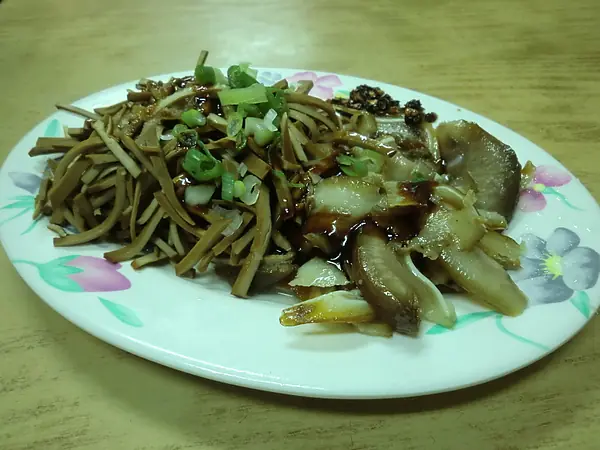
Image notes
Resized for the web; the photo itself has not been edited.
Dong Shi Hakka ban tiao (东势客家粄条) are the flat starch ribbons of Dongshi, a Hakka hill district in Taichung, Taiwan, China, cut from sheets of tapioca and sweet-potato starch rather than rice and served dry or in soup.
How it is made
Ban tiao is the Hakka ribbon noodle. Long-grain rice is soaked and ground into a slurry, steamed into thin sheets, then cut into strips — exactly the definition Taiwan's Ministry of Education gives in its Hakka dictionary: 用在來米磨成漿,蒸製成薄片後,切成條狀的食品. The same entry's example sentence sends you to Xinpu and Meinong, the Hakka towns where you are expected to eat several bowls.
Dongshi does it differently, and the dictionary entry says so: the ingredients it gives are 樹薯粉和地瓜粉 — tapioca starch and sweet-potato starch — with no rice flour mentioned at all. The sheet is steamed and cut the same way, but it behaves differently: more elastic, faintly translucent, and it keeps its shape in hot broth.
Flavour & texture
The dictionary's own word for the Dongshi texture is 承牙, literally "bearing on the tooth" — a springy resistance rather than the soft, slightly grainy give of a rice noodle. That single difference is why the district's version is named separately at all.
Expect a chewy, almost jelly-like ribbon with little flavour of its own, which is why the dressing does the talking. Reporting on the Meinong version singles out house-fried shallot oil (油蔥) and minced-pork sauce (肉燥) as what separates one shop from the next, with shredded dried squid and fried shallots as the Meinong signature. Dongshi's starch noodles take the same treatment.
Local roots & traditions
The dictionary entry is a language record rather than a restaurant guide, but it is the clearest official statement that Dongshi's ban tiao is a different food from the rice version. The ordinary meaning is filed under one accent with an example naming Xinpu and Meinong; the Dongshi ingredient list is filed under the Dapu accent as its own entry, with 粉條 (starch noodle) given as the closest synonym.
That matters when you sit down. A menu in Dongshi that says 粄條 is not promising the soft rice ribbon you may have eaten elsewhere in the Hakka belt. The starch, and therefore the chew, is local.
Ingredients & dietary needs
The dictionary lists only tapioca starch and sweet-potato starch for Dongshi, and only long-grain rice for the standard version, so the noodle itself contains no wheat. That makes ban tiao a reasonable choice for a gluten-free diet — but the noodle is the only simple part of the bowl.
What goes on top is normally pork. Hakka noodle shops dress the ribbons with lard, soy sauce, minced-pork sauce and a pork-bone broth, and some add dried squid. There is no vegetarian version unless you ask. Say 素的 (vegetarian) and then confirm three things separately: the lard, the sauce and the stock.
How to order Dongshi ban tiao
Show 粄條 and then choose the form: 乾粄條, tossed dry with sauce, or 湯粄條, served in broth. In Dongshi it is worth adding the question 用什麼粉做的 — what starch is it made from — if you want to be sure you are getting the local tapioca version and not a rice one.
Bowls are a light meal for one. Two people can share one bowl, one vegetable dish and still have room, so order both forms if you are curious: the dry bowl shows you the noodle, the soup bowl shows you the broth.
How to eat it & plan a meal
Start with the dry version while the ribbons are warm and the shallot oil still smells of the pan; they stiffen as they cool. Taste one plain ribbon before you stir in chilli or vinegar, because the point of Dongshi ban tiao is the chew, not the seasoning.
In the soup version, spoon broth over rice rather than draining the bowl — Hakka broths are salted for noodles, not for drinking. A small family shop will have a short menu; the noodle, a braised dish and a green vegetable is a complete meal for two.
More dishes to compare
Explore related local specialties and compare their names, preparation notes and ordering guidance.
Meinong Hakka Flat Rice Noodles 美浓粄条 →
Meinong, in Kaohsiung, steams its ribbons from locally grown long-grain rice and stir-fries them with dried squid and fried shallots. Dongshi, in Taichung, uses tapioca and sweet-potato starch for a springier, chewier noodle that holds up differently in broth.
Questions before you order
Is Dongshi ban tiao the same as the ban tiao I ate in Meinong?
No. Meinong's is made from long-grain rice ground into a slurry; Dongshi's is made from tapioca starch and sweet-potato starch, which gives it a much springier chew. Taiwan's Ministry of Education Hakka dictionary records the two ingredient lists separately.
Is it vegetarian?
Rarely. The noodle itself is starch only, but the dressing is usually lard, minced-pork sauce and pork-bone broth, and some shops add dried squid. Ask for 素的 and confirm the broth, the lard and the sauce one by one.
Sources & reading
The supplied food list supports this name and regional association. The culinary terms below are explained as menu vocabulary; a local recipe, origin story and venue availability have not been independently verified.