

Crab Thick Soup 螃蟹羹
Crab Thick Soup is featured among the local specialties of Taiwan.
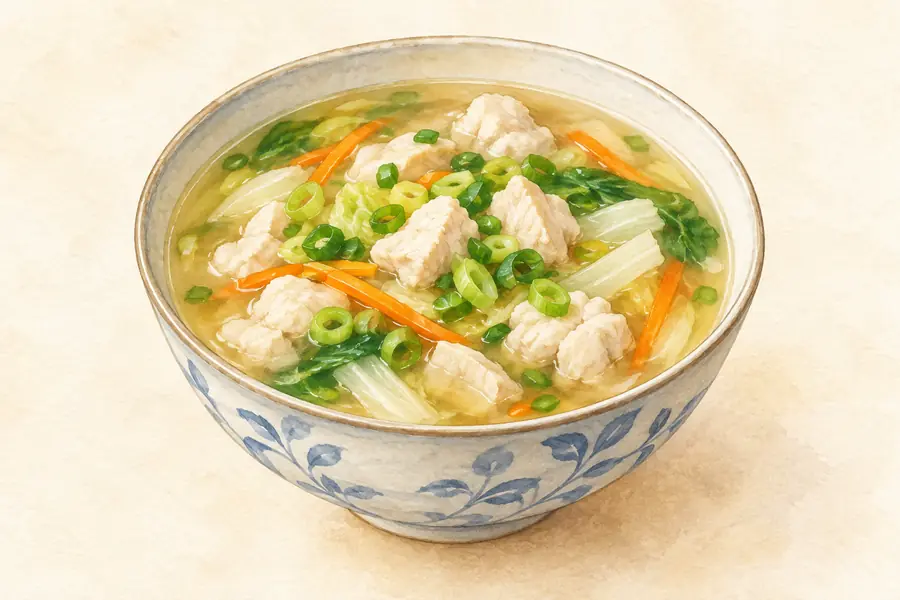
Keelung crab thick soup (螃蟹羹) is a lightly thickened broth built on crab and mushroom, a harbour-city speciality that is hard to find in other night markets.
How it is made
In Keelung, geng means a soup thickened with potato starch rather than a roux, and the crab version is built to stay light: the starch is used sparingly, and the body comes mostly from enoki and shiitake.
The starch is added carefully, because the dish fails if the broth turns gluey: crab is delicate and disappears under a heavy thickener. It is finished at the table, so you control the last seasoning yourself.
Flavour & texture
The soup is deliberately restrained — sweet with crab and mushroom rather than aggressively seasoned — which is why locals describe it as a bowl you can drink to the end. The crab is soft and slightly fibrous, and the mushrooms give it a gentle, slippery body.
It is not a chilli dish and it is not rich. White pepper is what lifts it, and a spoonful of black vinegar or chilli oil from the table will change its character completely.
Local roots & traditions
Crab thick soup is one of the dishes Keelung people use to explain what makes their market different: it appears in a harbour city and almost nowhere else on the island. Two stalls dominate, no.5 Wu Ji and no.10 Shen Ji, and both also sell oil rice.
The standard order is a set — one geng, one rice — and it is eaten late. At the best-known stall the queue is constant, and the pairing with oil rice is what it is known for.
Ingredients & dietary needs
Crab, enoki and shiitake, potato starch, stock, and white pepper at the table. The oil rice served alongside is pork-based, so the set is not vegetarian even if the soup were.
This is shellfish, so shellfish allergy is the main concern. The broth is usually made with seafood or meat stock, while the thickener is potato starch rather than flour — good news if you avoid wheat. There is no offal.
How to order crab thick soup
Show 螃蟹羹. To make it a set, add 油飯, the oil rice, which is how most locals eat it. Ask for 不要香菜 if you do not want coriander, and 不要胡椒粉 if you want the pepper left off.
Prices at Miaokou rise, and this has become one of the more expensive bowls on the street, so check the board first. Ask how much crab is in the bowl if that matters; portions vary between stalls.
How to eat it & plan a meal
Taste the broth before adding anything, then adjust with pepper, coriander or a few drops of black vinegar. The soup is designed to be seasoned at the table rather than in the kitchen.
Eat the oil rice with a spoonful of soup ladled over it, which is the local way. One soup and one rice is a light meal for one; for two people, add a vegetable dish or a second soup from a neighbouring stall.
More dishes to compare
Explore related local specialties and compare their names, preparation notes and ordering guidance.
Keelung Nutrition Sandwich 基隆營養三明治 →
Crab thick soup is what locals drink late at night with oil rice; the nutrition sandwich is the fried, creamy snack that draws the tourist queue. Eating one after the other shows the market's range.
Questions before you order
Is the crab real crab or imitation?
At the established Keelung stalls the soup is built on crab rather than on flavouring, and the shops will tell you what is in it. Because crab is expensive, it is worth asking at an unfamiliar stall before you order.
What should I order with it?
Oil rice. The local habit is one geng and one rice — the soup and the pork-topped rice are treated as a single set, and the rice also soaks up the broth if you spoon some over it.
Sources & reading
The supplied food list supports this name and regional association. The culinary terms below are explained as menu vocabulary; a local recipe, origin story and venue availability have not been independently verified.