

Pork Ball Rice Vermicelli 摃丸米粉
Pork Ball Rice Vermicelli is featured among the local specialties of Taiwan.
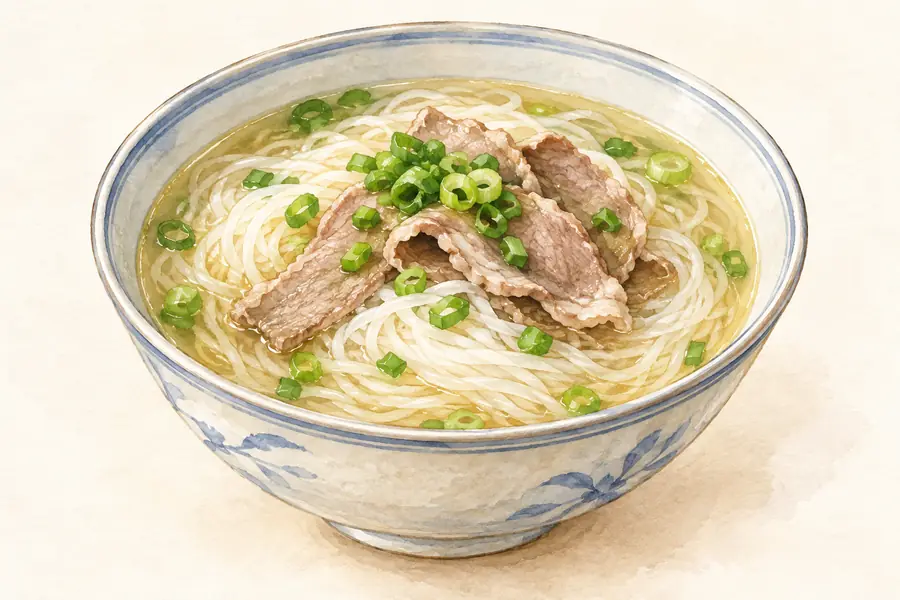
Pork Ball Rice Vermicelli (摃丸米粉) brings together two specialties of Hsinchu (新竹): pounded pork balls (摃丸) and Hsinchu rice noodles (新竹米粉). Chinese Wikipedia describes pork-ball rice-noodle soup as a combination of the two, and the Hsinchu City government holds a Rice Noodle and Pork Ball Festival (米粉摃丸节).
How it is made
The balls take their name from the key step, pounding: in Taiwanese the word for pounding sounds the same as gong (贡), and the balls became known as kòng-uân. In Hsinchu the meat is beaten with wooden rods or by machine, and must be freshly slaughtered, unrefrigerated pork; Chinese Wikipedia credits Hsinchu mainly with using machines to make the balls in quantity. Salt, pepper, MSG and sugar are the usual seasonings, sometimes with shiitake. CNA reports that most Hsinchu makers use fresh Taiwanese pork.
Hsinchu rice noodles come in two kinds: thick, short "water noodles" (水粉), the original form, and fine "steamed noodles" (炊粉), pressed into threads, steamed and then air-dried. The best noodles are made from October to December, when the dry northeast monsoon blows hard after the rice harvest. Today Hsinchu noodles are made mainly from corn starch, and most contain less than 50 percent rice.
Where it comes from
Noodle making was brought from Hui'an (惠安) in Fujian by Guo Quan (郭泉) and his three brothers during the Daoguang to Xianfeng reigns of the Qing dynasty. Its best-known production area, and the first home of Hsinchu rice noodles, is Danan Shi (大南势); before the 1960s the area was dense with rice paddies, which made it a major centre of noodle making, and it is often called "rice-noodle sheds" (米粉寮). The Tourism Bureau reported in 2006 that the mayor called the festival the city's most representative event; that year it had a rice-noodle week and a pork-ball week in September.
How it is eaten
The thick water noodles are most often simmered with meat into soup. The fine steamed noodles are commonly cooked in soupy dishes such as pork-ball rice-noodle soup (贡丸米粉汤), or stir-fried and then topped with soy-sauce meat gravy.
Sources & reading
Written from the linked sources and fact-checked against them on 2026-09-25. Recipes and servings vary between kitchens.