

Candied Fruit 蜜饯
Candied Fruit is featured among the local specialties of Taiwan.
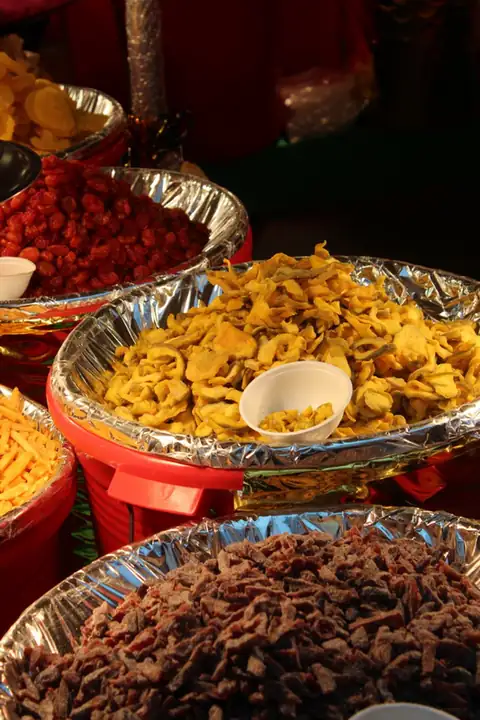
Candied Fruit (蜜饯) is candied fruit preserved in sugar or honey, also called 果脯 and known in Hokkien as 咸酸甜; and the name is recorded for Taiwan under Yilan County.
How it is made
The record describes a preserving method rather than a single recipe: fruit or nuts are cured in sugar or honey and then processed into a finished sweet. It names the raw materials it covers — peach, apricot, pear, jujube, winter melon, ginger and nuts — so the technique is applied across a range of bases rather than to one fruit.
Taste and texture
The Hokkien name the record gives is the taste description: 咸酸甜, salt-sour-sweet. That is a preserved, layered flavour rather than a fresh fruit one, and because the record covers peach through ginger and nuts under one word, the sweetness and the sourness vary with whatever is being cured.
Where it belongs
The record places the word in Hokkien speech and gives a tradition about its origin: it says 果脯 is said to have been invented by a chef of the Ming imperial kitchen. The name is carried for Taiwan under Yilan County, while the record itself describes a broadly Chinese preserved food rather than a Yilan speciality.
What goes in
Two things are named as the preserving medium, sugar and honey, and the record lists peach, apricot, pear, jujube, winter melon, ginger and nuts among the bases. It gives no proportions, no curing times and no finishing step, so the method is described only in outline.
Ordering it
Ask what the fruit or nut underneath is, because one word covers peach, apricot, pear, jujube, winter melon, ginger and nuts, and they taste quite differently. Ask also whether it is sold by weight or in a sealed pack, since a sugar-cured product keeps differently once it is opened.
How it is eaten
This is a preserved sweet rather than a dish: it is eaten in small pieces and works as 咸酸甜, something to take a little of at a time, often alongside tea. The record gives no serving custom, so the ordinary way to treat it is as a sweetmeat kept in the cupboard rather than a dessert served at the end of a meal.
More dishes to compare
Explore related local specialties and compare their names, preparation notes and ordering guidance.
Aiyu jelly 愛玉 →
Aiyu jelly (愛玉) and 蜜饯 both end up as Taiwanese sweets kept on the same list, but they are made in opposite ways: 愛玉 sets from the gel of a fig seed and is eaten fresh with syrup and lemon, while 蜜饯 is fruit or nuts cured in sugar or honey so it keeps, which is why the record gives it the Hokkien name 咸酸甜.
Questions before you order
What is 蜜饯 made from?
The record lists peach, apricot, pear, jujube, winter melon, ginger and nuts as bases, cured in sugar or honey. It gives no proportions or times.
What does 咸酸甜 mean?
It is the Hokkien name the record gives for 蜜饯, and it describes the preserved taste: salt, sour and sweet in one piece.
Source introduction: Wikipedia contributors: 蜜饯 · CC BY-SA 4.0. English translation and adaptation of the cited introduction, with additional preparation and ordering guidance.
Sources & reading
Named culinary source added during the audit. Source origin and local variants remain distinct; this is not a claim that all preparations have been individually verified.
