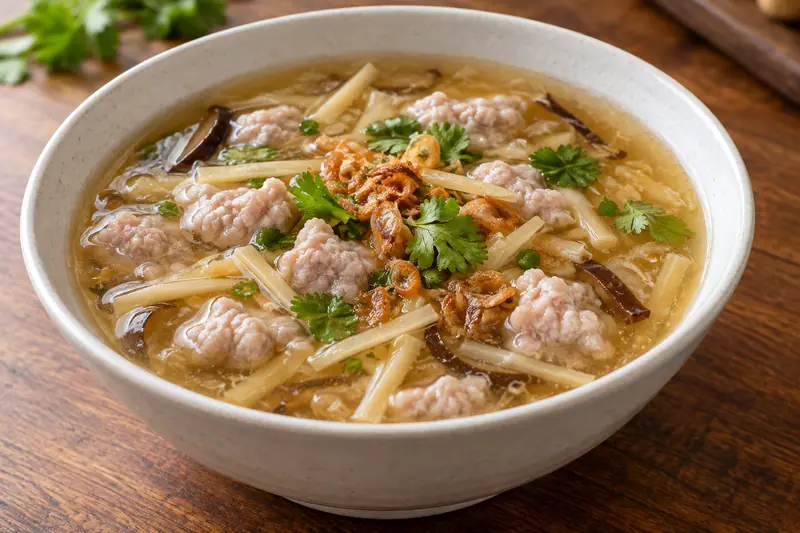
Luodong Pork Thick Soup 罗东肉羹
Luodong Pork Thick Soup is featured among the local specialties of Taiwan.
Image notes
Resized for the web; the photo itself has not been edited.
Luodong Pork Thick Soup (罗东肉羹) is Luodong's pork geng: pork worked into a paste with fish paste and served in a thickened, lightly vinegared soup in Yilan County.
How it is made
The dish starts as a paste rather than a piece of meat. Lean and fatty pork are minced and worked with salt, sugar, white pepper, sesame oil, potato starch and fried shallot until the mass turns strongly sticky, and only then is fish paste folded through. The mixture is pinched into pellets and dropped into boiling stock until they set.
The soup is built separately. Mushroom, cabbage, bean sprouts or shredded bamboo are stir-fried first, the liquid the pork was cooked in is added back, and the pot is seasoned with soy sauce, sugar and salt before a thin starch slurry or beaten egg thickens it. The pellets go back in at the end with coriander and shallot oil.
What it tastes like
Geng means a thickened, spoonable consistency rather than a clear broth, and in Taiwan the character is frequently written 焿 instead. Because the pork has been bound with fish paste, each piece is springy instead of dense, and the customary table condiments — garlic paste, black vinegar or soy sauce — sharpen the sweetness of the stock.
Where it belongs
Rou geng stands on both sides of the strait: the reference article describes 肉羹 as a representative geng dish of Taiwan and Fujian and one of the better-known Taiwanese dishes, sold as an everyday pork product in markets. The same article lists Chiayi, Xingang, Beigang, Daya and Yilan among the places known for it, and within Yilan it names Yilan City, Sanxing and Luodong.
Luodong is a township in central Yilan County on the Lanyang Plain, home to roughly 69,000 people and the most densely populated township-level unit on the island. Under Japanese rule it was written 羅東街, and on 11 December 1945 it became Luodong Township.
Ingredients and dietary questions
The article notes that the working ingredients are lean pork, fatty pork and fish paste, commonly in a rough 6:3:1 ratio, with starch and seasonings holding the mixture together. The fish species, the exact thickener and the amount of sugar all shift from shop to shop, so anyone avoiding pork, fish, egg or gluten should ask what goes into both the pellets and the soup.
Ordering it
Ask for 罗东肉羹, or simply 肉羹; a menu that writes 焿 is selling the same family of dish. A bowl of soup is the standard order and stalls often offer it over rice or noodles. Say 不要香菜 if coriander is unwanted, and ask for the garlic, vinegar and soy sauce separately if you want to control the seasoning.
How it is eaten
It arrives hot in a bowl with the broth still slightly thickened and flecked with coriander and shallot oil. This is market food rather than banquet food, eaten as a snack or a light meal, and the pellet texture is best judged immediately rather than after the soup has cooled and set further.
More dishes to compare
Explore related local specialties and compare their names, preparation notes and ordering guidance.
Shiitake and Pork Thick Soup 香菇肉羹 →
Shiitake and Pork Thick Soup (香菇肉羹) keeps the pork-and-fish-paste pellet and the thickened soup, then adds 香菇, shiitake, to the base. Set against the Luodong version, it shows how much of the local difference sits in the stock and garnish rather than in the pellet itself: mushroom and cabbage in one, a plainer pork stock in the other. Both remain recognisably rou geng, and the reference article lists Xingang in Chiayi County among the well-known rou geng places.
Questions before you order
Is rou geng a soup or a solid dish?
It is a soup with solid pieces: pork bound with fish paste sits in a thickened stock, so one bowl works as a snack on its own or as a topping over rice or noodles.
What should a traveller who does not eat fish check?
Both the pellets and the stock can contain fish, so ask whether the paste and the base are fish-free before ordering, and use the same question for pork and shellfish.
Source introduction: Wikipedia contributors: 肉羹 · CC BY-SA 4.0 (https://creativecommons.org/licenses/by-sa/4.0/). English guide adapted from the cited material, with additional preparation and ordering guidance.
Source introduction: Wikipedia contributors: 羅東鎮 (台灣) · CC BY-SA 4.0 (https://creativecommons.org/licenses/by-sa/4.0/). English guide adapted from the cited material, with additional preparation and ordering guidance.